Get Full Government Meeting Transcripts, Videos, & Alerts Forever!
Get email alerts on the Courthouse Security topic
No spam. Unsubscribe anytime.
Task force urges stronger courthouse security as judges, sheriffs report staffing shortfalls and rising threats
Summary
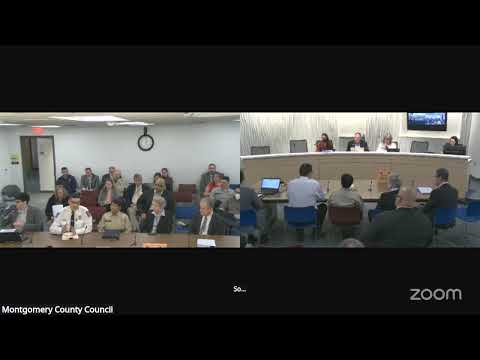
A county task force on courthouse security urged Montgomery County officials on multiple changes to courtroom safety practices and infrastructure, including minimum court security staffing, secure judicial parking and hardened public areas, at a Public Safety Committee briefing.
A county task force on courthouse security urged Montgomery County officials on multiple changes to courtroom safety practices and infrastructure, including minimum court security staffing, secure judicial parking and hardened public areas, at a Public Safety Committee briefing. The panel’s recommendations were presented to the committee by council staff and discussed with judges, the sheriff and court security managers.
The task force recommended at least one court security officer (CSO) present in any courtroom while proceedings are held, a second CSO for specified higher‑risk proceedings and an additional roving CSO on each floor that contains one or more courtrooms or judicial chambers. The task force also recommended that new or expanded courthouses include secure, attached underground parking for judicial officers and that jurisdictions without secure parking work with the Administrative Office of the Courts on interim measures such as gated enclosures, quick‑lift gates, video intercoms and escort procedures. The panel proposed a state mandate for personnel standards supported by transitional state funding and two separate non‑lapsing state funds to cover one‑time costs for secure public spaces and secure parking over a five‑year period.
The recommendations were presented alongside county staff analysis showing emergency courthouse calls for service rose each year from 2021 through 2024. At the briefing, judges described increases in courtroom disorder and direct threats to judges and staff. “The staffing of the sheriff’s department continues to me to be the biggest problem that we face,” said Judge Jim Bonifin, administrative judge of the Circuit Court, describing routine shortfalls that sometimes delay or pause proceedings. Judge Deborah Dwyer, an associate judge, described repeated threatening emails she and other judges have received and cited volatile behavior in family docket hearings, including a recent litigant who repeatedly threatened harm after a custody ruling.
Sheriff Maxwell Wie and court security managers said staffing and training constraints limit their ability to meet the recommended standards immediately. Sheriff Wie said the sheriff’s office is accredited by CALEA and supports the task force recommendations but would need a “significant additional staffing allotment” and noted that recruit training typically requires roughly six months plus about three months of field training before deputies reach operational independence. The sheriff’s office also is diverting staff and budget resources across other critical functions, including response to serious criminal trials and protective‑order volumes.
The district court’s security manager, Steve Barlow, described the county’s current practice of assigning two special police officers per courtroom and staffing screening areas with two officers each, and he said most bailiff special police officers are prior police or corrections officers. Barlow reported that the district court already meets some of the task force’s personnel recommendations but acknowledged countywide recruitment and retention challenges.
Panelists emphasized non‑personnel measures as well. The task force recommended reinforced or bullet‑resistant glass in vulnerable areas, expanded video surveillance retention, securing courtroom furniture to floors, bullet‑resistant anchoring at judicial benches and restricting routine officer presence in public lobby areas unless accompanied by security personnel. Committee members and court staff discussed procedures for requests to release security camera footage and the need to protect juror privacy; council staff described an administrative order and procedural steps intended to centralize and standardize the handling of such requests.
Speakers also highlighted the role of threat‑management infrastructure. The judicial threat management center in Annapolis maintains a database of judicial threats and coordinates with local law enforcement on credibility and response. Cliff Hesker of the Judicial Threat Management Center (referenced in the briefing) and the district court reported daily coordination with local sheriffs and county police partners when a threat is identified.
Several presenters and judges called for expanded behavioral‑threat‑assessment and de‑escalation training for courtroom staff, judicial officers and security personnel. Council staff said a portion of the upcoming judicial conference will present de‑escalation and mental‑health training for bench officers and sheriffs’ deputies. Panelists also noted a substantial mental‑health component to many threats and disruptive incidents and encouraged better early connections to reentry and diversion services.
Committee staff emphasized that jurisdictions across the state vary widely in courthouse age, layout and existing security; the task force chose a mix of state and local funding phased over time to enable jurisdictions to meet standards without expecting immediate, full retrofits. Panelists noted that some recommendations apply only to new or substantially renovated facilities because retrofitting older buildings is frequently infeasible.
Committee members and presenters did not record a formal committee vote on the task force recommendations at the briefing; the discussion concluded with agreement to continue budget and operational conversations as the county develops its next operating submission and considers specific staffing and capital requests.
The committee requested further fiscal detail on the county staffing numbers required to meet the task force standard and next steps for phasing improvements. Staff and agency representatives said they will return with staffing estimates and budget proposals.