Get Full Government Meeting Transcripts, Videos, & Alerts Forever!
Get email alerts on the Economic Indicators topic
No spam. Unsubscribe anytime.
Montgomery County quarterly indicators show tight housing market, lagging young-worker labor force and child-care shortfalls
Summary
County staff and MCEDC presented quarterly indicators showing a 2.4% unemployment rate, a jump in median home prices to about $615,000, an office vacancy near 18.5% and structural declines in the 25–34 labor force; private-sector childcare employment has not recovered to its pre-pandemic peak.
County economic planners and Montgomery County Economic Development Corporation analysts told the council’s Economic Development Committee on March 10 that recent quarterly indicators show a county economy with both strengths and structural weaknesses.
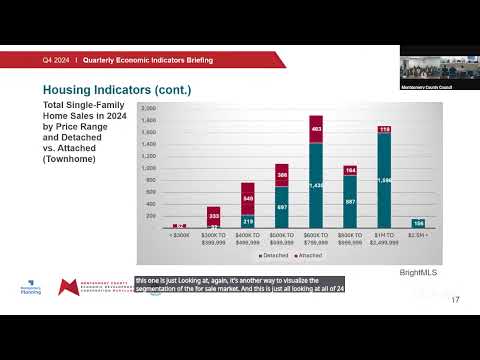
The unemployment rate was reported at about 2.4 percent, while median home prices rose from roughly $554,000 to about $615,000 — an increase staff described as roughly 11 percent year over year. Office vacancy was reported at about 18.5 percent, up from roughly 17.4 percent a year earlier. County presenters said multifamily and attached housing types (townhomes, condos) are the more affordable ownership or rental options and that condos are an increasingly important affordable ownership entry point, with many condo sales clustered below about $400,000.
Planners emphasized the longer-term labor-force concerns behind those numbers: the county’s working-age population has flattened since about 2013 and the 25‑ to 34‑year‑old cohort — an important early‑career group — has declined by roughly 12,000 people from 2013 to 2023. Presenters said Montgomery County’s labor‑force growth lags the state, region and national trends and that the county tends to lose younger cohorts faster and gain them more slowly than peer geographies.
Child-care indicators presented to the committee showed private‑sector child‑care employment has not yet recovered to its pre‑pandemic peak, though the number of establishments is slightly higher than a decade ago. Presenters said wages for child‑care workers are low relative to county incomes — roughly 40 percent of area median income for many workers — and have not kept pace with inflation since about 2021. County staff flagged the child‑care sector both as an economic and social priority because care availability affects parents’ labor‑force participation.
Committee members linked the trends. Several council members said housing affordability — particularly scarcity of “starter” detached homes and a demand for attached units — appears to be a major factor in the county’s difficulty retaining and attracting workers in the 25–34 age group. Members urged coordinated responses that align housing strategies, economic development marketing and workforce pipelines.
Planners and MCEDC staff said much of the data is a quarter behind and that federal workforce layoffs are changing near‑term conditions; they recommended continued tracking and targeted strategies to retain and attract young professionals.
The committee did not take legislative action on the indicators but directed staff and partners to continue tracking the measures and to bring additional analysis to upcoming budget and work‑session items.