Get Full Government Meeting Transcripts, Videos, & Alerts Forever!
Get email alerts on the School Budget topic
No spam. Unsubscribe anytime.
Framingham schools present 10.31% FY26 operating budget request; plan in-house busing and new special-education program
Summary
Framingham Public Schools presented an initial FY26 operating budget that requests a 10.31% increase, driven largely by salaries and new positions. The district plans to shift to in-house busing, open an 18–22 special-education program at Farley, expand preschool seats, and proceed with a special-education transportation bid.
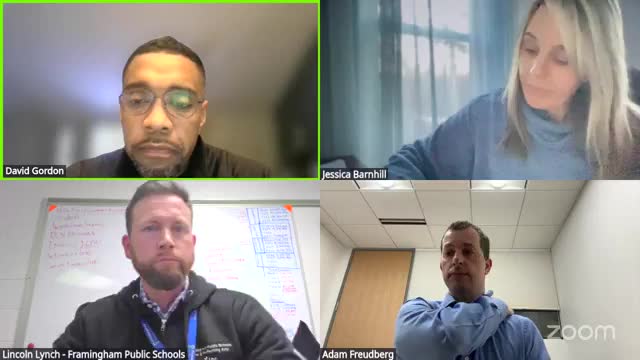
Framingham Public Schools’ executive director of finance and operations, Mr. Lynch, presented an initial FY26 operating budget request that would raise the district’s operating budget by 10.31%, or roughly $17.8 million, and set the total operating budget near $190.4 million if fully funded.
The request, presented to the finance subcommittee, includes a large increase in salary costs—about 78.39% of the budget—and roughly $3.1 million in new position requests. Lynch said the district expects a $6.5 million increase in Chapter 70 state aid after the state released preliminary figures, which he tied to an increase of 233 students in categories that generate incremental funding (special education in-district students, students with limited English proficiency and low-income students), even though overall district enrollment rose by only 11 students.
The budget proposal contains several program and operational changes: the district plans to shift from contracted to in-house busing starting July 1, 2025, by leasing buses and hiring drivers, monitors and support staff; to open an 18–22 year old special-education program at the Farley Building to replace out-of-district placements; to expand preschool seats through partnerships (Framingham State, the Y and Loving Nest) and an existing McCarthy Elementary classroom; and to add two elementary classrooms for students on the autism spectrum now moving up from preschool.
Lynch provided component figures and budget drivers: new positions totaling about $3.1 million; projected in-house busing costs of $7.2 million; projected transportation (including out-of-district and in-district special-education van contracts) of about $6.4 million; tuition and special-education tuitions totaling about $30.8 million (with $24.4 million tuition and $6.4 million transportation); utilities projected at $3.2 million (including about $755,000 gas and $2.3 million electric); and an anticipated $324,000 savings next year from bringing 18–22 students back in-district (estimated $1.1 million savings over three years).
On the in-house busing plan, Lynch said the district budgeted $22 per hour for bus monitors—about a 10% increase over current pay—and will post positions once the city gives approval. He also said the district will go out to bid on special-education transportation (in-district and out-of-district van contracts) with the procurement advertised for at least two weeks; Lynch said he expects bids back by February and was aiming for a three-year contract term for those services.
Committee members discussed timing for a joint meeting with the City Council finance subcommittee to review the schools’ budget before the district finalizes its submission to the mayor. Members generally favored holding the joint meeting in the first or second week of March, outside of school vacation week, to give the district time to vet new position requests and respond to city revenue projections. The schedule Lynch outlined calls for a completed budget book in March, submission of the school department budget to the mayor in March, the mayor’s presentation to the City Council in May and final budget adoption—if adopted on schedule—in mid-June, per the municipal charter.
The committee approved the school committee department budget recommendations that differed from FY25—modest increases for interpretation services for open sessions, professional development, graduation gown costs and an executive assistant salary adjustment—by recorded roll call (motion by Ms. Freeweg; seconded by Ms. Brunhill; unanimous). The subcommittee also approved inclusion of the FY26 initial budget materials and moved approval of meeting minutes (motion by Mr. Freiburg; seconded by Ms. Barnhill; unanimous) and adjourned.
Why it matters: the FY26 operating request and the district’s operational shifts—most notably moving transportation in-house and creating a local 18–22 special-education program—affect staffing, procurement and long-term tuition costs. The budget’s final size depends on local revenue projections and final Chapter 70 allocations.
The presentation and discussion left several items to be finalized: exact FY26 totals will change once the city’s projected local receipts are finalized; the special-education transportation contracts will be set through a competitive bid process; monitor hourly rates and final staffing levels for in-house busing remain subject to further review and city approval.