Get Full Government Meeting Transcripts, Videos, & Alerts Forever!
Get email alerts on the State Legislation Education topic
No spam. Unsubscribe anytime.
Lobbyist briefs Papillion La Vista board on mid‑session bills and tight state budget
Summary
Tim Gay of Catalyst Public Affairs gave the board a mid‑session legislative briefing March 10, warning that budget shortfalls are constraining education proposals and summarizing several education bills under consideration in the Nebraska Legislature.
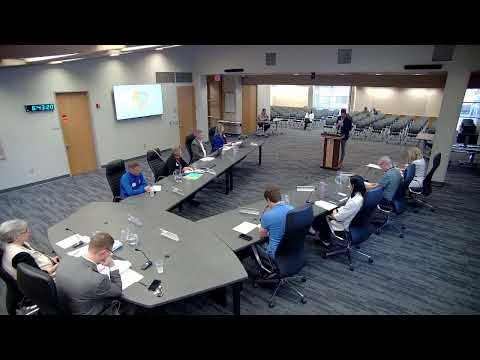
Tim Gay, a lobbyist with Catalyst Public Affairs, told the Papillion La Vista Community Schools board on March 10 that lawmakers are roughly halfway through the 90‑day legislative session and that fiscal constraints are shaping which education proposals can advance.
"Today's day 40 out of a 90 day session," Gay said, and noted that priority bill deadlines this week would winnow the field. He described LB303 as "a huge bill introduced by the governor" that addresses school finance and creates a board to look at TEEOSA (state school funding), and said the state’s fiscal picture has shifted since earlier estimates: "They were $432,000,000 in the hole... now it's 200 and some million."
Gay walked the board through a range of bills the district is tracking: proposed teacher retention grants (a bill he referenced that carried a large fiscal note for bonuses), LB509 (a tax‑credit measure that previously lost voter approval), LB428 (a change to survey notice timelines), and bills affecting device‑use and student privacy. He repeatedly emphasized money as the limiting factor: "Any bill with spending... is probably not going anywhere," he said, and highlighted that one teacher bonus proposal carried a fiscal note in excess of $95 million to $137 million in different estimates given in committee.
Board members asked about the preliminary budget and whether the state would find funds to close an estimated gap; Gay said the governor’s preliminary budget and the appropriations committee’s work would determine how much could move forward and noted the uncertainty created by multiple high‑cost priority bills. Gay also described outreach the district can do and encouraged board members to contact legislators on priority bills.
District leadership said they receive regular updates and that staff are coordinating with the lobbyist. Gay’s briefing provided the board with bill numbers and fiscal context but did not produce a recommended board position on any single bill during the publicly recorded portion of the meeting.