Get Full Government Meeting Transcripts, Videos, & Alerts Forever!
Get email alerts on the Taxes topic
No spam. Unsubscribe anytime.
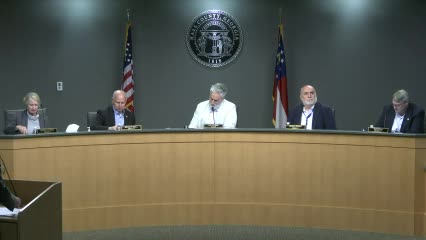
Hall County commissioners vote to opt out of statewide floating homestead exemption
Summary
At a third public hearing, the Hall County Board of Commissioners voted to opt out of the statewide adjusted base-year homestead exemption established by HB 581 and pursue the county’s local exemption that sets a 2023 base year with a 3% cap on assessed-value increases beginning 2026.
Hall County commissioners voted Feb. 25 to opt out of the statewide floating homestead exemption enacted by Georgia House Bill 581 and to adopt the county’s locally-enacted floating homestead exemption methodology.
County staff explained to the board that two separate laws apply: the statewide bill (House Bill 581), which establishes a 2024 base year and uses a CPI-based inflation adjustment for subsequent years, and a local act (House Bill 1268 as discussed in the presentation) that sets a 2023 base year and caps assessed-value increases for homestead-exempt properties at a maximum of 3% beginning in 2026. County Administrator Zach Probst presented the item during the board’s third public hearing on the matter and walked commissioners through examples showing how the local act and the statewide act would affect assessed values for sample properties.
Probst said the Department of Revenue had clarified an interpretation that for tax year 2025 the assessed value would not change for properties covered by either floating exemption (that first year effectively produces a 0% change in assessed value regardless of appraisal increases), and that beginning 2026 the local act would cap increases at up to 3% while the statewide act would use a CPI factor. He said administering both floating exemptions simultaneously would create a substantial administrative burden because the laws establish different base years and different adjustment methods. That would require computing the most advantageous exemption parcel-by-parcel each year.
Commissioners discussed practical implications and pending state legislation. Probst told the board House Bill 92 is under consideration in the General Assembly; as drafted it would require jurisdictions that opt out to re-opt out annually (the county would have to take action each year to remain opted out). Probst said the Association of County Commissioners of Georgia (ACCG) was working with state lawmakers to address that requirement for counties with local floating exemptions. He also told commissioners the Hall County School System had not yet taken formal action; if the school system chose a different path, it would increase administrative workload for county tax offices.
After the public-hearing period ended with no public speakers, a commissioner moved to opt out. The chair called for the question and the motion was seconded; the chair recorded the vote as "All in favor." The board’s action begins a process under state law; the county’s staff presentation noted administrative steps and potential need for additional tax-office resources for taxpayer communication and digest reconciliation depending on other jurisdictions’ choices.
Ending
Probst told the board staff will monitor developments at the state level and coordinate with the tax assessor and tax commissioner offices on implementation and communication; commissioners said they expect to revisit the practical effects as next year’s tax digest work proceeds.