Get Full Government Meeting Transcripts, Videos, & Alerts Forever!
Get email alerts on the Child Welfare topic
No spam. Unsubscribe anytime.
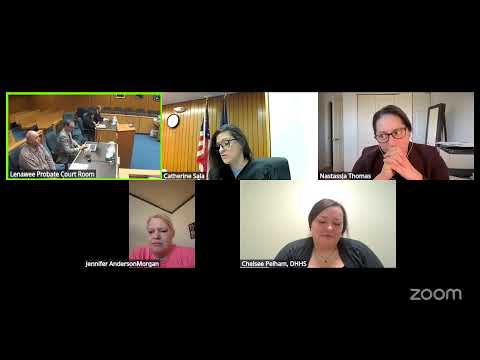
Father admits to petition in Lenawee County juvenile case; court finds jurisdiction, orders services and schedules disposition
Summary
Daniel Evertz, the child’s father, entered a general admission to the petition in Lenawee County Probate & Juvenile Court on March 3, 2025, and the court found jurisdiction under MCL 712A.2(b).
Daniel Evertz, the child’s father, entered a general admission to the petition in a juvenile proceeding in Lenawee County Probate & Juvenile Court on March 3, 2025, and the court found jurisdiction under MCL 712A.2(b). The court ordered continued investigation by Department of Health and Human Services (DHHS) staff, instructed the agency and foster-care provider to develop a proposed case service plan, and scheduled an initial disposition hearing for April 9, 2025, at 11:30 a.m.
The admissions and the court’s finding matter because they permit DHHS to provide services and to use the proposed case service plan as a framework to measure the father’s progress toward reunification. Sasha Thomas, counsel for the Department of Health and Human Services, told the court, "I think that, the admissions are sufficient for jurisdiction, your honor, as it relates to the custody matter." The judge said the petition’s allegations “do constitute violation of the statute, triggering the intervention of the court as well as the department.”
In open court, Michael McFarland, attorney for Daniel Evertz, confirmed his client has housing instability, intermittent employment and a prior termination of parental rights. McFarland told the court his client "wishes to make a general admission" and that Evertz "is willing to have a psychological [evaluation], go through parenting classes and provide approval for him." The father acknowledged on the record that he understood the rights he waived by entering a plea and that the plea could later be used in termination proceedings.
Francesca Madrid, a foster care worker with Fostering Solutions, reported the child remains placed with fictive kin and that the placement is meeting the child’s needs. Madrid said parenting time has been supervised and is "going well," adding, "We will be increasing parenting time following this hearing this month." At the hearing the current supervised schedule was described as two one-hour visits per week; Madrid and the agency proposed increasing visits to two two-hour visits per week after the family team meeting and further observation.
The court directed DHHS and the foster-care agency to prepare and submit a proposed case service plan for the initial disposition. Thomas said the report filed for the hearing is 51 pages, contains Indian Child Welfare Act (ICWA) documentation, green cards, and denial letters, and includes a proposed case service plan. McFarland raised no objection to the court receiving the report, but asked for time to review attachments with his client. "No objection, but we would like some time to at least present any questions," McFarland said.
The court also described active efforts to identify any tribal affiliation under ICWA and recited that inquiries had been mailed to multiple tribes. The record lists outreach to, among others, the Crow Creek Sioux Tribe, Cheyenne River Sioux Tribe, Oglala (Lakota) Sioux Tribe, Rosebud Sioux Tribe, Standing Rock Sioux Tribe, Sisseton Wahpeton Oyate, Shakopee Mdewakanton Sioux Community, Lower Sioux Indian Community, Prairie Island Indian Community and Spirit Lake Tribe; the court said it would monitor responses and any returned green cards as the ICWA inquiry proceeds.
Staff reported that Evertz has engaged with a fatherhood/parenting program and that referrals for counseling, parenting classes and a psychological evaluation are in progress. The foster-care worker said the child qualifies for early intervention services after a recent assessment; a court participant described the child’s speech as not yet meeting developmental milestones.
The court ordered continued supervision and active efforts by DHHS, reflected those efforts in the forthcoming order, and maintained the child’s placement with fictive kin pending the initial disposition. The court set the initial disposition hearing for April 9, 2025, at 11:30 a.m. The court advised that the proposed case service plan attached to the report would be the subject of the disposition hearing and that counsel may raise questions or objections at that time.
The hearing record shows no formal adversarial vote or contested motion during the session; rather, the matters reflected the acceptance of a plea, jurisdictional finding and scheduling and direction for agency follow-up and a written case service plan.