Get Full Government Meeting Transcripts, Videos, & Alerts Forever!
Get email alerts on the Post Secondary Education topic
No spam. Unsubscribe anytime.
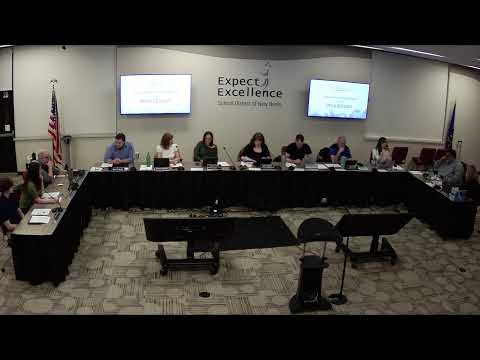
Board hears district overview of dual-enrollment, AP and technical-credit programs; staff outline transfer, cost issues
Summary
District staff summarized post-secondary options available to New Berlin students — AP, on-site and off-site dual enrollment, WCTC transcripted credits and academy options — and discussed credit transferability and costs to the district and families.
District staff presented an overview of post‑secondary opportunities available to students in the School District of New Berlin, saying the programs aim to reduce time to degree, expand career pathways and provide hands-on experiences for students who do not plan to pursue a four‑year college degree.
The presenter, identified in the meeting as Kelly, told the board that 96% of the Class of 2024 graduated with at least one college‑level coursework experience and that 43% of graduates finished with a career‑based learning experience such as an internship, co‑op or youth apprenticeship. Kelly said district students took 1,595 credits through Waukesha County Technical College (WCTC) during the 2023–24 school year.
Kelly described the district’s menu of options: Advanced Placement (more than 23 AP courses offered); on‑site and online dual‑enrollment courses run through partner institutions (examples cited included UW–Green Bay, UW–Oshkosh, UW–Whitewater and other UW campuses); transcripted credit taught by district teachers authorized as WCTC adjuncts; the WCTC Dual Enrollment Academy (on‑site academy that transports students and yields 16–30 college credits per year); and the Accelerate program for students seeking career‑and‑technical credentials such as cosmetology or auto technology.
On cost and logistics, Kelly said the district pays a portion of tuition for courses under the state’s early college/Start College Now program and that the district budgets for those expenses; the district may receive partial reimbursement through a state grant process later in the year. She warned that off‑campus enrollments can be uncertain for families because acceptance into college courses sometimes is not finalized until the summer, which can complicate planning.
Transferability of credits was a recurring topic: staff described tools and agreements used to check how credits will move between institutions (Kelly pointed to a transfer‑lookup tool often used by families). Board members told examples of uneven transfers: one board member said a student lost credits when transferring between UW campuses but later had credits accepted when transferring to a different private university. Kelly said the district includes college‑credit planning in junior conferences and advisory so students and families can better understand how credits may transfer.
Board members asked whether the district bears direct costs for out‑of‑district courses; Kelly confirmed the district does budget and pay a portion of such tuition under state law, and staff described a recent state reimbursement process that returns part of those expenditures to the district.
Board members and staff discussed expanding in‑district offerings by training staff as adjuncts and targeting transcripted courses that have broad transfer agreements with UW institutions. Kelly noted that sociology and college math were recent additions to the transcripted-credit list that have strong transferability across UW campuses.
Board members asked a range of follow-up questions about credit transfer tools and communication to families; staff said they will continue to include transfer planning in junior conferences and family advisory materials.
No vote was taken on program changes during the meeting; the presentation was informational.