Get Full Government Meeting Transcripts, Videos, & Alerts Forever!
Get email alerts on the Zoning Regulations topic
No spam. Unsubscribe anytime.
New Canaan subcommittee elects chair, launches RFP for comprehensive zoning rewrite with ~$100,000 budget
Summary
Members of the New Canaan Planning and Zoning Commission formed a Zoning Regulation Subcommittee, elected Daniel Radman chair, and agreed to issue an RFP for a consultant to lead a one- to two-year rewrite of the town’s zoning regulations with a consultant budget of about $100,000.
Daniel Radman was elected chair of the New Canaan Planning and Zoning Commission’s Zoning Regulation Subcommittee at the meeting, and members approved moving forward with a request for proposals (RFP) to hire a consultant to lead a comprehensive revision of the town’s zoning regulations.
The subcommittee will shepherd a townwide zoning review expected to take one to two years. Planning staff said the consultant contract budget will be about $100,000 and that the RFP will be posted broadly to professional planning channels; staff recommended monthly meetings at first and significant public engagement once the consultant is onboard.
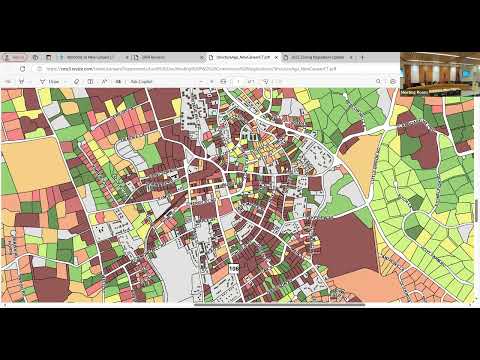
The rewrite is intended to update language that staff described as inconsistent, unclear or outdated and to align the regulations with state law and recent town planning guidance. “It needs a cleanup. It needs a refresh. It needs to be updated,” Daniel Radman said, outlining the subcommittee’s purpose. Planning staff noted they have already prepared an RFP draft and preliminary technical materials, including a GIS map of structure ages across town.
Planning Department staff member Sarah said the age map—sourced from tax assessor data—shows 7,557 structures in New Canaan and that roughly 748 of them were built under the town’s current zoning regulations; 1,032 structures predate zoning, and 43% were built between 1950 and 1979. “There are 7,557 structures on this map,” Sarah said. Staff cautioned the data are an imperfect but useful starting point for neighborhood-level analysis.
Staff described 10 draft goals proposed for inclusion in the RFP, including: remove regulatory text inconsistent with state statute and case law; clarify unclear language; re-evaluate triggers for commission review to reduce routine caseload; strengthen special-permit criteria; incorporate relevant recommendations from the 2024 Plan of Conservation and Development (POCD); reassess residential setbacks, heights and coverage; review business/downtown zone regulations and mixed-use potential; address nonconformities (lots, structures, densities); examine institutional-use and affordable-housing approaches; and update the zoning map where appropriate.
Commissioners discussed tradeoffs among increased "as-of-right" allowances, performance-based criteria for institutional uses, and maintaining the town’s character. Staff cited recent changes in state law that could affect points or incentives for permitting multifamily units as-of-right and noted the subcommittee will seek consultant input on sequencing work and public engagement strategy. The draft RFP will be posted on statewide and national American Planning Association channels and a Connecticut planning listserv; staff said the RFP would typically remain open about three weeks, with consultant selection following in roughly three to four more weeks depending on responses.
Two formal actions were recorded. Commissioner Chris moved to nominate Daniel Radman as subcommittee chair; the motion passed (members present voted in favor). Later, a motion to adjourn passed and the meeting ended.
The subcommittee will also consider whether to consolidate multiple text documents (zoning regulations, subdivision regulations, village-district guidelines) into a single, consolidated planning-and-zoning document and whether to refine or consolidate commercial and retail zone categories in the downtown. Staff highlighted that many existing special-permit criteria date from the 1950s and 1980s and said the consultant should propose modern, use-specific criteria where appropriate.
The meeting closed with staff and commissioners agreeing to finalize the RFP and circulate it to members for comment before posting. Staff and members emphasized that nothing will be final until the full commission votes on any proposed regulatory changes and that substantial public engagement and hearings will follow consultant recommendations.
Ending: The subcommittee will meet periodically (monthly to start) after the consultant is selected; staff estimates a one- to two-year process but acknowledged the timeline could extend. Specific dates for RFP posting, consultant selection, and future meetings were described as pending final RFP edits and scheduling.