Get Full Government Meeting Transcripts, Videos, & Alerts Forever!
Get email alerts on the Municipal Budget topic
No spam. Unsubscribe anytime.
New Canaan committee reviews FY2026 general government budget highlights
Summary
The Town Council Finance and Government Committee met to review highlights of New Canaan’s proposed fiscal 2026 general government budget, including department‑level increases and several one‑time transfers and authorizations that the town expects to refine as the budget process continues.
The Town Council Finance and Government Committee met to review highlights of New Canaan’s proposed fiscal 2026 general government budget, including department-level increases and several one-time transfers and authorizations that the town expects to refine as the budget process continues.
Committee members heard that general government expenditures across departments are up about 2.75% overall and that several individual line items and staffing changes account for much of that increase. The presentation grouped the increases and decreases by department and identified both recurring and one‑time items that will affect the operating budget.
The nut graf: The discussion matters because it identifies the drivers that could affect property taxes and the town’s use of fund balances and bond premium to smooth next year’s levy. Key items included a proposed new central procurement and risk management position in finance, a cybersecurity initiative moving from capital into the operating budget, a planned merger of the tax assessor and collector positions that officials say will save roughly $80,000, and an operating transfer request for tax‑supported capital that is currently shown at $1.7 million but may be lowered as the board reviews offsets.
Major department items and staff changes
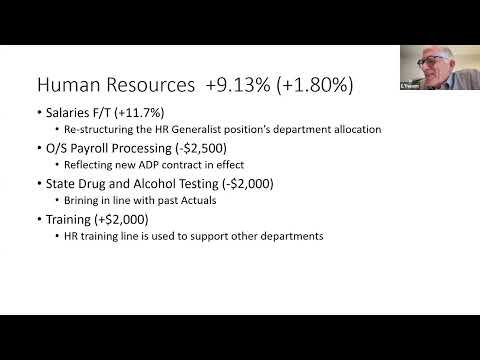
First Selectman’s office: The First Selectman’s department shows an 11.55% increase, primarily because the grant writer position was moved into that department from finance (identified in the presentation as Greg Riley, grant writer). The move also reflects a reallocation of an HR generalist position that had been split between HR and the First Selectman’s office.
Finance department: The finance budget shows a 2.67% reduction overall but includes a new purchasing agent position intended to centralize procurement and risk management functions. The presenter described the role this way: “This position would, oversee that whole, process.” Finance will also remove a part‑time project coordinator and reduce some external audit and banking fee lines.
Tax assessor/collector merger: Officials said they will merge the tax assessor and collector roles after the long‑tenured collector (17 years) retires. The presentation projected about $80,000 in savings from combining the two departments. The assessor budget rises roughly 11.1% to reflect merged full‑time salaries and a new part‑time support hire; the collector line drops by about 31%.
Information technology: IT shows one of the largest percentage jumps in general government—21.7%—driven mainly by a $115,000 increase in service contracts. The presenter said approximately $65,000 of that reflects a cybersecurity product (previously budgeted in capital) that is now being rolled into operating because initial hardware/software set‑up periods ended. Other increases include multi‑year contract transitions, a $5,000 increase for OpenGov, an $18,000 increase tied to Microsoft virtual desktop licensing, and a small new training subscription intended to replace more costly conference enrollments.
Pensions, OPEB and insurance: The town pension contribution is shown rising by about $275,000 following the actuarial report from HOKA (cited by presenters), driven in part by recent police hires and salary increases in several departments. OPEB contributions remain flat at zero in this proposal. Workers’ compensation costs were presented as down roughly 7.65% reflecting improved claim experience under the fully insured plan; overall insurance blanket coverage is budgeted up about 3%.
Elections and registrar: Town clerk and registrar of voters lines reflect lower costs from the absence of a presidential election year but added costs related to early voting and new equipment. Presenters said the registrar received roughly $15,000 in two state grants (early voting and ballots) that offset some new expenses; training and new voting‑system equipment lines rose modestly.
Building and land use: Permit revenues and staff efficiencies from OpenGov were cited as reasons for reduced part‑time costs in the building department and modest revenue increases in building permits. The land use department line items show small adjustments for membership fees and corrected voice/data allocations.
Parking and capital: Parking revenues were projected to rise (meters and tickets), reflecting actuals and increased paid‑by‑phone usage. The presentation listed capital funding for new pay‑by‑space machines—nine machines, quoted in the presentation as about $91,000—primarily for Elm Street and one location on South. Presenters said authorization is being placed so the town can move forward if leaders later decide to implement paid parking in those locations; several committee members noted merchant opposition that has been voiced to them.
Transfers, bond premium and one‑time items
The operating transfer for tax‑supported capital is currently shown at $1.7 million. Presenters said staff and boards are reviewing fund balances, closed projects and offsets to reduce that number; last year’s comparable number was noted as roughly $3.38 million after offsets. The presentation also identified last year’s one‑time transfer ins, including about $474,000 of ARPA used to reimburse the general fund and a bond‑premium offset that will be determined when the town goes to market for bonds.
Discussion and next steps
Committee members asked questions about staffing coverage for removed part‑time roles (presenters said duties would be absorbed by existing teams), the timing and accounting treatment for IT contracts that are moving from capital to operating, and the practical effect of the operating transfer on next year’s tax levy (presenters said it does increase the operating budget but that the number may come down during the process). Presenters encouraged the Board of Finance and other boards to review capital timelines and to prioritize projects that are ready to be executed in the coming 12–18 months.
No formal votes were recorded during this review. Officials said the town treasurer will present methodology on investment income forecasting at an upcoming meeting, and the Board of Finance will continue to examine the numbers ahead of budget adoption.
Ending: The committee continued the technical review and requested follow‑up materials on several lines (pension assumptions, the purchasing‑agent job description, and the detailed IT contract roll‑ins). The town plans further review by the Board of Finance and a treasurer presentation before final budget actions are taken.