Get Full Government Meeting Transcripts, Videos, & Alerts Forever!
Get email alerts on the Emergency Management Windstorm Recovery topic
No spam. Unsubscribe anytime.
South Pasadena reviews emergency response and recovery after early‑January windstorm
Summary
City chiefs told the Public Safety Commission the Jan. 7 windstorm triggered a multi‑agency emergency response, an emergency proclamation, and an initial damage estimate of roughly $2.9–3.0 million; officials outlined mutual aid, debris and reimbursement processes and next steps for recovery.
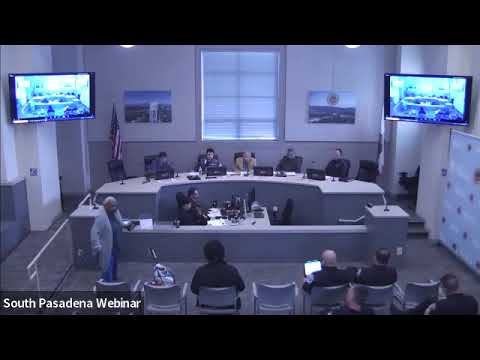
Chiefs from South Pasadena’s police and fire departments gave the Public Safety Commission an overview of the city’s response to the windstorm event that began Jan. 7 and the recovery work that followed.
The presentation described activation of the city’s emergency operations center (EOC), large‑scale mutual aid, extensive calls for service and an initial damage estimate of about $2.9–3.0 million. "This presentation is an overview of the windstorm event that we experienced in early January," Police Chief Brian Solinski said.
The nut graf: the storm produced widespread downed trees, power outages and emergency incidents that required overtime staffing, EOC coordination and mutual‑aid support. City officials told commissioners the council issued a city emergency proclamation at its prior meeting and that state and federal disaster declarations make certain reimbursement programs available.
Police, fire and public‑works officials described immediate actions taken. Solinski said the police department ramped up staffing, deployed officers for traffic control and evacuations, and sent about 20 additional officers during the event. Fire Chief Greg Lloyd said the department pre‑positioned resources and that South Pasadena units were first on scene for a vegetation fire on Santa Teresa Avenue that was held to roughly a half acre. Public works reported more than 50 service reports and described one 36‑inch‑diameter tree that fell on a house and required a crane and about 24 hours to remove.
Officials reported call volumes and mutual‑aid usage: the police department handled 1,409 calls for service over three days; the fire department provided 604 responses to other jurisdictions and received 652 incoming mutual‑aid responses in 2024 overall. Solinski described the region’s mutual‑aid arrangement (Area C) and said agencies must often send half of their on‑duty force when requested.
On recovery and finance, Solinski and Lloyd outlined the reimbursement path: the presidential disaster declaration for Southern California and the state proclamation make South Pasadena eligible for FEMA assistance under the Robert T. Stafford Disaster Relief and Emergency Assistance Act and for state reimbursement under the California Disaster Assistance Act (CDAA). Lloyd said the CDAA is a cost‑share program covering 75% of eligible costs and noted that other federal assistance often reduces the city’s net share; officials estimated the city’s responsibility at roughly 7–9% after applicable offsets. The chiefs said the city completed an initial damage assessment and provided FEMA/Cal OES with location‑specific damage lists and GPS coordinates for damaged infrastructure, trees and street lights.
Officials described next steps: a preliminary damage assessment (PDA) and more detailed surveys by the state recovery branch (Cal OES/Cal OES recovery teams), expected audits, and continued tracking of personnel time and equipment to support reimbursement claims. Lloyd emphasized documentation needs: contracts for debris removal (for example, West Coast Arborists), tonnage records, and disposal locations are part of the PDA.
Commission discussion covered hydrants, evacuation planning for Monterey Hills, registries for residents needing assistance, debris‑pickup confusion, and communications. Chief Lloyd said hydrants functioned during the event and that engines carry 800–1,000 feet of supply hose for redundancy. Commissioners asked about evacuation routing for narrow, steep roads in Monterey Hills; Lloyd said the department is working on a comprehensive wildfire protection plan that would include evacuation routes, weed abatement and community coordination. Council liaison Omari Ferguson urged more formal neighborhood watch and tree‑ordinance input from public safety.
On debris and cleanup, staff said two parallel efforts were underway: Athens Services was doing extra pickup (green waste and household debris) and public works was addressing debris on public property. City staff acknowledged confusion in public messaging about where residents should place debris and said they are clarifying arrangements with Athens.
Commissioners and chiefs also reviewed communications and incident‑management tools used during the event. Solinski described the EOC organization and said the city used Nixle and ConnectSouthPasadena notifications. Lloyd and Solinski said the Verdugo communications arrangement allowed the city to assume local dispatching responsibilities when the regional dispatch center was overwhelmed. Solinski noted operational benefits from incident‑management software (tablet command) and that some police Tesla vehicles provided filtered cabin air for officers in smoky conditions.
Ending: chiefs said the recovery phase will last many months and that staff will continue to refine damage estimates and reimbursement packages. They asked residents to be patient as debris removal, insurance and assistance programs proceed and said the city will provide updates as the PDA and audits advance.