Get Full Government Meeting Transcripts, Videos, & Alerts Forever!
Get email alerts on the Education Budget topic
No spam. Unsubscribe anytime.
Board of Education outlines operating cuts, defends self‑insured health plan
Summary
A Board of Education representative reviewed FY26 operating and capital requests, proposed targeted reductions, and explained why New Canaan remains self‑insured while comparing costs with neighboring Darien.
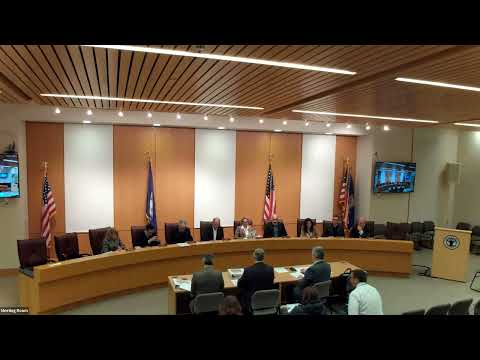
A Board of Education representative told the Board of Finance on Monday that the school system has identified several targeted reductions in its FY26 capital and operating requests while continuing work to refine its insurance projections.
The representative said the board aims to reduce the FY26 capital request by using prior-year funds and delaying or scaling projects. "We're looking at reducing the request in FY26 for masonry by $250,000," the Board of Education representative said, and described proposed reductions including $80,000 in painting, $100,000 from a $250,000 ceiling‑tile replacement, and $150,000 from an energy‑conservation line tied to a combined heat‑and‑power (CHP) effort the district will pause for further study. The east walking trail funding of $30,000 was described as likely to be covered by PTC fundraising.
Why it matters: school budgets are the largest recurring public expenditure for most Connecticut towns, and the board said it is trying to meet a requested operating reduction by finding one‑time capital offsets and additional operating savings from attrition and turnover.
On health care, the board explained why New Canaan remains self‑insured rather than moving to a fully insured or state plan. The representative said the district's reported 2023–24 all‑in cost for medical, vision and dental — including stop‑loss and administrative fees — was $16,856,351, while a neighboring district's premium bill (Darien) for the same period totaled about $17,000,157. "You're not comparing apples to apples," the representative said, noting Darien's number is a premium for a fully insured plan while New Canaan reports actual claims, stop‑loss costs and fees because it self‑insures and pays claims out of an internal services fund.
Board members asked for further analysis. Several finance officials proposed bringing the district's actuary back in May or June for a deeper review of plan design, per‑participant costs and the district's stop‑loss corridor. The Board of Education representative said the district had built a 15% margin in projections but that recent reviews suggested the aggregate stop‑loss exposure could be reduced to about 5%, a change the presenter estimated could save roughly $150,000 if confirmed by market conversations.
The board also addressed the recurring question of year‑end turnbacks. The presenter said a 10‑year lookback shows the district typically turns back funds (an average near $690,000 and a median near $558,000), and argued that historical turnbacks are part of how the board manages budget risk while protecting services.
The Board of Education representative concluded by asking the Board of Finance and selectmen to allow a schedule that would permit a special appropriation for an athletic scoreboard (to be bonded and authorized by town bodies) so the district could guarantee installation before the fall season; finance staff agreed to return with clarifying numbers in time for the town vote.
Looking ahead: the district offered to return in May/June with actuarial staff to tighten insurance projections and to provide a more specific operating‑reduction commitment ahead of the Thursday budget vote.