Get Full Government Meeting Transcripts, Videos, & Alerts Forever!
Get email alerts on the Emergency Response Drones topic
No spam. Unsubscribe anytime.
Vendor demonstrates Paladin drone system to South Pasadena officials; quote given for one drone and dock
Summary
Paladin presented its Watchtower-connected drone system to South Pasadena City officials, describing FAA waivers needed, operational features (LTE remote flights, BVLOS, docking stations, thermal and 200x zoom cameras), insurance and a quoted price of a discounted M30T-and-dock package plus an annual software/support fee.
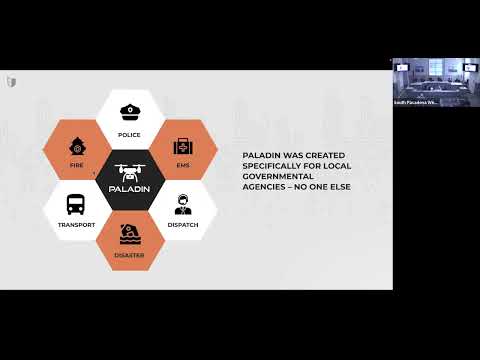
Paladin, a private drone-services company, demonstrated its end-to-end drone response system to South Pasadena City staff and public-safety leaders in a vendor presentation. The presenter, Alex (Paladin representative), said the system can be flown remotely over LTE from Paladin’s operations in Charlotte, North Carolina, while a live drone operates from the company’s engineering site in Houston, Texas.
The demonstration and product overview focused on the program’s legal and technical features, why the company seeks FAA authorizations, and the vendor’s price quote. Alex said Paladin combines hardware (docking stations and compatible drones) with a cloud software called Watchtower that offers live streaming, unlimited cloud storage, CAD and GIS integrations, and tools for incident sharing with responding units and command staff.
Why it matters: South Pasadena officials are weighing whether to add drone capabilities that can reach incidents rapidly and feed live video to responders and command staff. Paladin’s presentation spelled out operational limits, safety measures and recurring costs the city would consider if it pursues a contract.
Paladin said the program is built around two FAA authorizations: a certificate of authorization (part 91 operations, described by the presenter as a blanket waiver that allows non‑certified staff to operate under the company’s approval) and a beyond‑visual‑line‑of‑sight (BVLOS) waiver to permit flights beyond the pilot’s unaided line of sight. The presenter contrasted those waivers with Part 107, under which each individual pilot must pass the FAA exam and maintain required flight hours.
On technical capability, Paladin said the system uses LTE cellular links to allow remote, autonomous flights up to “5-plus miles” from the docking station and that a drone can reach any point within that radius in about 90 seconds. The company demonstrated autonomous routing with geofencing around obstacles and a “detect-and-avoid” approach that combines onboard sensors with an ADS‑B receiver to register nearby manned aircraft. Paladin also highlighted a 200x optical zoom camera, a thermal sensor (white‑hot mode with multiple palettes), augmented-reality overlays for street names and house numbers, and an estimated 30‑minute typical flight time for the class of quadcopter shown.
The hardware example shown in the presentation was the DJI M30T paired with Paladin’s docking station; Paladin also said it maintains an American-made alternative for continuity. Docking stations are heated/cooled enclosures with automatic charging contacts; Paladin said a drone can be airborne from a docking station and reach a five‑mile radius target in roughly 90 seconds and that the docking station’s charge cycle yields about a 25‑minute turnaround to full charge.
On data and security, Paladin said Watchtower stores unlimited footage on Amazon Web Services and that only the department would have access to that archive. The company said it would provide a dedicated support engineer rather than a ticket queue and that multifactor authentication (via Google or Azure) was planned as a deliverable by year‑end. Paladin also said it would add city users to its liability insurance program with coverage up to $2,000,000 per incident, according to the presenter.
Cost and procurement details were stated during a pricing slide. Paladin quoted a discounted equipment package — the presenter said the M30T plus a docking station was being offered at $15,000 (described on the slide as a discount from a higher retail price). Paladin also quoted an annual recurring fee of $49,000 per year for one drone and one dock, which the presenter described as an all‑inclusive package covering software, training, maintenance, waiver upkeep and support. The company said additional drones, docking stations or extended modules would increase the price.
City staff asked several technical follow‑ups during and after the demonstration, including questions about physical size, persistent connectivity, multi‑SIM support (FirstNet, T‑Mobile, AT&T discussed as examples), proximity and obstacle sensing, the company’s uptime figure (stated at 99.9%), crash history (the presenter said he was aware of two crashes outside testing out of thousands of monthly flights with no injuries or damage reported), and the availability of spec sheets and references.
No formal procurement decision or vote occurred during the presentation. Chief Lloyd (addressed by the presenter) noted that the city would address legal and policy questions later in the meeting, and city staff requested Paladin provide specification sheets and references for further review.
The vendor’s proposal and the FAA authorizations it requires will be material to any next steps: the system’s ability to operate BVLOS and under a certificate of authorization, its recurring cost, insurance and the city’s determination about privacy, public‑safety integration and vendor selection.
Paladin’s presenter closed by offering references, promising follow‑up materials (pricing/spec sheets), and noting integration options (open API) for CAD and GIS systems. City staff indicated they would review legalities and the quote as part of subsequent procurement steps.