Get Full Government Meeting Transcripts, Videos, & Alerts Forever!
Get email alerts on the City Center Zoning topic
No spam. Unsubscribe anytime.
Fife council affirms preferred City Center alternative, directs final EIS and planned-action ordinance
Summary
The City Council unanimously affirmed a preferred alternative for the City Center subarea, directing staff to prepare a final environmental impact statement and a planned-action ordinance to guide zoning and development around the planned light-rail station.
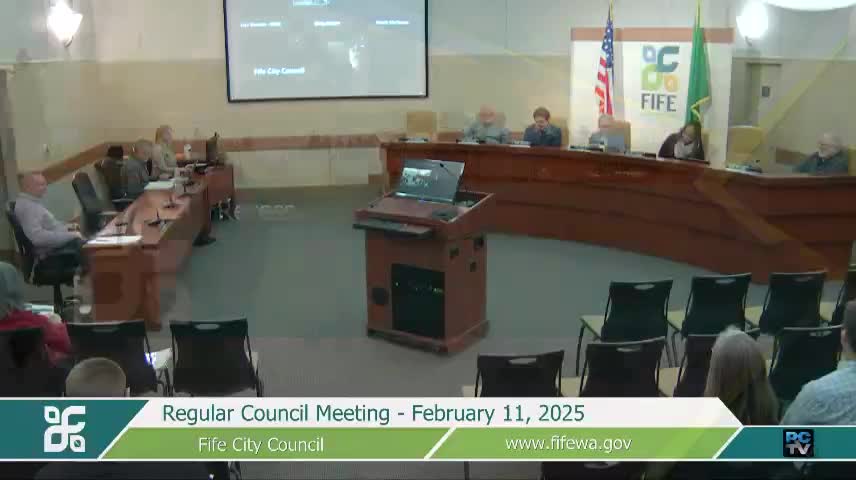
The Fife City Council on Feb. 11 unanimously affirmed a preferred alternative for the City Center subarea and directed staff to prepare a final environmental impact statement (final EIS) and a planned-action ordinance to implement new zoning around the planned Sound Transit light-rail station.
The preferred alternative, recommended by the Planning Commission and presented by city planning staff and consultants, aligns closely with Alternative 2 from the draft environmental impact statement (DEIS). That alternative is intended to meet the Puget Sound Regional Council and Pierce County growth targets studied in the DEIS (2,044 housing and employment growth units) and emphasizes medium-density mixed-use development, multimodal connections and community gathering space. The recommendation also incorporates inclusionary zoning incentives drawn from the higher-growth Alternative 3 and expands the city’s multifamily tax exemption (MFTE) program across the City Center to encourage affordable units.
Why it matters: Council members and staff said the action frames how the city will plan for growth and housing near a future light-rail station and establishes the regulatory tools that will guide redevelopment in the area. The planned-action ordinance and final EIS will set parameters for development standards, affordable-housing incentives and mitigation measures.
Staff and consultants said the preferred alternative would permit mixed-use development up to six stories in portions of the City Center and would add policies encouraging shared stormwater facilities and multimodal improvements. The recommendation would expand the MFTE program (currently codified in Fife Municipal Code chapter 3.95) so developers in the City Center could choose a 12-year property-tax exemption in exchange for affordable units; it would also add a voluntary, incentive-based inclusionary zoning program that would offer benefits such as additional density, reduced parking requirements or expedited permitting to projects that include affordable units.
Council members and staff summarized the public and agency comments on the DEIS: the Washington State Department of Ecology advised use of clean fill and guidance if contamination is encountered; Sound Transit commended the DEIS and asked for follow-up on how development standards could affect transit facility siting; and the Washington Department of Fish and Wildlife said it preferred Alternative 2 because it centralizes development and reduces impacts on creeks, while noting some sensitivity around two creeks in the subarea. In total the city received six comments during the 45-day comment period that closed Jan. 16: three from agencies and three from individuals. Individual commenters included one who urged maximum density and inclusionary zoning, one who raised traffic concerns on Twelfth Street and the Fife Heights area (which the DEIS addresses via traffic analysis), and one who requested moving the station closer to the port (staff said station location is outside the DEIS scope).
City planning director Chris Larson told council there is flexibility in the process and that the preferred alternative can be refined up to adoption: "You could still change what the preferred alternative is all the way up to the final EIS, all the way up to the adoption of the sub area plan," he said. Councilmember questions focused on implementation timing, the scope of rezoning, and outreach to property owners and stakeholders, including tribal staff. Staff said property owners in the study area received both an initial scoping notice in spring 2024 and the DEIS notice for the 45-day comment period; planners said the Puyallup Tribe had been engaged but leadership turnover affected written comment during the DEIS period.
Council action: Councilmember Gathers moved to "affirm the preferred alternative, as recommended by the Planning Commission, and direct staff to move forward with the creation of a final EIS and planned action ordinance." Councilmember Fagundes seconded. The motion passed unanimously.
Next steps: Staff will incorporate DEIS comments, finalize the preferred alternative in the final EIS, and draft a planned-action ordinance and subarea plan language as part of the comprehensive plan periodic update. Staff indicated the final EIS and remaining materials were expected within months and will come before the council again as the documents are finalized.