Get Full Government Meeting Transcripts, Videos, & Alerts Forever!
Get email alerts on the Street Lighting topic
No spam. Unsubscribe anytime.
Fife Council weighs adding 15 cobra‑head street lights to 60 Second Avenue to improve nighttime safety
Summary
City staff proposed installing about 15 cobra‑head street lights along 60 Second Avenue between 20th Street and Valley Avenue, a planning‑level $250,000 estimate funded from the city’s Public Safety Fund; council members asked for pedestrian‑scale alternatives and a light study before final design.
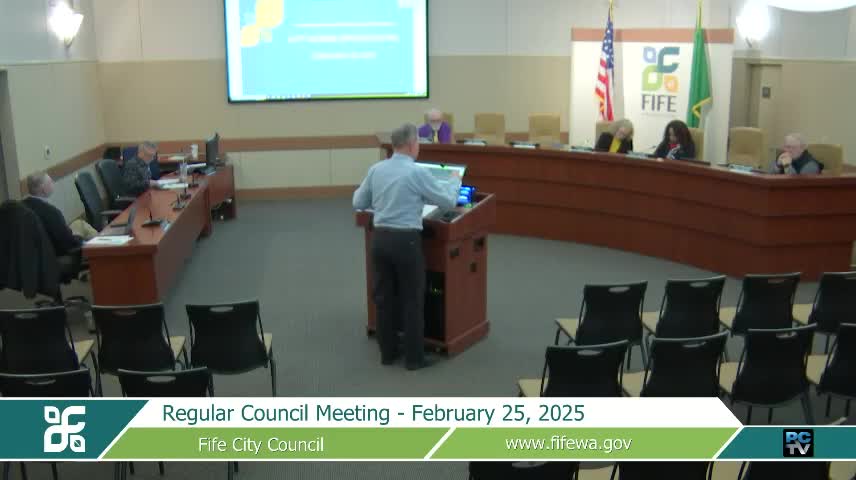
Fife officials discussed adding street lighting along 60 Second Avenue on Feb. 25 as part of a larger Safe Routes to School reconstruction project.
City engineering staff told council the city received a Safe Routes to School grant worth “a little over $3,000,000” for the 60 Second Avenue project, which will reduce the roadway from three lanes to two, add bike lanes on both sides and fill in missing sidewalks. Director Greg Vigoren said the city initially omitted lights from the grant request to avoid jeopardizing funding but is now proposing about 15 cobra‑head street lights to match existing poles in the neighborhood. “We’re recommending to install about 15 of those and the planning‑level estimate for that’s about $250,000,” Vigoren said.
The lights would be located between Twentieth Street and Valley Avenue and include illumination at a raised pedestrian crossing near Bella Sonoma Apartments, Vigoren said. He recommended funding the lights from the city’s Public Safety Fund, which he said allows expenditures for pedestrian safety and similar uses.
Council members pressed staff for more detail on design and pedestrian lighting. Mayor Kim Roscoe asked whether cobra‑head fixtures primarily benefit motorists and whether the city should pursue fixtures aimed at sidewalks. “I am concerned that these are street lights and that they’re not for the pedestrians,” Roscoe said. Vigoren responded that cobra‑head fixtures are taller and “light up the bike lane” and that a separate light study could show pedestrian light levels. He also said some grant projects on Twentieth Street do include street lighting.
Council member Gathers asked for comparative cost estimates for alternatives such as double mast‑arm fixtures that would place light both over the roadway and back toward sidewalks or trails; several council members supported adding that analysis before design is finalized. Council member Wolfram and others voiced general support for adding lights to address nighttime safety concerns in a corridor several speakers described as “very dark” after dark.
Vigoren said the current $250,000 figure is a planning‑level estimate based on matching existing non‑decorative poles; final costs will depend on fixture choice and bids. He also noted some neighbors may object to light intrusion into residences and that tree canopies could affect light distribution.
Next steps identified in the discussion included: running a photometric light study to quantify whether cobra‑head fixtures will provide required pedestrian and bike lane illumination; pricing alternative fixtures (including dual‑arm or pedestrian‑scale fixtures); and coordinating public outreach, including the neighborhood meeting scheduled for March 18.
If council pursues the street lights, staff said they would bring refined design and budget estimates back to council before committing Public Safety Fund dollars.