Get Full Government Meeting Transcripts, Videos, & Alerts Forever!
Get email alerts on the Firwood Rezoning topic
No spam. Unsubscribe anytime.
Firwood rezoning draws split between residents and developers over utilities, housing and industrial proposals
Summary
Residents and developers clashed at the March 3 public hearing over Firwood’s proposed rezoning; residents cited undrinkable wells and failing septic systems, while developers proposed industrial conversions tied to utility extensions and new jobs.
During the March 3 public hearing on Fife’s 2024 periodic update, the Firwood neighborhood became the most contested single topic, with residents, property owners and developers presenting sharply different proposals for the area’s future.
Residents urged the commission to keep Firwood residential. Several speakers said water and septic systems are failing, that well water is undrinkable and that sewer and potable-water access are prerequisites to any large-scale redevelopment. Bill Thomas, speaking on behalf of an estate in Firwood, said recent tests show water “a 9” on a 1–10 scale of potability and urged attention to water and sewer infrastructure before approving zoning changes.
Developers, landowners and their consultants asked the commission to approve industrial zoning or to adopt alternatives that mix industrial development with targeted housing. Tyler Litzenberger, who identified himself as a business owner with Vector Development Company and owner of about 20 acres along Freeman Road, described an amended proposal that would place industrial uses closer to Freeman Road while reserving buffers and adding net new housing and utility infrastructure that would benefit adjacent city-owned parcels.
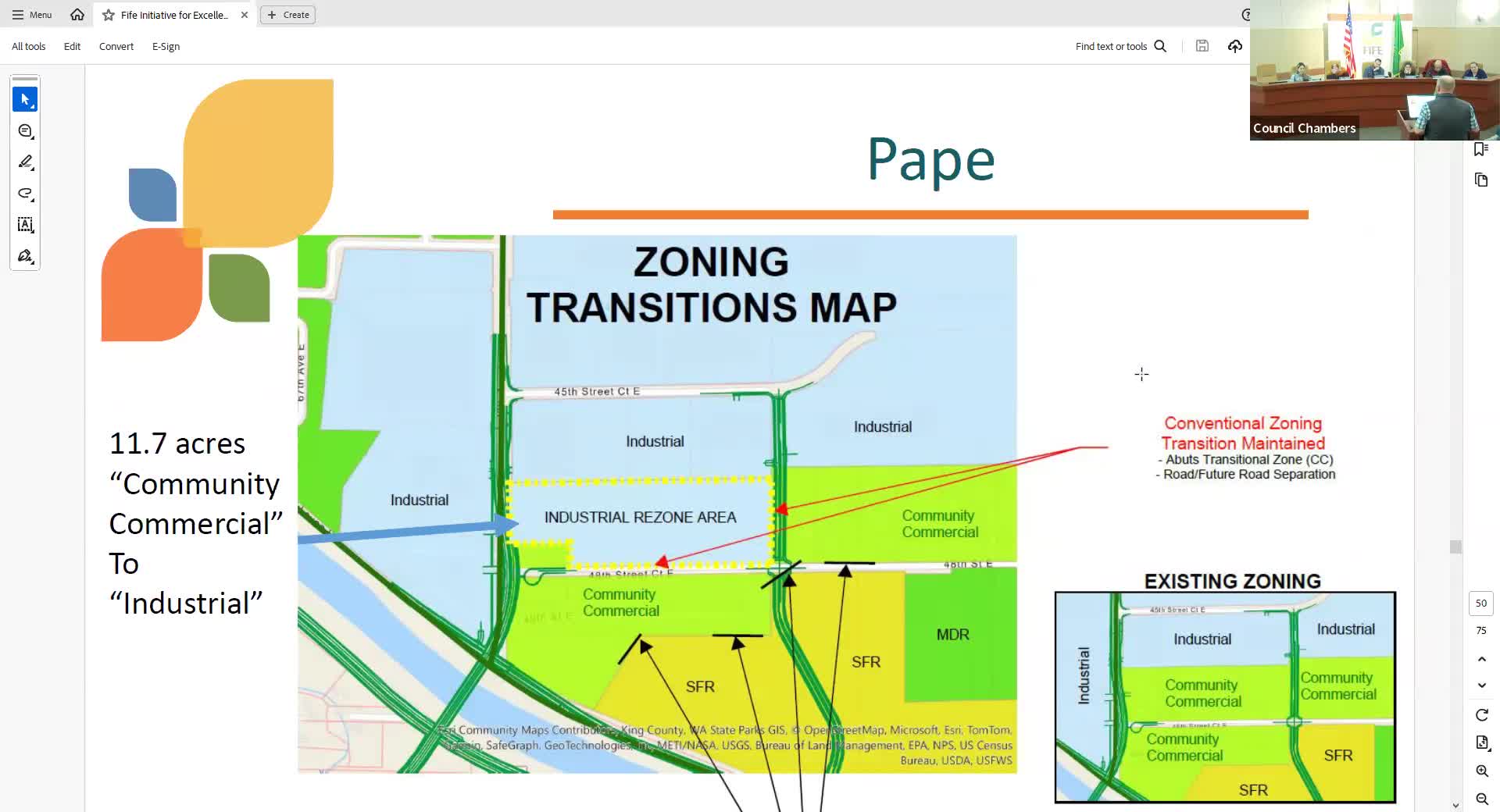
The Pappay Group (Quinn Clawson) and other industrial proponents asked that portions of Firwood be zoned industrial to support truck-oriented and manufacturing uses adjacent to SR 167 and existing industrial areas. Quinn Clawson said Pappay’s plan would develop a machinery dealership and build a road extension (70th/70 Fourth) and related improvements.
A land-use representative appearing for Graham Trucking (senior planner Cheryl Ebsworth) asked the commission to retain industrial zoning for roughly 3 acres in the Benton Loop area, arguing that industrial designation matches the site’s proximity to SR 167, is consistent with the current comprehensive plan goals and avoids placing new residential uses next to a major freeway.
Residents and representatives highlighted the infrastructure gap in Firwood as the primary practical constraint. Several residents and their representatives said homes in the neighborhood rely on private wells and septic systems that they described as inadequate; speakers asked the city to secure sewer and potable water before approving rezonings that would alter residents’ options or increase density. Vector and other developers replied that utility extensions typically accompany private development and that a development-driven infrastructure strategy (or developer-provided latecomer agreements) is a common way to bring water and sewer to formerly unserved areas.
What was proposed
- Vector alternative: staff said Vector submitted a proposal to rezone about 54.5 acres from medium density residential to industrial adjacent to Freeman Road; Vector told the commission its plan would include utility improvements, some housing and opportunities for affordable housing as part of the project.
- Pappay alternative: Pappay submitted a proposal to rezone roughly 11.7 acres from community commercial to industrial in a portion of the Benton Loop area; Quinn Clawson said the company plans a machinery dealership and related industrial uses.
Implications and staff response
Director Chris Larson told commissioners that rezoning residential land to industrial would reduce residential capacity and increase job capacity, but he said the capacity analysis indicates the city would still meet its growth targets under the alternatives presented. Larson reiterated that an existing residence that becomes nonconforming under a rezone generally can continue indefinitely if the owner chooses; nonconforming uses are allowed to remain unless abandoned or changed, though expansion and redevelopment are limited by code.
Residents asked whether rezoning would trigger utility hookups and who would pay for water and sewer. Larson and other staff explained typical pathways: developer-funded extensions tied to private development, city-funded projects or local improvement districts, and latecomer agreements that allow developers to recoup costs from later connections.
Why it matters
Firwood sits amid existing industrial uses and SR 167; decisions about its zoning will shape whether the neighborhood remains residential, transitions to industrial, or becomes a mixed-use area with new infrastructure. Residents stressed public-health and quality-of-life concerns tied to water and sewage; developers argued the area’s proximity to freeway ramps and industrial nodes makes it more suitable for commercial and industrial investment and that development could finance needed utilities.
Ending
Planning commissioners heard competing written and oral proposals and said they would consider the alternatives before making a recommendation on April 7. Several speakers asked staff and commissioners to prioritize securing potable water and reliable sewer access for Firwood residents regardless of the final zoning choice.