Get Full Government Meeting Transcripts, Videos, & Alerts Forever!
Get email alerts on the Municipal Finance topic
No spam. Unsubscribe anytime.
Edgewood council discusses reinstating $20 vehicle fee to shore up street fund
Summary
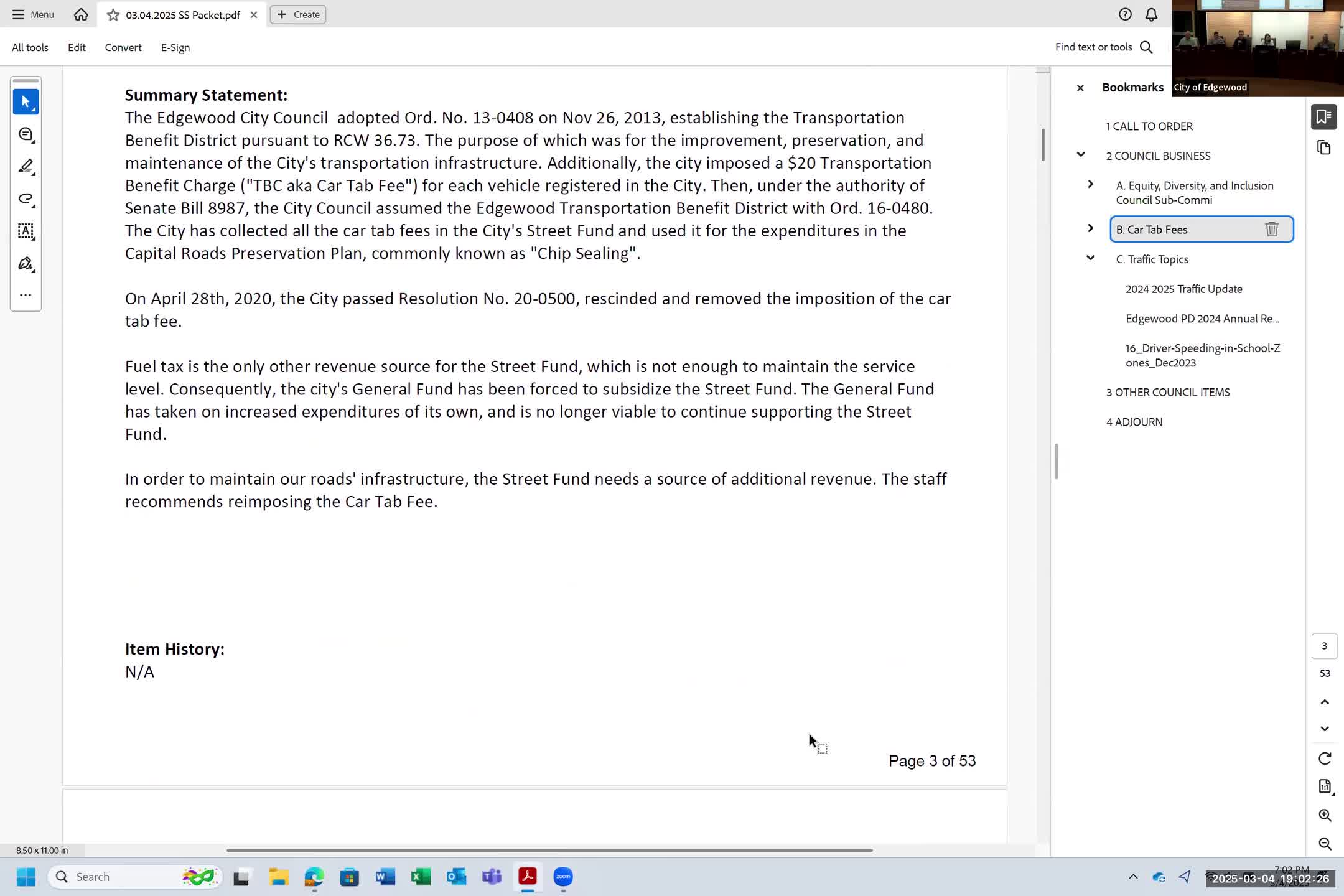
Finance staff recommended reimposing a $20 vehicle (car-tab) fee to bolster the city—s Street Fund. Council members raised questions about timing, exemptions, outreach and reliance on volatile REET revenue; no vote was taken and the item was placed on next week—s regular meeting agenda.
Edgewood Finance Director Hardeep Gariah on Tuesday presented a proposal to reinstate a $20 vehicle fee — commonly called a car-tab or transportation benefit charge — to restore revenue the city stopped collecting in 2020.
The fee would be collected by the Washington State Department of Licensing after the council gives notice; Gariah said the agency needs about six to eight months to implement collection. Based on historical collections, staff estimated the city could collect about $250,000 in calendar 2026 if the council approves the fee this spring.
The proposal stems from an ongoing shortfall in the Street Fund. Gariah told the council that fuel-tax receipts average about $250,000 a year and that the city has been supplementing road maintenance with transfers from the General Fund and real estate excise tax (REET). He said Street Fund expenditures rose to roughly $1.2 million in 2022 and about $1.3 million in 2023 and that returning the vehicle fee would ease but not eliminate the subsidy need.
"In staff's efforts to continue look for new revenue sources, tonight, we present a proposal to reimpose the CARTA fees, also, commonly, known as transportation benefit charges," Gariah said.
Council members asked detailed questions about the fee—s history and limits. Gariah and staff recounted that Edgewood created a Transportation Benefit District in February 2013, reorganized it in 2016 to assume district assets and responsibilities, and stopped collecting the fee in April 2020 (the city kept the benefit district in place). Staff said city attorneys advised the council that state law (cited in discussion as RCW 82.80.140) limits the city to a $20 fee in the circumstances described, so the recommendation is to start at $20 rather than attempt a higher charge.
Members pressed staff on outreach and equity. Council Member Roseanne and others said the fee was originally removed amid COVID-era relief and tied to concurrent utility-tax discussions, and that the city should explain clearly to residents why it is being considered again. Council Member Christy asked whether the city could apply an income-based exemption or AMI table for low-income households; staff said they would check whether the Department of Licensing can implement exemptions at the vehicle-renewal point.
Members also raised budget sensitivity to REET receipts. City staff and Council Member John said REET transfers that were used when the fee was suspended should not be treated as a stable ongoing revenue stream because residential construction activity has softened; Christy said single-family starts had been revised down 8.5 percent and cautioned against depending on REET.
Several council members asked for additional data before a vote, including average tab costs for Edgewood vehicle owners and potential exemption designs. Gariah said department-of-licensing setup would delay collections by six to eight months if the council approves the fee soon, and that the city could budget partial-year revenue for 2026 depending on timing.
No formal motion or vote occurred at the study session. Mayor Olsen said the item is slated for the council—s regular meeting next Tuesday, when members may make a motion and vote.
Why this matters: Edgewood officials said the Street Fund faces a structural gap between fuel-tax and other limited revenues and rising pavement-maintenance costs; reinstating the vehicle fee is framed as a way to direct the cost of roads to vehicle owners rather than the General Fund.
What council directed staff to do: staff agreed to check with the Department of Licensing and the city attorney on (1) whether an AMI- or income-based exemption table could be applied at vehicle renewal, (2) whether the fee can be implemented at a level above $20 under the cited RCW language, and (3) to provide additional data on REET estimates and example impacts for residents ahead of next Tuesday—s meeting.
Ending: The council did not vote at the March 4 study session; the proposal was scheduled for the March 11 regular council meeting.