Get Full Government Meeting Transcripts, Videos, & Alerts Forever!
Get email alerts on the Zoning Amendments topic
No spam. Unsubscribe anytime.
Plan Commission hears public concerns and splits on zoning-code amendments tied to 2023 Act 16
Summary
The Germantown Plan Commission on March 10 held a public hearing and split 3‑3 on a package of five zoning‑code changes prompted by 2023 Wisconsin Act 16, leaving the commission with a negative recommendation to send to the Village Board.
The Germantown Plan Commission on March 10 held a public hearing on five proposed text amendments to Section 17 of the Village of Germantown Municipal Code intended to bring the code into conformity with 2023 Wisconsin Act 16.
Jeff Retzlaff, community development director, summarized the package and said the changes are “necessary to maintain consistency between our zoning code and Wisconsin statutes.” Retzlaff said the revisions implement provisions in 2023 Act 16 — including language now codified in Wisconsin statute section 66.10015 — and that the village attorney provided a written opinion on specifics included in commissioners’ packets.
Retzlaff outlined five changes in the draft ordinance. He described them as: removing a prior code provision that required a three‑quarters favorable vote of the full village board to increase maximum density in a planned development district; removing the village’s “protest petition” provision that previously could trigger a super‑majority requirement; creating a certiorari appeal route to circuit court for denial of conditional use permits consistent with the new code sections; clarifying that most zoning amendments will require a simple majority of a quorum except for down‑zoning (which would still require a two‑thirds vote); and recreating an appeal process to the circuit court for decisions of the Board of Zoning Appeals. “This change requires that all zoning amendments be approved by a simple majority vote of the governing body and therefore eliminates any authority for local municipalities to require a super majority vote for zoning changes,” Retzlaff said, reading from the village attorney’s written opinion.
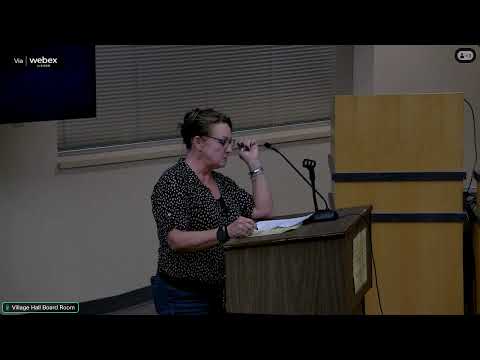
More than a dozen residents spoke during the public hearing. Common concerns included the timing of the change, the loss of the super‑majority protection in cases where a valid protest petition is filed, potential impacts on school capacity and municipal finances, and a perception that the changes facilitate development proposals now pending in the village. Written comments submitted before the meeting asked the commission to retain the protest‑petition provision and to delay action until elected representation is fully seated.
Commenters included Tammy Schneider and Scott Schrader, who urged preserving the three‑quarters requirement; Sarah Larson, who asked the commission to table the draft and noted packet materials were released less than one business day before the meeting; and Melanie Smythe, who said she believes Act 16 favors developers and asked that the commission delay its action. Russ (last name on file), who identified himself as president of the school board, told the commission that preliminary district analyses indicate multifamily development could create substantial near‑term enrollment swings that would affect staffing and the district budget; he said the district’s facilities study will be presented March 17 and an enrollment study will follow in April.
After public comment the commission considered a motion to forward the draft ordinance to the Village Board with a positive recommendation. During debate commissioners asked whether the Plan Commission vote changes the village board’s authority (it does not; the Plan Commission makes a recommendation for board action), and whether the village must update its code at all (staff and the village attorney argued the code should be cleaned up to avoid inconsistency and litigation risk under the new state statute). The commission also voted to separately request that the Village Board consider a resolution to state legislators expressing opposition to the statutory change; the commission’s motion to draft that resolution passed.
When the final recommendation vote was taken the result was a 3‑3 tie on the motion to recommend adoption of the amendments; a tie caused the motion to fail on the Plan Commission floor and the body recorded a negative recommendation to the Village Board. No zoning amendments were enacted by the Plan Commission on March 10; the package will proceed to the Village Board for its decision. Separately, the Plan Commission approved a motion directing staff to prepare the resolution to the state legislature expressing local opposition to Act 16’s limits on municipal authority.
Commissioners repeatedly emphasized that the Plan Commission’s action is a recommendation to the Village Board and not final zoning law. Retzlaff and the village attorney advised that leaving inconsistent language on the books risks confusing residents and encouraging appeals or litigation. Several commissioners asked for more time or to wait until full representation is seated on the Village Board before the board acts; others argued that the village should align its code with state statute to avoid legal exposure.
No new ordinance language was adopted by the Plan Commission on March 10; the Village Board will receive the record, staff materials and the commission’s recommendation for its consideration at a future meeting.