Get Full Government Meeting Transcripts, Videos, & Alerts Forever!
Get email alerts on the Impact Fees topic
No spam. Unsubscribe anytime.
Edgewood panel reopens debate on transportation impact fees to lure businesses
Summary
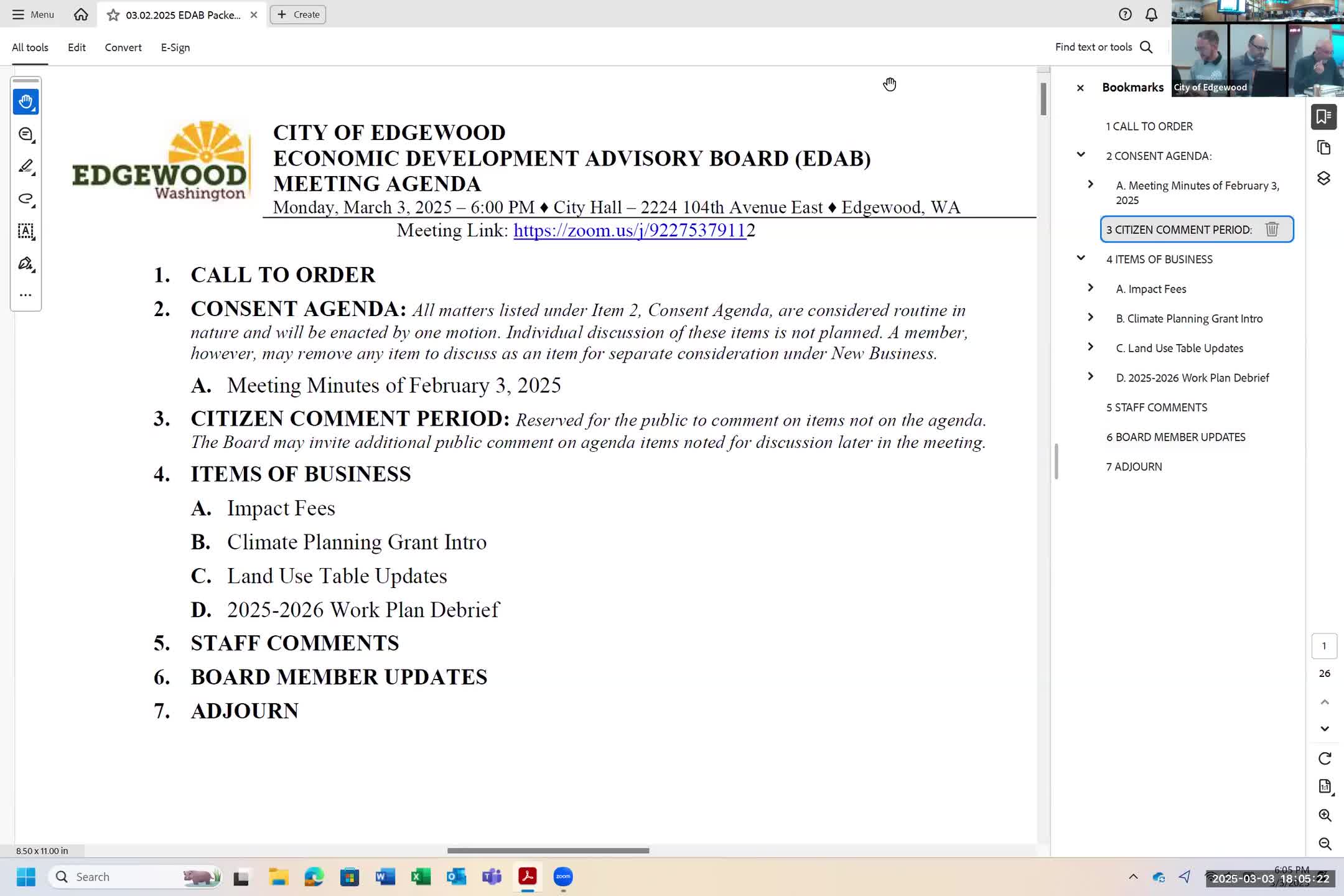
At an EDAP meeting March 3, staff and board members discussed how Edgewood's transportation impact fees (TIFs) affect nonresidential development and agreed to return with a prioritized list of uses for potential fee relief.
Edgewood's Economic Development Advisory Panel (EDAP) spent the bulk of its March 3 meeting discussing how the city's transportation impact fees apply to nonresidential development and whether reduced or targeted fee schedules could help attract desired businesses to the Meridian corridor and town center.
The board heard staff explain that the city's only fee that currently applies to nonresidential uses is the transportation impact fee, which is calculated on a "per-trip" basis using Institute of Transportation Engineers (ITE) trip-generation categories, while the city's land-use table uses NAICS codes. Public works director Chuck Hendrickson and planning staff told the panel the difference requires judgment when mapping city land-use categories to the ITE trip rates used to compute fees.
EDAP members and several residents raised concerns that a one-time impact fee can feel punitive to developers and small-business owners because it increases upfront costs even though sales tax revenue accrues over time. Board members said costs specific to individual sites (for example, turn lanes or driveway modifications identified in a traffic impact analysis) must be built by the developer at land-use entitlement, while impact fees are intended to fund broader, citywide transportation projects and nonmotorized infrastructure identified in an impact-fee project list.
Board members asked whether the city or consultants can model the long-term tradeoffs of fee relief versus future sales-tax revenue. Staff said they can ask the city's on-call consultant for modeling tools and encouraged the board to identify which nonresidential land uses they want staff to research further.
After extended discussion about anchors and retail mix'grocery, restaurants, and "destination" uses were mentioned repeatedly'the board agreed on two near-term steps: members will each identify their top categories (roughly five) of nonresidential uses to prioritize for potential fee reductions, and staff will ask the city's consultant whether modeling tools are available to estimate long-term revenue tradeoffs. The items are scheduled for follow-up at the next EDAP meeting.
The panel also discussed policy limits: impact-fee revenues cannot be used for ongoing maintenance or to replace existing capacity; they fund citywide expansion or capacity projects (for example, adding a travel lane or constructing sidewalks and trails) amortized over a planning horizon. Staff said the city typically uses a 20-year horizon consistent with the comprehensive plan when amortizing capital costs.
Participants noted geographic limits: impact fees stay within the jurisdiction that collects them and do not cross jurisdictional lines, though SEPA project review can identify off-site mitigation needs. Board members suggested exploring regional coordination with neighboring jurisdictions as a practical measure, even if statute prevents fee transfers.
The discussion included developers'and builders'concerns about upfront development costs, the high cost of building new structures in Edgewood, and how rent and operating margins affect tenants'particularly for small local businesses. Several board members recommended focusing first on attracting developers willing to build multi-tenant buildings and on identifying one or two anchor uses (restaurants, grocery or grocery-like anchors, or clusters of taxable retail) that could create foot traffic and support smaller businesses.
Ending: Staff will email links to past market studies and the town-center survey for EDAP members to review. Board members will return next month with prioritized lists of target uses; staff will seek consultant modeling options in the interim.