Get Full Government Meeting Transcripts, Videos, & Alerts Forever!
Torrington council schedules March 3 public hearing on joining Connecticut Municipal Redevelopment Authority
Summary
The Torrington City Council heard a presentation Feb. 18 from the Connecticut Municipal Redevelopment Authority about joining the state-backed program, including a $60 million bond pool for downtown housing and infrastructure. Council voted to schedule a public hearing March 3 to solicit local input on starting the opt-in process.
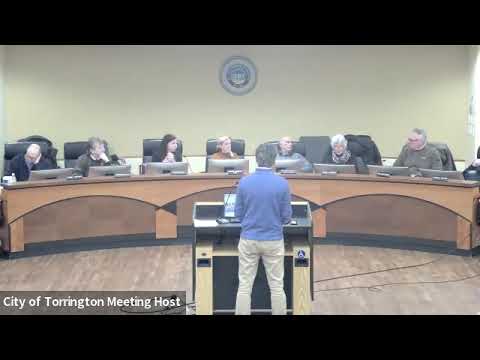
Torrington held a presentation Feb. 18 on a state program that would let the city join a Connecticut Municipal Redevelopment Authority to finance and support housing and downtown infrastructure projects, and the council voted to schedule a public hearing March 3 to begin the local opt‑in process.
The Municipal Redevelopment Authority (MRDA) — which the presenter said was created by the Connecticut General Assembly in 2019 and funded in 2024 — is designed to provide technical assistance and gap financing for housing focused in walkable downtowns and around transit hubs. "We have a $60,000,000 state bond authorization, with a proposal for an additional 30,000,000," David Kors, identified in the presentation as executive director of the MRDA, told the council. He said that funding could be used for gap financing to private developers or for public infrastructure such as streetscape, ground-floor retail, trails or parks that support housing.
Kors emphasized limits on MRDA powers and the local role in any project. "We don't have any authority over municipal zoning. Right? We can't tell you what to do. We are not coming in with dictates. We have no, power to usurp local land use control," he said. He described the initial local step as an opt-in resolution by the municipal legislative body to indicate interest; a later memorandum of understanding (MOU) with the mayor would set the certified boundaries of a development district…
Already have an account? Log in
Subscribe to keep reading
Unlock the rest of this article — and every article on Citizen Portal.
- Unlimited articles
- AI-powered breakdowns of topics, speakers, decisions, and budgets
- Instant alerts when your location has a new meeting
- Follow topics and more locations
- 1,000 AI Insights / month, plus AI Chat