Get Full Government Meeting Transcripts, Videos, & Alerts Forever!
Get email alerts on the Mrda Membership topic
No spam. Unsubscribe anytime.
Torrington council schedules March 3 public hearing on joining Connecticut Municipal Redevelopment Authority
Summary
The Torrington City Council heard a presentation Feb. 18 from the Connecticut Municipal Redevelopment Authority about joining the state-backed program, including a $60 million bond pool for downtown housing and infrastructure. Council voted to schedule a public hearing March 3 to solicit local input on starting the opt-in process.
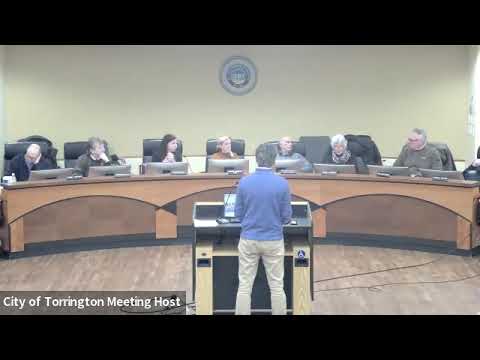
Torrington held a presentation Feb. 18 on a state program that would let the city join a Connecticut Municipal Redevelopment Authority to finance and support housing and downtown infrastructure projects, and the council voted to schedule a public hearing March 3 to begin the local opt‑in process.
The Municipal Redevelopment Authority (MRDA) — which the presenter said was created by the Connecticut General Assembly in 2019 and funded in 2024 — is designed to provide technical assistance and gap financing for housing focused in walkable downtowns and around transit hubs. "We have a $60,000,000 state bond authorization, with a proposal for an additional 30,000,000," David Kors, identified in the presentation as executive director of the MRDA, told the council. He said that funding could be used for gap financing to private developers or for public infrastructure such as streetscape, ground-floor retail, trails or parks that support housing.
Kors emphasized limits on MRDA powers and the local role in any project. "We don't have any authority over municipal zoning. Right? We can't tell you what to do. We are not coming in with dictates. We have no, power to usurp local land use control," he said. He described the initial local step as an opt-in resolution by the municipal legislative body to indicate interest; a later memorandum of understanding (MOU) with the mayor would set the certified boundaries of a development district and mark the point at which projects within that district could apply for MRDA funding.
Why it matters: City officials and developers have cited multiple large, centrally located parcels in Torrington — the Penrose riverfront project area, the former Hotchkiss site on Water Street, the Nidex property and the old Stop & Shop plaza — as locations that could benefit from targeted finance and permitting support. MRDA officials said the program aims to make downtown options more attractive to developers by combining financing, permitting support and other state-level assistance.
Details from the presentation and council discussion: - Eligibility and process: Kors said MRDA will certify whether existing municipal zoning in a proposed downtown district is likely to produce housing; if certified, the city and MRDA would sign an MOU that establishes district boundaries. Within those boundaries, municipalities or developers in compliance with zoning may apply for funding on a project-by-project basis. Kors said the authority expects to operate on a first-come, first-served basis for the bond funds. - Board, governance and funding: Kors described MRDA as an independent quasi‑public authority governed by a 16‑member board that includes cabinet-level commissioners from seven state departments plus gubernatorial and legislative appointees. He said MRDA is currently funded with state operating and capital dollars and that initial capital comes from a $60 million bond authorization; he described the funding as, at present, exclusively state dollars. - Enrollment and timeline: Kors said MRDA had two municipalities enrolled in the last week (Naugatuck and Derby) and that roughly 28 municipalities were actively considering the opt-in resolution. He said the authority has been operational for about six months and is conducting a statewide roadshow to explain membership and the application process. - Developer applications and oversight: Kors said developers can apply directly to MRDA but each project must conform to local zoning and that MRDA plans to coordinate with municipal economic development staff so projects are not surprises to local officials. He said MRDA will tailor financing terms on a case-by-case basis and aims to “fill the gap” after other sources are maximized. - Local commitments and public tools: Council members asked about local matches, tax abatements, and whether MRDA participation would force the city to route all development through the authority. Kors and staff replied that MRDA participation would be voluntary and advisory: any local tax agreements, zoning changes or approvals remain under municipal control. Kors said MRDA could provide templates and advisory support for local tax-fixing agreements but would not be able to override local decisions.
Council action: After the presentation and questions, the council moved to schedule a public hearing. Councilwoman Espino moved to set a public hearing for Monday, March 3 to solicit citizen input regarding municipal compliance with the statutory requirements for opting in; Councilman Iveen seconded. The council took a voice vote and the motion carried; the mayor said the public hearing will be held March 3 so the council can later decide whether to adopt a certified opt-in resolution to begin the MRDA review.
Next steps: If Torrington’s council later adopts an opt-in resolution following the public hearing, MRDA officials said the next step would be a zoning review and, if necessary, recommended zoning tweaks limited to the downtown district, followed by a mayoral MOU to finalize district boundaries. Only after those steps would projects within the certified district be eligible for MRDA funding and technical assistance.
Council members asked MRDA staff about specific financing terms, loan rates and local cost‑sharing; MRDA staff said many details (term, rate, local match) would be tailored to each project and that some infrastructure grants could be structured as grants rather than loans. Kors also said members of MRDA’s staff would help municipalities navigate state permitting and other interagency processes to speed project approvals.
The council’s March 3 public hearing will be the formal local step before the council considers a certified resolution to begin the statutory review and potential MOU with MRDA.