City staff recommend Walla Walla maintain Pine Street planter strips, estimate $10,000 annual cost
Loading...
Summary
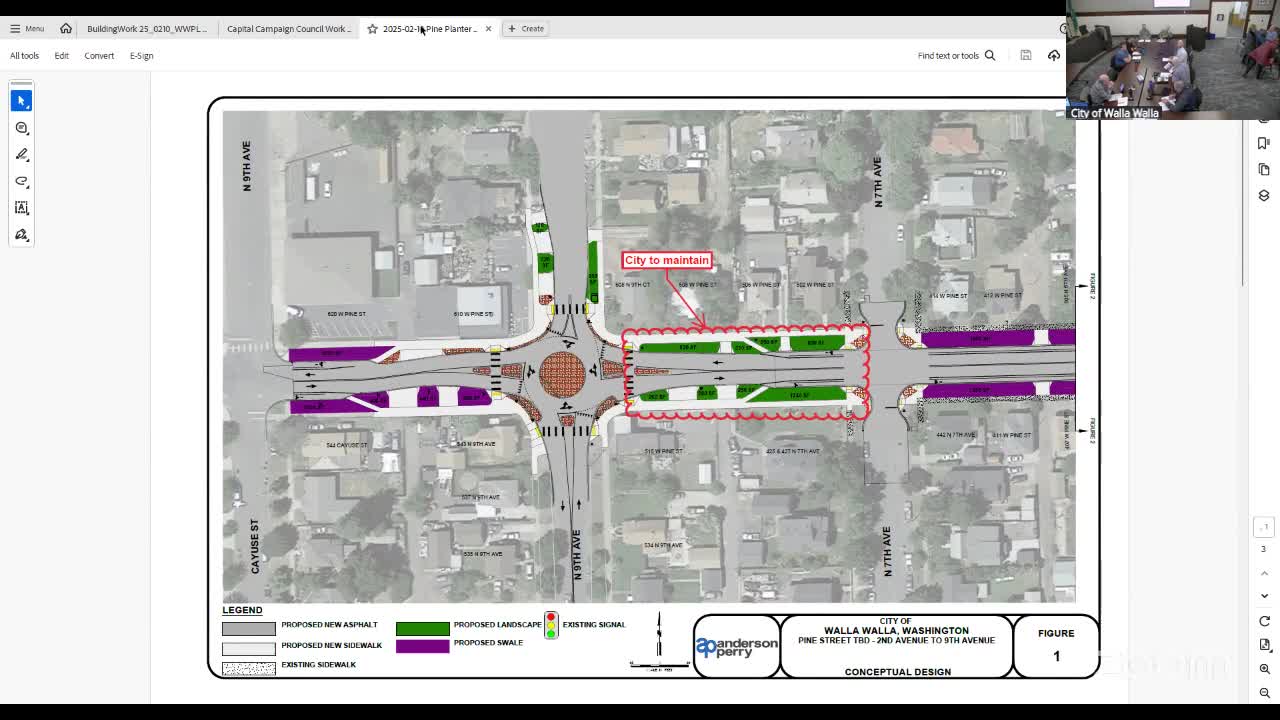
City staff presented a conceptual redesign of Pine Street planter strips at the Feb. 10 work session, proposing irrigated street trees and city maintenance of the non‑swale (green) areas; staff estimated about 50 new trees, roughly 40 adjacent property owners and $10,000 per year to maintain the green strips, and said an ordinance will be brought
Walla Walla — City staff presented conceptual plans for Pine Street planter strips and recommended the city assume maintenance responsibility for certain non‑stormwater planting strips at a Walla Walla City Council work session on Monday, Feb. 10.
Kai (city staff) said the purple areas on the project illustrations are intended as stormwater swales and would be paid for and maintained through the stormwater utility, while the green areas are non‑swale planter strips that staff recommended the city maintain. "The purple areas are intended to be stormwater swales, where they will collect runoff from the roadway, help treat and infiltrate it," Kai said during the presentation.
Staff said the corridor is unusual because Pine Street is a residential roadway that also serves as a minor arterial and gateway into the city. Kai told council that the project team’s initial estimate would add about 50 trees along the corridor and that roughly 40 property owners have frontage along the corridor; staff estimated about $10,000 per year to maintain the green strips (irrigation, mowing, weeding, fertilizing and general upkeep).
Andy, representing Parks, told council that a city‑managed approach would better protect tree canopy and the corridor’s appearance over time. "Long term, to keep it looking good, it should be in city control and management of these areas," Andy said.
Next steps and ordinance: staff said they will return to the council on Feb. 20 with an ordinance that would (as described in the staff report) exempt the clouded planting areas from the usual code placing maintenance responsibility on adjacent property owners and set city maintenance and irrigation for the non‑swale strips, with an exit strategy to transfer maintenance responsibility if property frontage is redeveloped. Kai said staff will seek council direction on the proposal before drafting the ordinance.
Council response: several council members spoke in favor of staff’s recommendation, calling the corridor a gateway and stressing the long‑term benefits of canopy and neighborhood investment. Councilmembers also raised concerns about enforcement (preventing parking or misuse of the planters), whether adjacent property owners were consulted, precedent for other streets, and how maintenance costs would be budgeted; staff said stormwater‑eligible swales would be funded from the stormwater utility and the green‑area maintenance would come from the general fund and parks resources.
Financial and technical details: staff said stormwater swales will be designed for runoff collection and will use plantings appropriate for filtration; parks will perform maintenance for swale areas with a chargeback to the stormwater fund. For the non‑swale green areas, staff estimated a recurring maintenance cost of approximately $10,000 per year for the three pages of green areas shown in the presentation, and said tree pruning would continue to be managed under the city’s urban forestry program.
No formal action was taken at the Feb. 10 work session; staff requested direction to proceed with design and to bring an ordinance and budget implications to the Feb. 20 council meeting.