Get Full Government Meeting Transcripts, Videos, & Alerts Forever!
Get email alerts on the Parking Policy topic
No spam. Unsubscribe anytime.
NDOT outlines expanded on‑street space rental policy to allow valet and temporary loading zones
Summary
Nashville Department of Transportation presented an informational update to expand its 2021 bag‑meter policy to allow paid space rentals for valet and short‑term loading zones, keeping $28/$35 per‑space rates and proposing limits on rental duration and lane‑closure requirements; commission took the item as information and will vote next month.
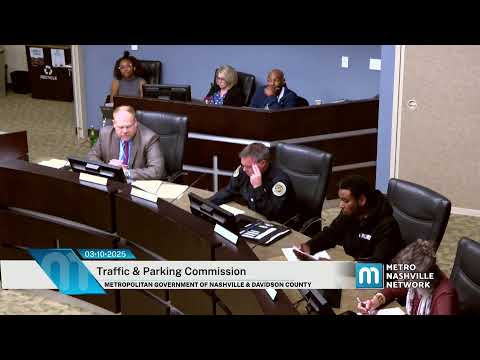
The Nashville Department of Transportation presented an informational update to the Traffic & Parking Commission on a proposed expansion of the city’s on‑street space rental policy that would allow paid reservations for valet operations and short‑term loading zones as an extension of the city’s 2021 bag‑meter policy.
NDOT said the draft policy would keep the previously established per‑space rates introduced in last year’s update — $28 per space in non‑Central Business/CPD areas and $35 per space within CPD — and add three explicit rental options: (1) multi‑hour or multi‑day parking reservations for vehicles or buses; (2) metered‑space valet permits (standard 7‑day cap); and (3) unmetered‑space valet or temporary loading zones (standard up to 30 days) with an option requiring a lane‑closure permit for safety.
The expansion is intended to formalize uses beyond short‑term curb parking and to provide a temporary mechanism for businesses and event operators to reserve curb space without converting the curb to a permanent loading zone. NDOT staff said a standard space is 22 feet long and that the new permit types would be issued only if the requested space is not already reserved.
Commission members pressed staff on operational details. One commissioner said valet rentals should not be easily repeatable as a way to circumvent annual permits; NDOT staff agreed and said they would close potential loopholes so a different applicant could not simply re‑rent the same spaces to achieve continuous occupancy. Commissioners also asked whether the temporary loading‑zone option should include a cooldown or limits on frequency similar to valet; NDOT indicated it could add such a restriction on request.
Members raised enforcement and cost questions. Commissioners asked NDOT to estimate labor and equipment costs (truck rolls for cones, staff time and enforcement) so the department can ensure charges reflect the service cost rather than underpricing short‑term reservations. NDOT acknowledged that staff labor is involved and said it would follow up on how to factor those costs into future pricing or permit fees.
NDOT gave an update on related smart‑parking rollouts: staff said 750 new parking signs are in production and will begin installation downtown first this week or next week, with further rollout to other areas thereafter.
NDOT staff characterized the current presentation as an informational “phase 2” to let commissioners review the options; the department will return next month with a formal approval item. No formal vote was taken on the policy at this meeting.