Get Full Government Meeting Transcripts, Videos, & Alerts Forever!
Get email alerts on the Parks And Open Space topic
No spam. Unsubscribe anytime.
Trust for Public Land outlines park, open‑space and financing options for Norwich
Summary
Representatives of the Trust for Public Land told the Norwich City Council that the nonprofit can help municipalities assemble funding, perform due diligence and support contaminated‑site remediation for parks and open‑space projects, citing examples in Bridgeport, Stonington and Hartford.
At an informational session for the Norwich City Council, representatives of the nonprofit Trust for Public Land described how the group helps cities and towns acquire land, fund park projects and navigate environmental remediation.
The Trust for Public Land representative, Honor Waller, said the organization “acts on that by protecting land and creating parks, ensuring healthy, livable communities for generations to come.” Program manager Kelly Guasti described urban park projects and technical‑assistance programs the organization offers to municipalities.
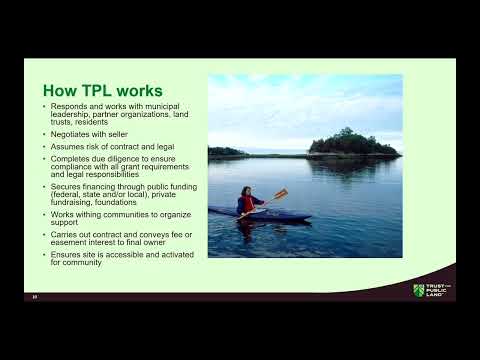
The presentation explained how Trust for Public Land (TPL) typically works as a nonowner intermediary: TPL can negotiate quickly, secure property under contract, perform appraisals and environmental assessments, assemble a funding “stack” of grants and bonds, and then convey land to a partner such as the municipality or a local land trust. “We can negotiate the time that it takes to put those grants together,” Waller said.
Guasti highlighted several Connecticut examples the organization has worked on: a 20‑plus‑mile multiuse waterfront pathway vision in Bridgeport intended to bring roughly 40,000 residents closer to the shoreline; a 4‑acre site known as Sliver By The River that TPL has advanced through participatory design; and a roughly 200‑acre Stonington acquisition where financing combined town open‑space funds (about $250,000), a conservation easement contribution from a private water company and a Fish and Wildlife purchase of roughly half the property at fair market value.
TPL also described trail planning at a recently expanded state park (referred to in the presentation as Mono Ponds State Park), where a master trails plan funded through a state grant will propose about 14 miles of new trail, some optimized for mountain biking and some multiuse.
Council members raised two recurring local concerns: what happens when deals collapse after state grant awards, and how TPL handles contaminated sites. Waller said TPL has “resurrected many deals” but cannot guarantee outcomes when sellers’ value expectations change; she added that TPL’s practice is to put projects under contract when pursuing grants to reduce risk. On contamination, Waller described a Hartford example where TPL used a grant to pay for environmental investigation and then sought follow‑on remediation funding; she said remediation costs can be substantial and postindustrial contamination is a frequent barrier to urban park projects.
The presenters described funding channels TPL commonly uses in Connecticut, including the Open Space and Watershed Land Acquisition Grant Program, bond funds, federal grants, state agency funding and other foundation or agency sources (examples cited included Fish and Wildlife, DECD and DEP). Guasti also described TPL’s involvement in the “10‑minute walk” or Park Equity Accelerator (PEA) program, which offers technical assistance intended to increase park access and equity; the presentation noted more than 300 mayors nationally have committed to the 10‑minute‑walk goal and that Bridgeport and New Haven were part of a small PEA cohort that year.
Council members asked procedural questions about ownership. Guasti said TPL’s business model is generally not to retain ownership: “We really facilitate these transactions, but we don't ever take ownership. We partner with a land trust, whether it's a local land trust or a regional land trust or a municipality or a government agency.” If a municipality sells city‑owned land to be conserved, TPL would treat that as a transaction requiring appraisal and appropriate compensation.
Council members named local sites of interest, including a previously supported effort to preserve about 101 acres in the Occam section of Norwich where a state grant had been awarded but the sale later collapsed; councilors asked whether TPL could assist in reviving such projects. Waller said TPL would review and “take another shot at it” where feasible and urged the council to bring specific files for review.
The presenters offered to work with Norwich officials on park planning, site assessments and funding strategies and provided contact information at the session’s close.