Get Full Government Meeting Transcripts, Videos, & Alerts Forever!
Get email alerts on the Traffic Calming Ada topic
No spam. Unsubscribe anytime.
BPAC asks city to notify ADA coordinator about Sixteenth–Fruitvale crossing; members press for clearer traffic‑calming policy
Summary
The Bicycle & Pedestrian Advisory Committee voted unanimously to forward a citizen complaint about missing curb ramps at Sixteenth and Fruitvale to the city's ADA coordinator and debated the city's traffic‑calming point system and follow‑through on petitions lodged in 2022–23.
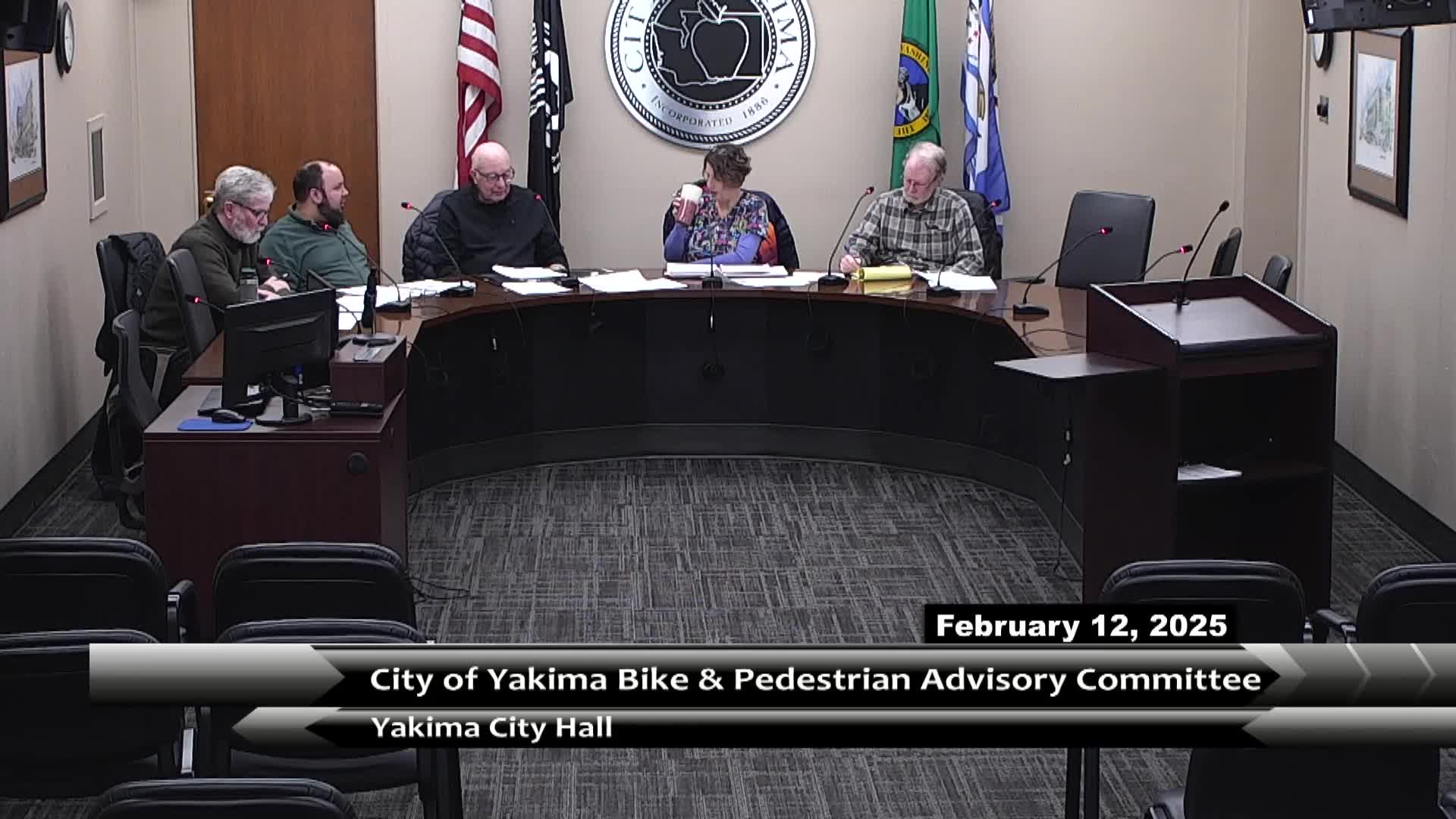
The Yakima Bicycle & Pedestrian Advisory Committee voted unanimously on Feb. 12 to notify the city’s ADA coordinator about a citizen complaint that Sixteenth and Fruitvale lacks curb ramps. The committee moved, seconded and approved a written referral to the city’s ADA compliance officer; the transcript records the vote as unanimous but individual roll‑call votes were not recorded.
During discussion leading to the motion, members described a recent bicycle fatality on Fruitvale and said the intersection’s lack of curb cuts hinders safe passage for pedestrians and cyclists. One member said the committee should forward the complaint as part of its responsibility to flag accessibility issues; the motion maker said, “I make a motion that we communicate with a written email to the ADA [coordinator] that we've had a complaint about this intersection, and we're passing it along as part of our responsibility.” The motion was seconded and approved.
The committee also spent substantial time reviewing the city’s traffic‑calming program and an external point‑based system a committee member prepared to compare against the city’s public map. Committee members reported many petitions listed as “in progress” (from 2022–23) that show little movement and urged staff to clarify the city’s thresholds for passive measures (signage, enforcement) versus physical traffic‑calming devices (speed cushions, chicanes, four‑way stops). Participants noted the city’s policy allows a neighborhood traffic plan and an inventory analysis when thresholds are met, but committee members said the on‑the‑ground outcomes appear to favor enforcement and signage rather than physical devices even when petitions show substantial concern.
Members suggested next steps: share the committee’s point‑system comparison with city staff, ask staff to clarify decision thresholds and funding availability, and monitor material Bill will present to City Council next week. Committee members also discussed whether to recommend a lower technical threshold or an annual target that matches the city’s available traffic‑calming budget, noting the city has sometimes under‑spent its traffic‑calming allocation in recent years.
Why it matters: The motion responds to an accessibility complaint affecting Cyclists and pedestrians at a location committee members described as having no curb ramps. Separately, the traffic‑calming discussion highlights community frustration with petition follow‑through and the need to align policy with available funding and enforcement capacity.