Get Full Government Meeting Transcripts, Videos, & Alerts Forever!
Get email alerts on the Water Infrastructure topic
No spam. Unsubscribe anytime.
Norwich council adopts $5.75 million planning appropriation for lead service-line program
Summary
The Norwich City Council on March 3 adopted an ordinance to increase planning funds for a lead and copper service-line replacement program in the city, approving an appropriation increase from $2,000,000 to $5,750,000 and authorizing revenue bonds secured by water revenue to meet that appropriation.
The Norwich City Council on March 3 adopted an ordinance to increase planning funds for a lead and copper service-line replacement program in the city, approving an appropriation increase from $2,000,000 to $5,750,000 and authorizing revenue bonds secured by water revenue to meet that appropriation.
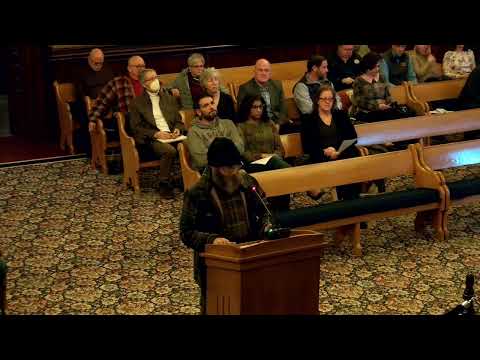
Council members voted 7–0 to adopt the ordinance after a public hearing with few speakers and a presentation from Norwich Public Utilities staff about the scope and legal drivers for the work.
Norwich Public Utilities Assistant General Manager Jeff Breining told the council the requirement came from the U.S. Environmental Protection Agency and then through the Connecticut Department of Public Health, and said the utility has so far found "very little lead here in the community. We found 4, lead pipes on our side and 7 on the customer side." He said the city has spent "about $900,000 worth of analysis so far" and officials are seeking additional planning funds so they can "be sure that there isn't anything that we're missing here in the community."
The ordinance, as presented, authorizes the Department of Public Utilities to enter into grant and loan agreements and a joint resolution with the state of Connecticut related to the program. Breining said approval will allow the city to secure a roughly 70% state grant with a 30% match funded through water rates rather than property taxes.
Larry Sullivan, water and wastewater operations manager for Norwich Public Utilities, described the required fieldwork for the inventory and planning phase. "We have about a thousand unknowns right now," he said, and warned that Department of Public Health rules require excavations and basement investigations before bids can be issued. Sullivan said the city has about "11,500 round number service lines in the community," called inventorying the lines "expensive and absolutely required," and noted the state gives the city 13 years to complete the program.
Sullivan also gave an estimated range for replacement costs: "The average service replacement is roughly $13,000 to $15,000." He added that, from a program perspective, it is "cheaper to investigate than it is to replace." Council members asked whether replacement of the portion of the service line on private property — conventionally a homeowner responsibility — would fall to owners; Breining said homeowners are technically responsible from the curb inward but that the utility "is hopeful" it can secure funding and a program structure to address homeowner costs if the inventory shows enough need.
Council members also heard that the likely loan terms for any Clean Water Fund borrowing would be long-term and low-interest; Sullivan said the loans are "20 years at 2%." Breining reiterated that any loan portion would be repaid through water rates only and would not be a tax burden.
After members asked questions and held discussion, the council took a roll call vote. Aldermen voting in favor were Alderman Nash, Alderman Hayes, Alderman Betancourt, Alderman Gould, Alderman Singh, President Pro Tem DeLucia and Mayor Nystrom. The council president announced the ordinance was adopted, 7–0.
Officials said next steps include completing the additional inventory work required by the state, then, depending on findings, designing replacement work and identifying matching funding for any replacements beyond planning and investigation.