Get Full Government Meeting Transcripts, Videos, & Alerts Forever!
Get email alerts on the Zoning Text Amendments topic
No spam. Unsubscribe anytime.
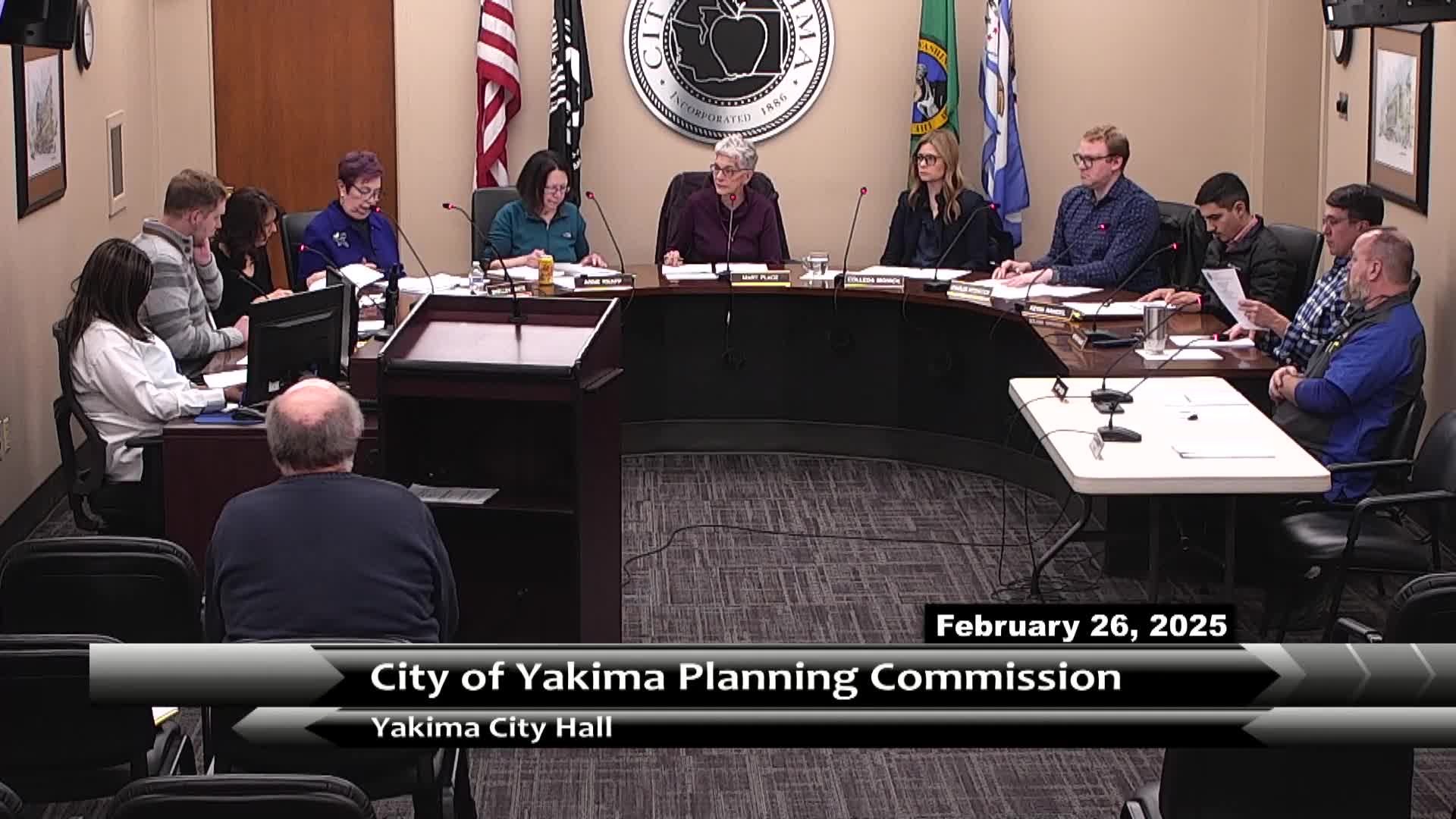
Yakima planning commission forwards broad zoning text amendments to city council after debate
Summary
The Yakima City Planning Commission voted in February to forward a package of zoning and subdivision text amendments to the City Council, approving staff’s draft with edits after debate over public notice, childcare review levels and allowed uses in the regional development zone.
The Yakima City Planning Commission voted on Feb. 12 to forward a package of amendments to Titles 14 and 15 of the municipal code to the Yakima City Council, approving staff’s requested revisions with changes recorded in the minutes by a vote of 8–1.
The package bundles edits to definitions and permitted-use tables, updates to subdivision and short-plat noticing, clarified site-plan requirements, new entries and screening standards for outdoor storage facilities, and changes to review levels for several residential and neighborhood uses. The commission’s action directs planning staff to revise the draft to reflect the changes discussed at the hearing and for staff to prepare findings and a recommendation to council.
Why it matters: The amendments are intended to streamline internal procedures, address inconsistent or obsolete code language, and align local rules with state-level changes commissioners said are pending. Several proposals would shift routine permitting to faster administrative review if state law changes, while other edits—particularly those affecting neighborhood notice and childcare review—were retained or made more restrictive after commission discussion.
Key changes and debate - Definitions and permitted uses: Staff proposed removing obsolete definitions (for example, “desktop publishing”) and consolidating similar commercial uses. The commission debated whether to eliminate “bed and breakfast” as a distinct definition and instead capture the activity as either a short-term rental or hotel/motel; staff said existing operations would be grandfathered but their use type would change. Commissioner comments led staff to keep the bed-and-breakfast category available if the commission prefers.
- Short plats and public notice: Staff recommended reducing notice for short plats to reflect a statewide push to make some short plats administrative. Commissioners and members of the public pushed to retain neighbor notice; the commission voted to keep public notice for short plats in the local code so neighbors will continue to receive notification and the opportunity to comment.
- Outdoor storage screening: The draft added outdoor commercial and residential mini-storage uses and removed the abstract requirement that such facilities be "completely screened." Commissioners asked for precision. The commission suggested and staff agreed to require a minimum 6-foot, view‑obscuring fence or wall for screening (landscaping may be used in addition to a fence), and to include that minimum in the code language.
- Childcare/daycare review level and capacity: The packet reflected pending state changes that could allow more children in family daycares (participants referenced pending legislation that could raise allowed numbers, discussed in the hearing as “up to 16”). Commissioners debated the public-notice tradeoffs and narrow streets/parking impacts. The commission decided to change review level for certain high-capacity residential daycare uses in R-1 and R-2 zones from an administrative (Type 1) to a Type 2 review (public notice and comment) so neighbors are notified and staff can seek mitigation measures during review.
- Tiny-house communities: Because the code ties tiny-house communities to the binding site‑plan process (cited in testimony as “RCW 5817030”), commissioners agreed it is appropriate for tiny-house communities in R-2 to be treated as a Type 2 review so neighbors receive notice.
- Regional Development (RD) zone and automotive/service uses: Multiple public commenters and commissioners raised that large swaths of land near the interstate and Fairgrounds have long functioned as automotive and towing service areas but are now zoned RD (regional development). Business owner testimony described how a past rezone made longstanding repair and towing operations legal-nonconforming. Commissioners agreed to add maintenance and repair, towing, and paint/body repairs to the RD column so those uses can be reviewed (the discussion recorded placing them as higher‑level reviews so they come before the hearings examiner or receive stricter scrutiny). Commission staff said the comp‑plan periodic update will revisit RD mapping and purpose statements.
- Site-plan contents and process: Staff proposed removing an extensive separate “detailed site plan” list from the code and instead keeping a single, consolidated site-plan checklist on file in the planning department and available online; the checklist will carry a revision date and be provided to applicants during pre‑application meetings. Commissioners asked for transparency; staff agreed to include a revision date on the checklist and make it available online and at the planning counter, and suggested council resolution could be used if the city wants to formalize future checklist updates.
Public comment and context Resident and business commenters spoke at length about local impacts. Business owner Bill Horton said the city’s prior rezone had left automotive and towing operations legally nonconforming and urged the commission to allow those services in the RD column so future businesses would not be turned away. Horton and other commenters asked the commission to prioritize economic development and to correct zoning that does not match how areas are used today.
Motion and vote A commissioner moved that staff modify the draft language to include the changes noted in the minutes of the public hearing and that the commission forward findings and a recommendation of approval to Yakima City Council. The motion was seconded. The roll-call vote recorded eight votes in favor, one no; Vice Chair Knapp cast the lone dissent. The commission’s action forwards a recommendation of approval—subject to the edits discussed—to City Council for final consideration.
Next steps The commission’s recommendation will go to Yakima City Council. Staff will produce a revised draft and findings reflecting the changes recorded in the planning‑commission minutes (including the 6‑foot screening language, retention of short‑plat notice, the daycare review‑level edits, and the RD‑zone service‑use adjustments) and transmit those materials to council for its public process. The commission’s schedule items also flagged an upcoming comprehensive-plan update with public workshops and a separate climate/resiliency advisory group.
Votes at a glance - Motion to forward revised Title 14 and 15 text amendments to Yakima City Council with staff revisions and findings: passed, 8–1 (Vice Chair Knapp opposed). The motion text and vote are recorded in the minutes and will be included with the planning commission’s findings when transmitted to council.
Ending: The commission closed the hearing and directed staff to prepare the revised draft and findings for City Council review; the commission also requested clearer, dated site‑plan checklists be posted and that comp‑plan follow‑up work evaluate RD mapping near the interstate and Fairgrounds.