Get Full Government Meeting Transcripts, Videos, & Alerts Forever!
Get email alerts on the Historic Preservation topic
No spam. Unsubscribe anytime.
Speakers urge city to recognize 19th‑century African American leaders; council agrees to display local historian's materials
Summary
A Black History Month presentation documented nineteenth‑century African American businesses, educators and elected officials in Huntsville and asked the council to adopt resolutions and install markers at several historic sites.
Ali Ballard Conley (presented as the speaker on behalf of local historians) gave a detailed Black History Month presentation tracing nineteenth‑century African American contributions to Huntsville, including business owners, civic leaders, educators and early professionals.
Conley recounted named individuals and institutions — including John Robinson (a livery stable owner), Richmond (Richard) Terrell (barber and bathhouse operator), the Freedmen's Bank branch on Jefferson Street, the Russell Institute (established 1865), Samuel Lowery (one of the first African American attorneys in the 19th century) and several early African American elected aldermen and municipal employees. In her remarks she urged the council to pass resolutions and place historical markers at sites such as the Freedmen's Bank and Russell Institute, to install plaques at the fire station, courthouse and city hall, and to consider sidewalk medallions and wall plaques commemorating named individuals.
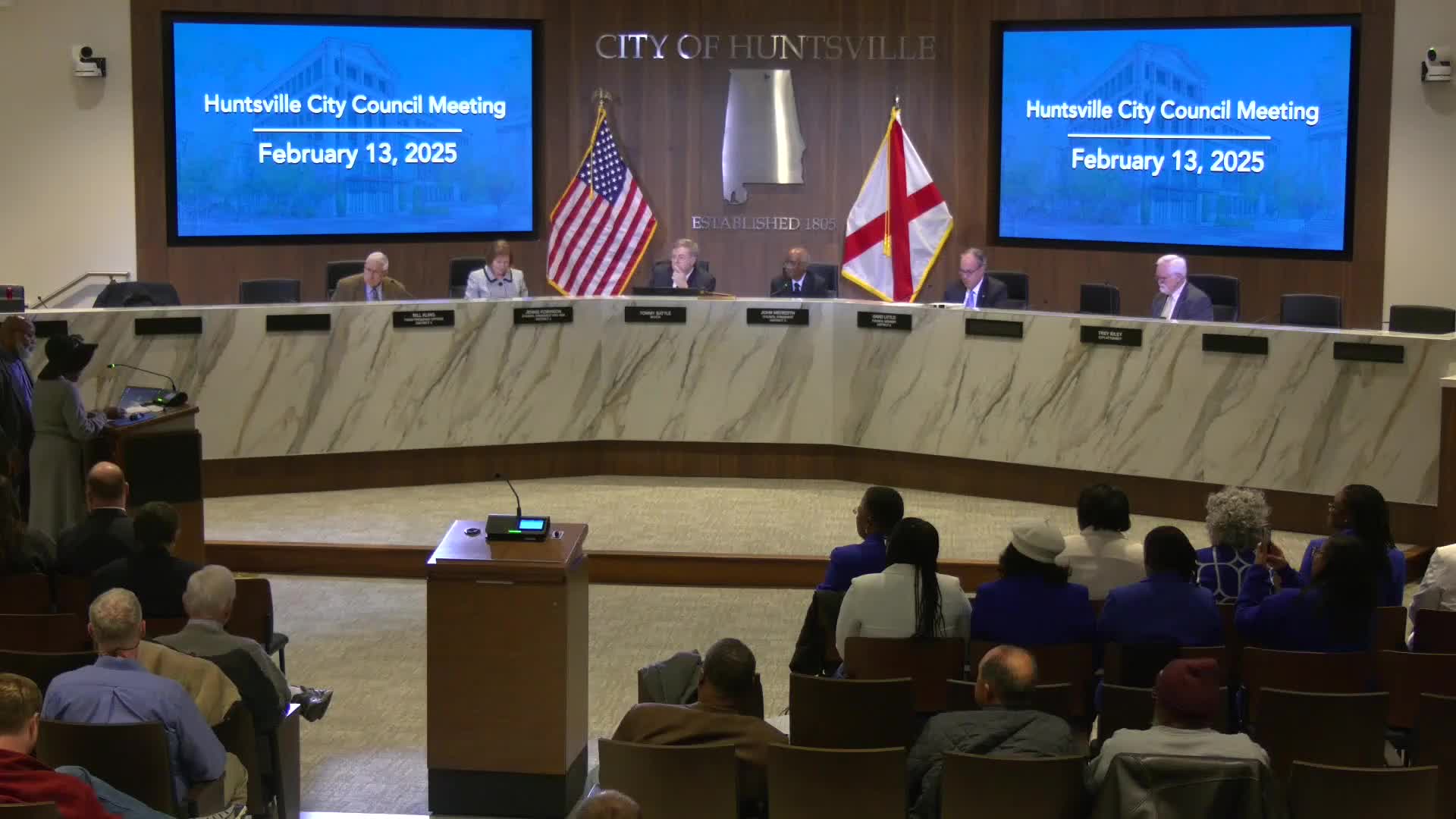
Council response: Councilmember Kling said the presentation only touched "the tip of the iceberg" and asked whether the presenter's display materials could be brought to the council floor so the public could view them. Without objection, the council agreed to arrange for those items to be displayed for a period of time and to promote the exhibit.
Why it matters: the presentation cataloged early Black entrepreneurship, education and municipal service in Huntsville and led to a council direction to make the presenter's research accessible to the public via a temporary exhibit on the council floor; the presenter explicitly requested formal city recognition (resolutions and historical markers) at specific locations.
Ending: Councilmembers thanked the presenter and asked staff to coordinate logistics for displaying the research materials; no formal resolution was introduced at the meeting.