Get Full Government Meeting Transcripts, Videos, & Alerts Forever!
Get email alerts on the Emergency Services Budget topic
No spam. Unsubscribe anytime.
Adjutant General outlines multimission budget: 911 dispatch upgrades, disaster relief access, Guard facilities and staffing requests
Summary
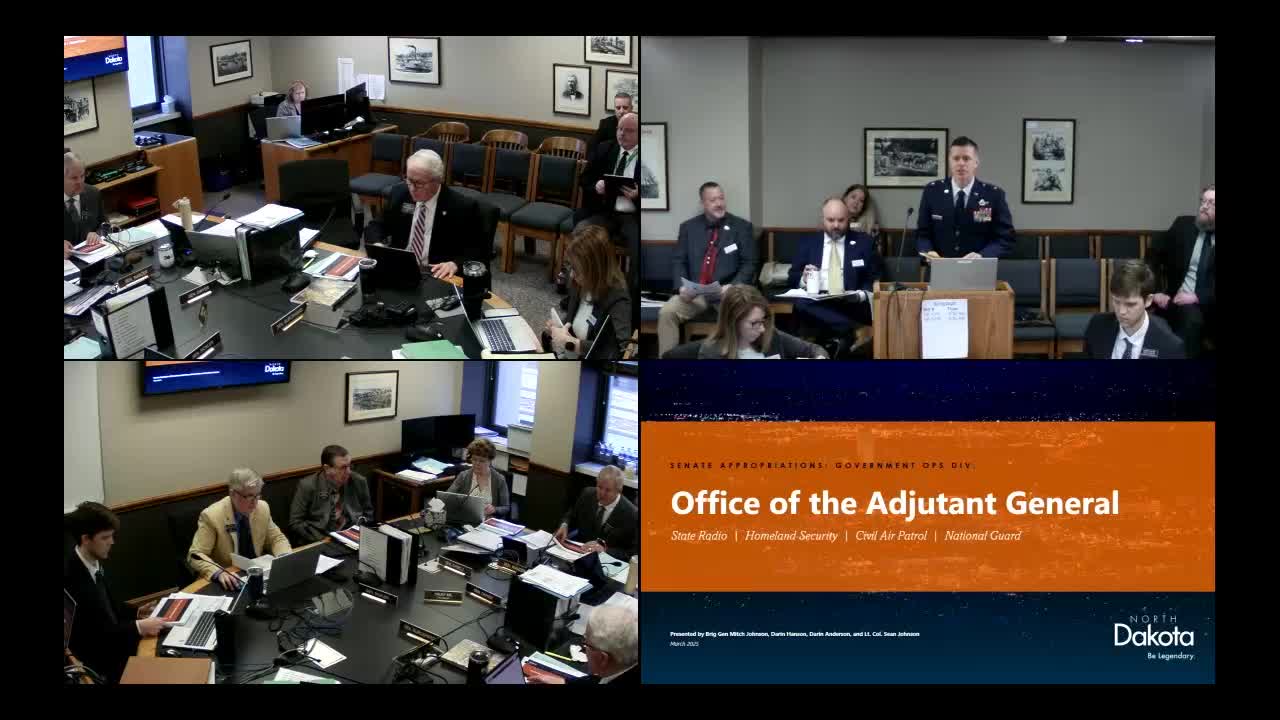
Adjutant General Mitch Johnson and division directors briefed the Senate Appropriations Government Operations Division on House Bill 1016, covering State Radio (911 dispatch), Homeland Security disaster mitigation and response, Civil Air Patrol siren compatibility, and National Guard facility and maintenance funding requests.
Mitch Johnson, Adjutant General and Director of Emergency Services, told the Senate Appropriations Government Operations Division that the department encompasses four distinct components — National Guard, State Radio, Homeland Security and Civil Air Patrol — each with different missions and funding sources and that that structure complicates budget decisions.
“We’re 4 different departments inside 1 department,” Adjutant General Mitch Johnson said in his opening remarks, asking lawmakers to consider federal‑matching rules and varying federal and state funding streams when they review House Bill 1016.
State Radio (soon to be the State Emergency Communications Center) director Darren Anderson testified that the division dispatches 26 counties for 9‑1‑1 and serves as an overflow backup for other centers during major incidents. Anderson asked for one‑time special infrastructure funding to add redundancy to the state law‑enforcement query/ message switch and to update audio‑recording systems used to archive radio and 9‑1‑1 traffic; the request was described in testimony as roughly $525,000 (Anderson also referenced $495,000 later in the same explanation when describing the compatible recorder costs). He said much of the state radio budget is a roughly 50/50 split of general and special funds and that updated equipment is required to remain compatible with the statewide radio replacement project and to meet record‑keeping needs for prosecutions and open‑records requests.
Darren Hansen, Homeland Security Division director, described the division’s emphasis on preparedness, response and mitigation. He said the division distributed nearly $86 million in disaster assistance in 2023 and manages multiple active disaster projects. Hansen’s requests included: access to $2 million in state disaster relief funds (to allow rapid initial response and to replenish stockpiles such as protective gear and sandbagging equipment); authorization to accept certain federal capital‑asset grants (a $660,000 federal authority request) so federal funds can be used for equipment purchases late in the biennium; ongoing general‑fund support of $462,426 for two additional 24/7 watch‑center FTEs (the watch center request was not funded by the House); and authority to accept FEMA’s new mitigation revolving loan (the STORM Act) federal allocation (Hansen testified the package included about $35,500,000 federal and $3,550,000 state match authority, with $16.6 million already awarded but not yet accepted for lack of state authority).
Hansen said mitigation projects produce long‑term savings: “For every dollar that's spent on mitigation we save $6.54 in recovery costs,” he testified, and described mitigation loans and projects targeted at small jurisdictions, including a Marion project to redirect basin flooding and a flood wall project for Bismarck.
Lieutenant Colonel Shawn Johnson, representing the North Dakota Wing of Civil Air Patrol, requested one‑time special‑fund support (about $206,000) for siren/radio upgrades to maintain interoperability with other emergency response agencies and the statewide radio system. He described CAP’s statewide volunteer aviation and imagery capacity for fires, floods and search‑and‑rescue missions.
Johnson and National Guard leaders described the Guard’s long‑standing $20 million general‑fund appropriation (steady for roughly 20 years), federal matching and local economic impact. The Guard sought recurring state match funding for critical infrastructure maintenance (a $1.5 million recurring request) and $4.5 million one‑time to address a backlog of maintenance projects across armories and facilities; they also asked for $790,000 to correct an insurance shortfall exposed by a recent Camp Grafton fire assessment. A federal authority request of $34 million was described for Camp Grafton lodging expansion (federal funds only). The Guard also requested state design funding ($2.5 million) for a Williston Readiness Center site the city has agreed to provide.
Jennifer Sheat, division chief for fiscal and administrative services, briefed the committee on carryover and exemption requests that the House approved, including carryover authorities for large construction projects (Dickinson Readiness Center, Line Of Communication Bridge, Camp Grafton fitness facility), approximately $2.2 million anticipated carryover for state tuition assistance, and carryover for cybersecurity grants and flood‑mitigation grants still in progress. She also said the House included emergency clause language on several items (the $6 million critical infrastructure match request, certain FTEs, Civil Air Patrol siren upgrades and STORM Act authority) in its version of the bill.
Committee members asked clarifying questions about which items the governor and the House had funded. Division directors said most of the State Radio and Homeland Security technical upgrades were funded in the governor’s recommendation and in the House; the Homeland Security watch‑center staffing request was not funded by the House. Several senators and staff discussed possible transfer of the securities budget into the insurance department pending separate legislation (House Bill 2214) and signaled that some appropriations may need to be adjusted depending on final committee action.
Ending: The committee recessed to consider the items and signaled plans for a facility tour; no final appropriations votes were recorded during the hearing.