Get Full Government Meeting Transcripts, Videos, & Alerts Forever!
State Superintendent outlines K–12 'overarching' budget, warns most funding flows to local districts
Summary
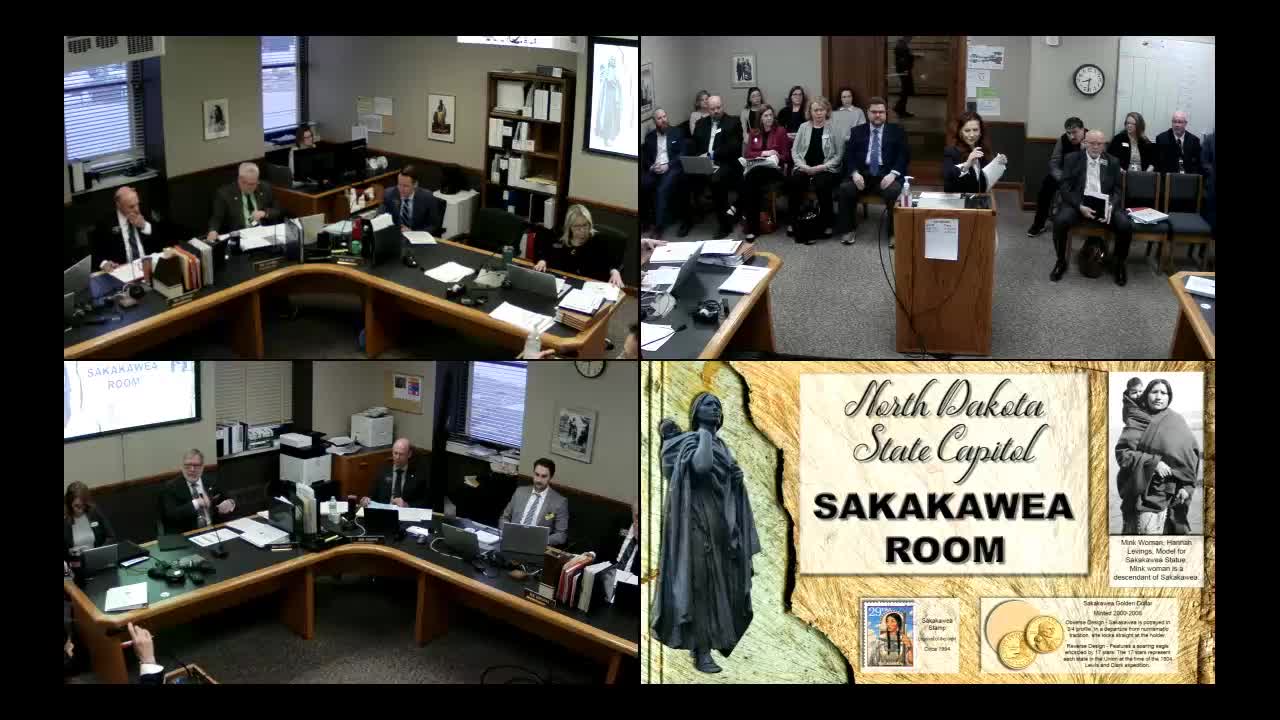
Kirsten Basler, State Superintendent for the North Dakota Department of Public Instruction, told the Senate appropriations subcommittee that House Bill 10‑13 should be considered an overarching K–12 budget in which 98% of the appropriation is delivered to local school districts as per‑pupil foundation aid.
Kirsten Basler, North Dakota’s State Superintendent of Public Instruction, told the Senate Appropriations — Education and Environment Division on March 5 that House Bill 10‑13 should be viewed as the statewide K–12 budget rather than a DPI bill and that 98% of the total appropriation is delivered to local school districts as per‑pupil foundation aid.
Basler said the department prepared a visual “spaghetti chart” to show the many entities that influence K–12 education beyond DPI, and reiterated the constitutional duty that the state must provide a uniform system of free public schools. “The Department of Public Instruction is the only constitutionally created K–12 agency,” Basler said, noting DPI’s oversight responsibilities for the State Library, the School for the Blind, the School for the Deaf and the Center for Distance Education.
Basler and DPI staff told senators the agency has 83 employees (measured as 82.5 filled FTE), and that the department’s operations represent about 2% of the overall K–12 appropriation. DPI’s operating budget is funded roughly 66% by federal funds, 25% general fund and 9% special funds. Jamie Mertz, DPI chief financial officer, said the largest single appropriation by far is the per‑pupil foundation aid, currently shown at about $2.3 billion on the long‑sheet.
Why it matters: committee members repeatedly heard that most policy decisions on classroom staffing and services occur at the district level because the state distributes the bulk of funding to local boards. Basler emphasized the “funding cliff” after ESSER dollars ended in December 2024 and described DPI initiatives aimed at sustaining programs that showed measurable impact.
Major programs and one‑time items discussed
- School food processing: DPI negotiates statewide contracts to process raw food into…
Already have an account? Log in
Subscribe to keep reading
Unlock the rest of this article — and every article on Citizen Portal.
- Unlimited articles
- AI-powered breakdowns of topics, speakers, decisions, and budgets
- Instant alerts when your location has a new meeting
- Follow topics and more locations
- 1,000 AI Insights / month, plus AI Chat