Get Full Government Meeting Transcripts, Videos, & Alerts Forever!
Get email alerts on the Solar Advantage Program topic
No spam. Unsubscribe anytime.
San Diego Community Power opens second solicitation for CPUC-funded Solar Advantage program
Summary
San Diego Community Power outlined eligibility, capacity and timeline for a second RFO under the CPUC Disadvantaged Communities Green Tariff (Solar Advantage) program, including a March 14 opening, Aug. 14 closing, 20.16 MW program allocation and rules allowing projects within 5 miles of eligible disadvantaged communities in SDG&E territory.
San Diego Community Power on a pre-solicitation webinar described the agency’s second request for offers (RFO) under the California Public Utilities Commission’s Disadvantaged Communities Green Tariff (DAC-GT), marketed to customers as the Solar Advantage program, and laid out eligibility, evaluation and schedule details for developers.
The webinar presenters said the RFO will open March 14 and remain open for five months, with proposals due Aug. 14; shortlisted respondents are expected to be notified by Sept. 29 and agreements finalized over the following roughly three months before CPUC approval. Morgan Adam, senior manager of local development at San Diego Community Power, said projects are expected to reach commercial operation no later than Dec. 31, 2028.
Why it matters: The Solar Advantage/DAC-GT program is CPUC-funded and is designed to provide bundled renewable energy and bill discounts to low-income residential customers in designated disadvantaged communities. San Diego Community Power holds the largest megawatt allocation in the state for this program—about 20.16 megawatts—and said it has already procured roughly 4.61 MW, leaving capacity to serve roughly 7,000 additional customers under current assumptions.
Eligibility and project requirements
San Diego Community Power staff summarized the CPUC-mandated eligibility rules: projects must be new, front-of-meter solar generating facilities eligible under the state Renewable Portfolio Standard and must be physically located within San Diego Gas & Electric (SDG&E) territory and within five miles of a California Environmental Protection Agency (CalEPA) CalEnviroScreen-designated disadvantaged community. Project size must fall between 500 kilowatts and 15 megawatts, interconnection must occur under SDG&E’s Wholesale Distribution Access Tariff, and projects must comply with California Air Resources Board voluntary renewable electricity rules and the CPUC program documents.
Storage is now permissible: The revised program structure allows paired battery energy storage; Community Power said it prefers solar-only baseline proposals but will accept and evaluate hybrid proposals that include storage sized to match PV nameplate capacity, with alternative pricing requested for hybrid configurations.
Customer benefits and program scope
Kate Reebel, public outreach coordinator, explained the customer side: the program is intended for residential customers enrolled in the California Alternate Rates for Energy (CARE) or Family Electric Rate Assistance (FERA) programs. According to the presenters, eligible customers will be auto-enrolled when project capacity comes online and will receive the program’s renewable energy product plus an additional 20% discount on the electricity and delivery portion of their bill (stacked on existing CARE or FERA discounts cited during the presentation).
San Diego Community Power reported it has more than 40 eligible CalEnviroScreen census tracts across member jurisdictions, including the cities of San Diego, Chula Vista and National City, and that its service territory now includes several member agencies and unincorporated areas of San Diego County.
Solicitation process, submittal materials and evaluation
Morgan Adam described required offer materials: a completed offer workbook, site plan and single-line diagram, financing plan and assumptions (including tax-credit expectations), evidence of financial standing, organizational charts showing teaming/finance partners, interconnection status and plans, a permitting plan and a project schedule with key milestones (interconnection, permitting, procurement, construction and commercial operation). Bidders were asked to describe interconnection risks and any long-lead procurement items.
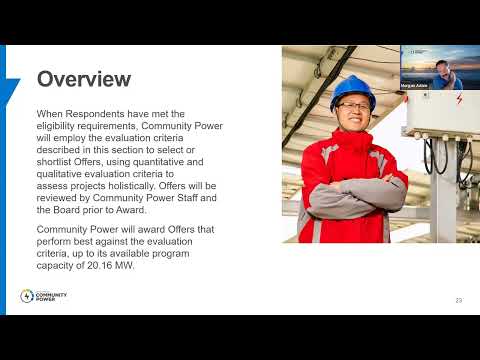
Evaluation will combine binary eligibility checks required by the CPUC with a holistic scoring rubric covering price, developer and project readiness (site control, permitting, financing), community benefits and outreach, workforce development (including prevailing wage and local hiring commitments), and environmental considerations such as siting on previously developed land and mitigation plans. Offers that score highest against these criteria will be awarded up to the remaining program capacity.
Timeline, outreach and next steps
Presenters said Community Power will host a second pre-RFO webinar and that answers to submitted questions will be posted on the program web page; questions for this solicitation will be accepted through April 15 with responses posted by April 28. The agency also asked developers to register on its Solar for Our Communities web page to receive solicitation notifications and materials.
Contacts and materials: Webinar presenters invited attendees to consult the Solar for Our Communities page on the San Diego Community Power website for the solicitation packet, the Q&A log and recording. They also noted a contact center on the website for general inquiries and said slide materials and the recording will be posted after the webinars.
No formal votes or board actions took place during the webinar; the session was informational and aimed at potential bidders and stakeholders.