Get Full Government Meeting Transcripts, Videos, & Alerts Forever!
Get email alerts on the Juvenile Justice Budget topic
No spam. Unsubscribe anytime.
Appropriations committee reviews juvenile services budget, emphasizes community programs and YCC staffing and repairs
Summary
The Appropriations Committee heard an overview of the Division of Juvenile Services’ operations, outcomes and budget requests, including restoration of cut day-treatment funding, one night-security FTE at the Youth Correctional Center and a $6.5 million heating-plant request.
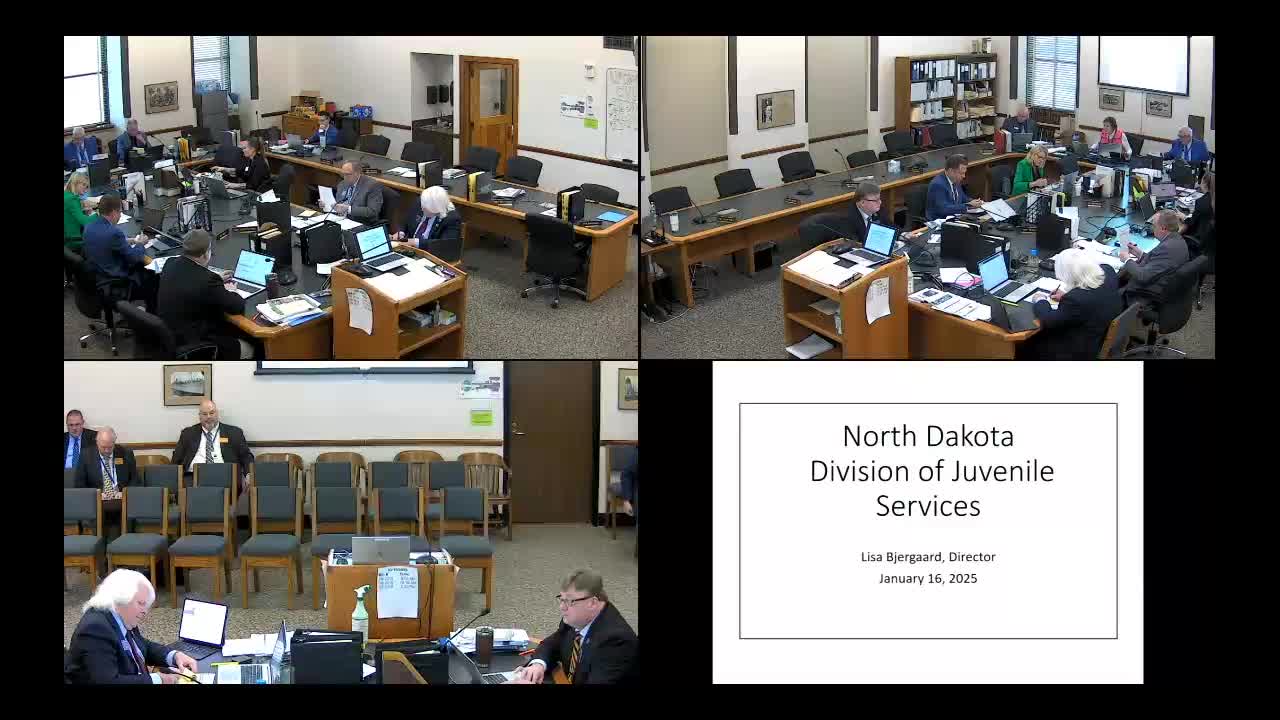
The Appropriations Committee heard a detailed briefing on the Division of Juvenile Services’ operations, outcomes and budget priorities during a budget hearing that covered arrest trends, community treatment programs and infrastructure needs. Lisa Beauregard, director of the Division of Juvenile Services, told the committee the division is focused on keeping youth in family and community settings while using short-term contract placements and secure confinement only when necessary.
Beauregard said juvenile courts processed almost 4,000 youth in 2023: 2,022 were diverted, 448 were handled informally, 579 saw a judge, 342 were placed on probation and “just a little over a hundred” were placed in state custody. “We intake probably about 60 unique youth every every year,” Beauregard said, referring to the number of youth admitted to long-term custody each year. She added that the division also houses about 100 pretrial detainees at times, in addition to those longer-term commitments.
Why it matters: Committee members heard that juvenile arrest rates have fallen from 1990 peaks but that North Dakota’s adolescent population has grown, increasing the number of young people who might need services. Committee members and agency staff framed much of the discussion around sustaining community-based, evidence-backed programs — notably brief strategic family therapy and school-based day-treatment classrooms — that officials say reduce placements away from home and subsequent law-enforcement contact.
Beauregard described outcomes the committee had in hand: during the most recent school year, roughly 250 students participated in day-treatment programs; 91% of those students did not lose their home placement, 80% maintained or improved school attendance and 75% had no further contact with law enforcement. “Brief strategic family therapy views child behavior as a symptom of what has happened or not happened in the family,” Beauregard said, explaining the therapy’s focus on family communication and parental leadership.
Funding and federal partners: The division and Department of Corrections and Rehabilitation (DOCR) staff explained how they rely on a mix of federal and state funding to support community services. Agencies use Title IV‑E reimbursement for certain residential placements, and the Department of Human Services (Child and Family Services) draws down IV‑E for evidence‑based family therapy programs; the division contracts with that unit so it can access federal IV‑E reimbursements on services youth receive in the community. The division also receives federal grants (Title II and Title V) and earlier one‑time state contract dollars that leaders said were essential for short-term contract beds when federally eligible placements were not available.
Capacity, girls and clinical needs: Committee members pressed staff about capacity for girls and youth with severe mental-health needs. Beauregard said girls in secure custody are rare and that girls who need long-term psychiatric residential treatment are generally better placed in psychiatric residential treatment centers; the division has not placed a girl under long-term state custody at the Youth Correctional Center (YCC) recently. Beauregard said many youth who reach the deep end of the juvenile system have serious mental-health needs and that about 85% of youth who come to youth corrections have either an active substance-use disorder or one in their immediate family.
Youth Correctional Center operations and requests: Officials reviewed YCC operations and a small number of staffing requests. The division is asking for one permanent night-security FTE at YCC to replace temporary night-security staff that left. Beauregard told the committee those temporary positions had been used to staff overnight campus checks and to respond to facility needs; with those temps gone, the division seeks a permanent FTE to maintain required staffing ratios. The administration also described ongoing overtime and vacancy pressures at YCC tied to difficult front-line work (assaultive incidents, constant supervision for suicidal risk, high staff skill needs) and turnover that agency leaders say they are actively addressing.
Infrastructure and extraordinary repairs: The committee reviewed a series of repair and capital requests tied to juvenile facilities. Chief Physical Plant Officer Chris Jingle described a near‑term need to replace a failing deaerator tank vessel in the heating plant — a component that removes oxygen from boiler water and prevents corrosion — and said the current unit is at end of life. The division also included a request for a $6.5 million heating-plant building and a larger $9.5 million bucket of extraordinary repairs used across DOCR sites; juvenile services would carry a modest share of those larger repair requests.
Personnel and market equity: DOCR officials described efforts to raise hiring rates and address pay compression for front-line positions after a multi‑year period of recruitment and retention challenges. Travis Singlehart, DOCR chief human resources officer, summarized a target‑market equity package paid in June 2023 and the remaining need: “Most of those targeted market equity dollars went to frontline facility security positions,” Singlehart said. The governor’s recommended equity proposal includes additional funds for hiring-rate increases; DOCR leaders said the need exceeds the current recommendation and that further action may be required in future biennia.
Data, early intervention and next steps: Committee members and agency staff discussed data projects intended to identify at‑risk children earlier (North Dakota’s state longitudinal data system was cited), and representatives asked how schools and local partners can connect youth to family therapy and day-treatment programs before problems escalate. The division noted that many services are available through Title IV‑E portals without court adjudication and that slots and therapist capacity remain limiting factors.
No formal committee votes were recorded in the transcript. Committee members scheduled a site visit to YCC, with DOCR staff arranging logistics; Colby Braun, DOCR director, told members the group would meet at the agency’s west entrance at 8 a.m. for the tour and presentations.
What committee members asked to follow up on: members requested clearer monthly accounting of when contract beds and day‑treatment contracts start and spend state dollars, more detail on overtime and temporary‑staff expenditures, and documentation of the heating‑plant condition and replacement plan.