Get email alerts on the Medicaid Waivers topic
No spam. Unsubscribe anytime.
Panel endorses technical changes to Medicaid waivers to avoid program churn for young adults
Summary
The committee heard and provisionally supported amendments in House Bill 1067 that will disregard certain income sources for children on Medicaid waivers and raise age limits so waiver participants can remain enrolled at ages 19 and 20; fiscal impacts to the biennium were modest and the department asked for the effective date to be July 1, 2026.
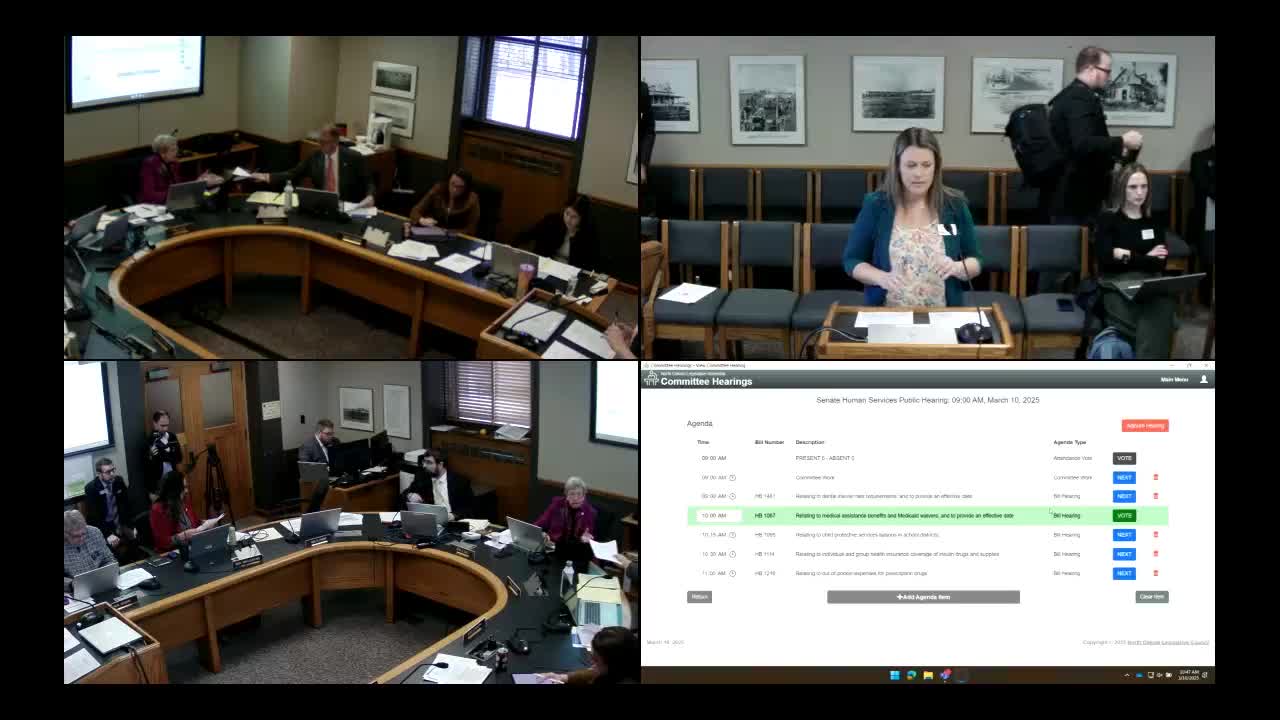
Krista Framing from the Department of Health and Human Services explained House Bill 1067 to the Senate Human Services Committee. The bill’s amended section 1 directs the department to disregard certain income sources when calculating recipient liability for children in Medicaid 1915(c) waivers: Social Security survivor benefits and court-ordered child support would not count as income for these children. The change would take effect July 1, 2026 if enacted.
Framing said the department estimates a $62,000 fiscal impact in the 2025–27 biennium and about $125,000 in 2027–29, and notes the change would be phased in because of the delayed effective date. Section 2 would increase the age limit for participation in the children's autism and medically fragile waivers to age 20, allowing currently enrolled young adults to remain on those waivers at ages 19 and 20 rather than aging out at 18. Staff said there is no fiscal impact for that change because waiver slots are funded and already allocated.
Committee members asked how many children this would affect; DHHS told the committee approximately 10 children currently have the listed income types counted toward their client share. Senators asked clarifying questions about who would pay previously counted client liability if the income is disregarded; the department said the department would assume those costs rather than the families.
Ending: Committee expressed support for the targeted changes and closed the hearing; staff and lawmakers asked for the fiscal note details and implementation timing to be captured in bill language.
AI generated
The text on this page is AI generated. Summaries, highlights, analysis, and video transcripts are all produced from the original source material.
AI can make mistakes, so if you spot one, and we will fix it for everyone.
Note: the source content is unaltered by us. Any content source we link to, be it a video, an audio recording, or a document, is presented exactly as its publisher released it. That publisher is usually a government body, sometimes an individual official or another organisation.