Get Full Government Meeting Transcripts, Videos, & Alerts Forever!
Get email alerts on the Education topic
No spam. Unsubscribe anytime.
Committee advances bill clarifying state library council authority over state‑funded grants
Summary
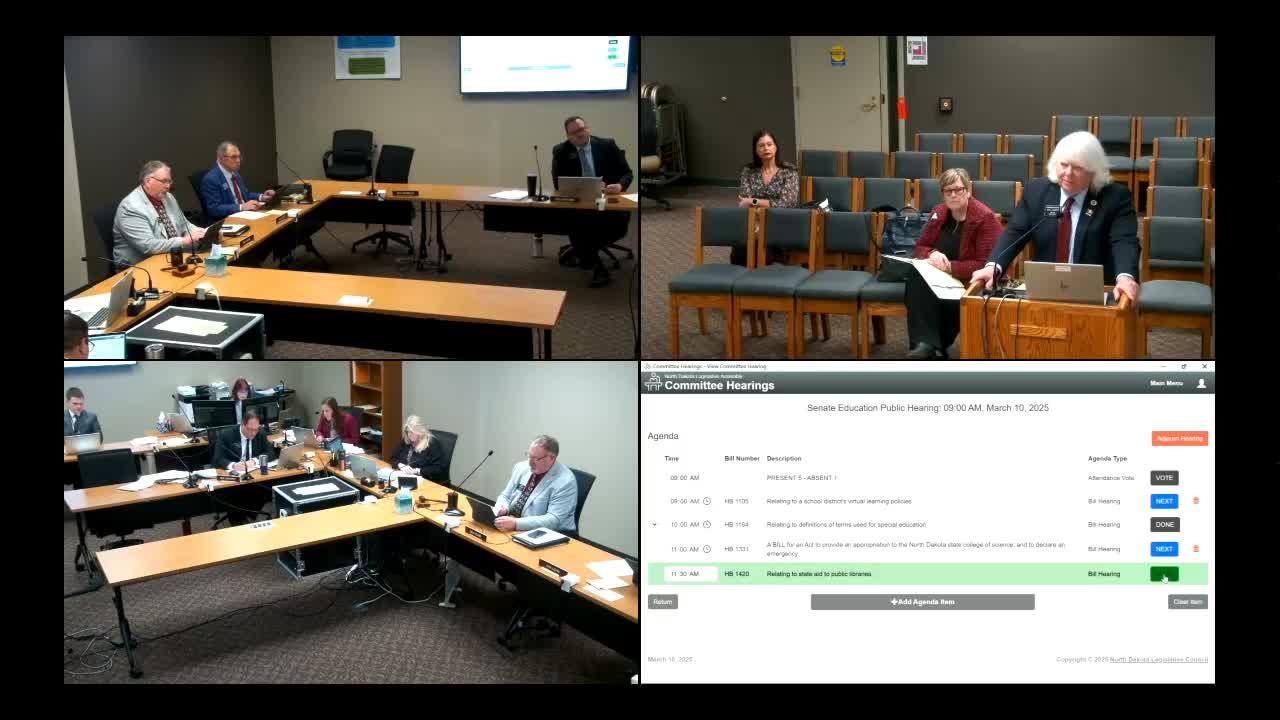
House Bill 1420 would specify that the North Dakota Library Coordinating Council has authority only over state‑funded grants (not federal grants); the committee voted 5–0 to advance the bill after the state librarian described how the change aligns statute with current practice.
Representative Murphy presented House Bill 1420, saying the bill adds language to Century Code to clarify that the North Dakota Library Coordinating Council (NDLCC) has authority specifically over the distribution of state‑funded grants.
Mary Susie, state librarian, described the makeup of the NDLCC and said the state library already administers federal Library Services and Technology Act (LSTA) funds under federal rules and its five‑year plan. Susie told the committee that the proposed language would align state statute with current practice and avoid requiring the coordinating council to meet additional times to administer federal grants — meetings that can be burdensome for small, rural library representatives.
"HB 14 20 clarifies that the Library Coordinating Council approves the awarding of state funded grants," Susie said, adding that federal grant review and awards would continue to be processed by state library staff in accordance with federal program rules.
Senator Baucher moved a due‑pass recommendation and Senator Axman seconded. The committee vote was 5 yeas, 0 nays, 1 not voting; House Bill 1420 passed the committee and the sponsor indicated willingness to carry the bill to the floor.
Testimony on the bill focused on statutory clarity and administrative burden; no opposition testimony was recorded in the hearing.