Get Full Government Meeting Transcripts, Videos, & Alerts Forever!
Get email alerts on the Juvenile Competency topic
No spam. Unsubscribe anytime.
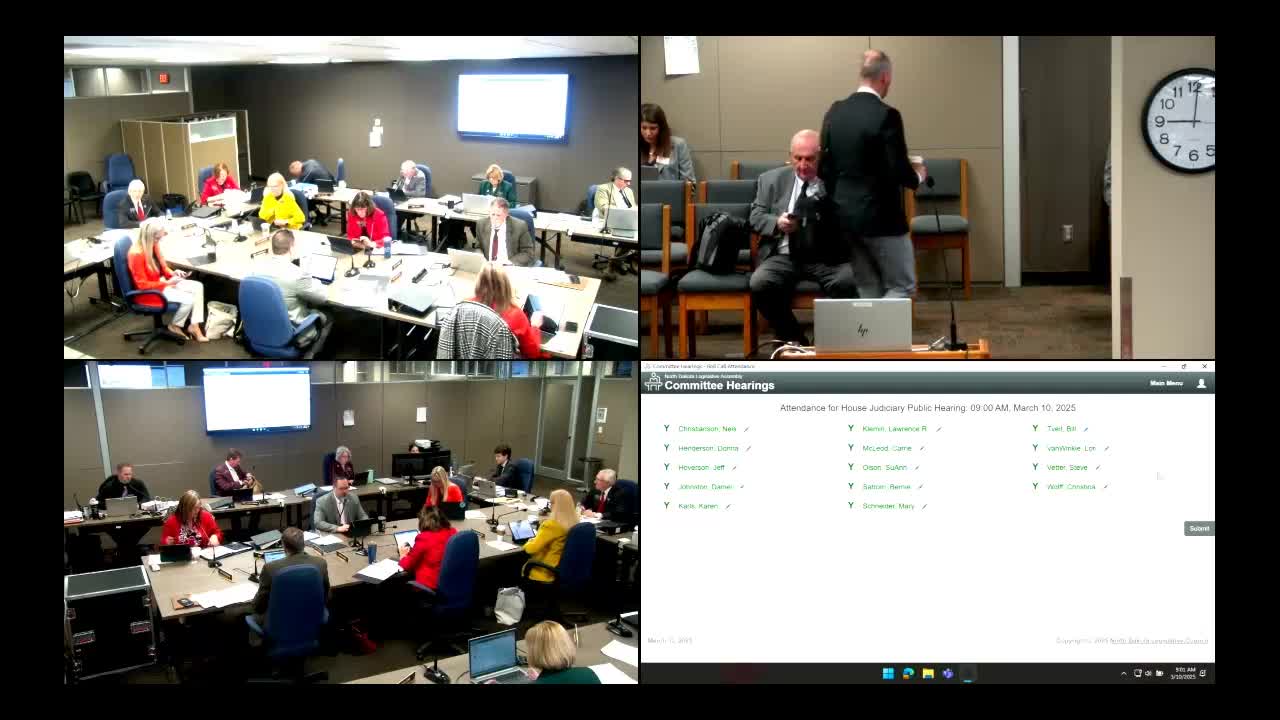
House Judiciary hears bill to create juvenile-specific competency process, $500,000 appropriation and delayed start
Summary
The House Judiciary Committee heard testimony and extensive questions on Senate Bill 2,036, which would move juvenile competency procedures into the juvenile code, set timelines for evaluations and remediation, authorize courts to take judicial notice of prior findings and includes a $500,000 appropriation with a delayed effective date of Jan. 2,
House Judiciary Committee members opened a public hearing on Senate Bill 2,036, a measure that would create a standalone juvenile competency chapter in the North Dakota Century Code, set timelines for fitness evaluations and hearings and authorize remediation paths for juveniles found unfit to proceed.
The bill matters because current practice evaluates juvenile fitness under adult statutory sections and lacks a unified juvenile-specific process, proponents said. The measure would codify due-process protections, define “remediation” for juveniles, and allow courts to take judicial notice of prior fitness determinations. The bill includes a $500,000 appropriation to contract for remediation and evaluation services and carries a delayed effective date of Jan. 2, 2027.
“We do stand in support of Senate Bill 2,036,” said Travis Fink, executive director of the Commission on Legal Counsel for Indigence, who described the bill as the product of an interim competency work group chaired by Judge Nick Thornton and guided by national best practices. Fink said the legislation pulls provisions now scattered across adult and delinquency chapters into a new juvenile chapter (proposed chapter 2720.5xx) and codifies time frames for evaluation, reporting and hearings.
Under the bill as described in committee testimony, a fitness (competency) evaluation must be scheduled within 20 days after the order for evaluation (the Senate amended an earlier 15-day requirement to 20 days), with the court allowed to grant an additional 15 days for good cause. A tier 1A mental health professional (typically a psychologist or psychiatrist) must file its written evaluation within 15 days of conducting the exam. A court hearing on the evaluation must be held within 10 days of the report’s filing. If a juvenile is found unfit, the court may suspend proceedings and order remediation in the least restrictive setting for an initial 60 days; the remediation provider must file a status report 14 days before the order expires. The court may grant a second 60-day remediation term for a 120-day total remediation period; proponents said most remediation, if effective, occurs within that timeframe.
The bill would also allow courts, where appropriate, to “deflect” or take judicial notice of prior fitness findings so a child is not subjected to repetitive full evaluations when earlier findings are on record. Fink and other witnesses emphasized safeguards: statements made during competency examinations generally would remain inadmissible in the case in chief, mirroring current adult provisions.
Derek Steiner, who testified later and advocated for an amendment, said a key policy question is what happens to juveniles who cannot be remediated. Steiner explained the amendment he seeks would add a definition to the CHIPS (child in need of protection or services) chapter so a juvenile found unfit and not remediable could be directed into CHIPS proceedings and receive continuing services through human service zones. He said the change was removed in the Senate and that Health and Human Services has expressed concerns about workload and placement capacity if that population shifts to CHIPS.
Human service directors and the Department of Health and Human Services officials testified that the state does not currently have remediation programs or sufficient placement options for some youth found unfit, and that the $500,000 appropriation is intended to contract for evaluations and remediation services. Dr. Dan Kramer, clinical director for Behavioral Health at the Department of Health and Human Services, said the department lacks staff capacity today to provide statewide juvenile remediation and that the appropriation and delayed start date would allow the department to contract, recruit and train providers.
Committee members pressed on multiple points: whether the bill changes the statutory age of criminal responsibility (it does not), how long evaluations and reports will take under the amended timelines, and whether juvenile dispositions could include retention of jurisdiction to offer services rather than immediate dismissal. Fink and Steiner said the measure does not change the law that a child aged 10 or older may be criminally responsible; it reorganizes and adds juvenile-specific procedures. Fink said the Senate reduced the original appropriation from roughly $4.5 million to $500,000 and pushed the remediation provisions’ effective date to Jan. 2, 2027 to allow planning and contracting.
Witnesses from human service zones cautioned that adding this population to CHIPS would change the zone workload and require placement and service capacity that does not currently exist in parts of the state. They urged careful implementation planning and training. Supporters said the revisions reflect national best practice, more protective due-process timelines for juveniles and a greater emphasis on rehabilitation.
The committee took testimony but did not take a vote during the hearing. The record includes multiple proposed technical edits and at least one policy amendment request to restore language that would expressly allow CHIPS proceedings for some juveniles found unfit. Questions about fiscal scope and service capacity, and how many cases would be affected, remained part of the committee record.
What’s next: committee members will weigh amendments, clarify time-frame language and consider how the delayed effective date and the $500,000 appropriation should be structured to support vendor contracting and statewide availability of remediation services.