Get Full Government Meeting Transcripts, Videos, & Alerts Forever!
Get email alerts on the Dental Insurance Loss Ratio topic
No spam. Unsubscribe anytime.
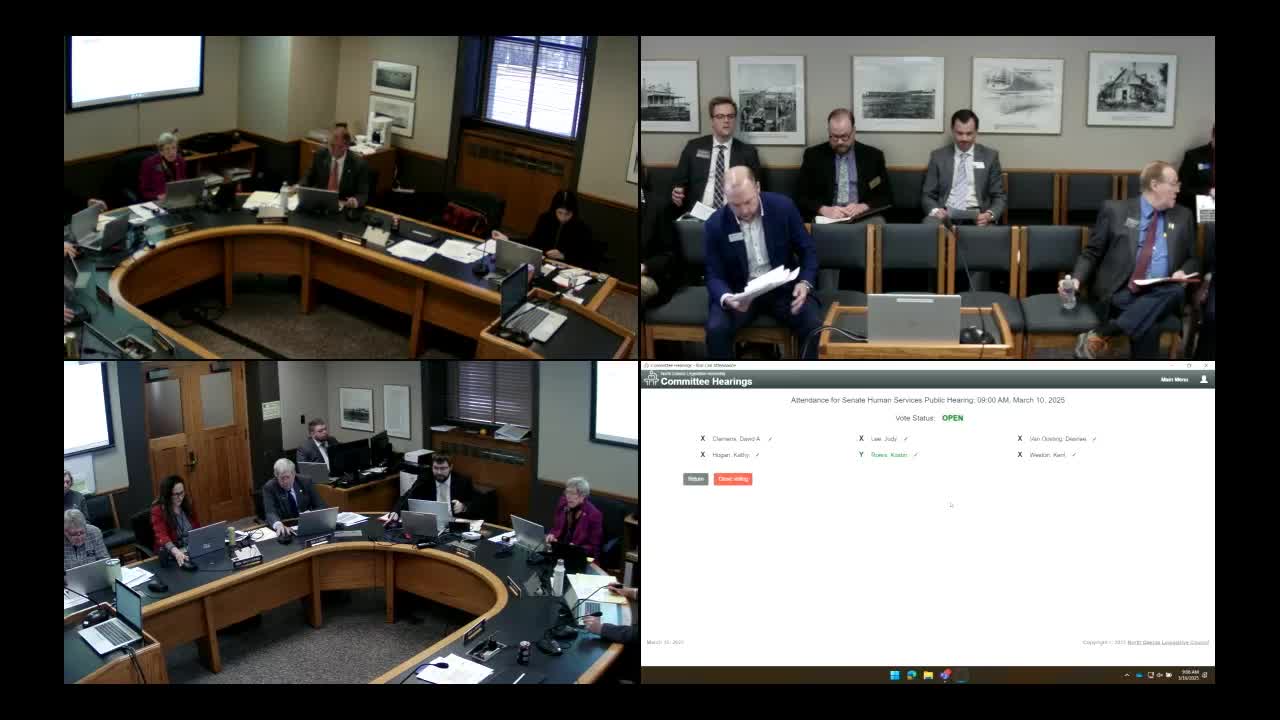
Senate Human Services hears lengthy debate over House Bill 1481 on dental insurance "loss ratios"
Summary
Lawmakers, dental providers and insurers debated House Bill 1481, a proposal to require dental insurers to spend a minimum share of premium revenue on patient care. Dental groups pushed for a 83% threshold and an exemption for very small carriers; insurers warned of market contraction and urged a commissioner-led, market-based reporting approach.
Representative Jim Casper introduced House Bill 1481, which would set a minimum dental loss ratio for dental insurance plans and require rebate or credit when a plan fails to meet the threshold. The bill was the subject of extensive testimony from dentists, dental associations, brokers, insurers and regulators during the Senate Human Services Committee hearing.
The bill’s backers said the measure is intended to increase transparency and guarantee “value” for purchasers of dental coverage. William Sherwin, executive director of the North Dakota Dental Association, told the committee HB 1481 aims to ensure “83 or 75 percent of the patients’ dollars that are going into the premiums have to be spent on them,” and that the proposal includes a phase-in, an exemption for carriers with fewer than 1,000 lives, and an effective date of Jan. 1, 2027 so markets and the Insurance Department can prepare.
Representative Casper, a broker who sponsored the bill in the House, described the problem from brokers’ and patients’ perspectives: insurers do not routinely disclose plan- or group-level loss ratios to brokers or employers, and small-group plans can be skewed by single large claims. Casper said the bill originally sought an 83% loss ratio, the House amended it to 75% and the committee should decide which standard to adopt.
Supporters argued data from state filings show many large carriers are already at or above the levels sought in the bill. Sherwin and dentist witnesses said the change would reduce incentives to deny claims and return unused premium dollars to payers or as credits to buyers. Dr. Bradley King, a longtime dentist, described repeated denials and administrative burdens in dental offices and said guarantees on how premium dollars are spent would benefit employers and patients.
A number of insurers and insurance-industry groups testified in opposition or urged amendments. Ben Wagsland, vice president of government affairs for Delta Dental of Minnesota, and representatives of Blue Cross, ACLI and other national groups warned that a straight product-level mandate at a single percent across all market segments fails to account for differences between large-group, small-group and individual markets and could force carriers to exit the small-group or individual market. ACLI and others pointed to Massachusetts, where a ballot initiative-style loss-ratio mandate was followed by higher premiums and several carriers leaving the market.
Industry witnesses and national trade groups recommended an alternative used in other states: a reporting-based approach (NCOIL/NAIC-style models) that uses multi-year, segment-level aggregate data and allows insurance commissioners to identify and remediate outliers rather than imposing a fixed threshold across every plan. Representatives of the National Association of Dental Plans (NADP) and others said reporting and a commissioner-driven remediation process would provide transparency without the market disruption they fear.
Committee members pressed proponents and opponents on whether the bill applies to individual plans or to aggregated carrier filings. Representative Casper and William Sherwin said the intent is to protect each plan (per-plan basis) but acknowledged the aggregated data shows carriers can meet higher thresholds. Several senators cautioned that applying a fixed threshold to small-group plans could skew results and potentially reduce the availability of coverage for small employers.
The Insurance Department’s representative, Crystal Bartuska, told the committee the department is neutral and asked for more time; she offered to return in committee work to walk through regulatory and implementation questions. Several senators requested additional data and time to consider whether an aggregate approach, a reporting regime, or a product-level threshold would best protect consumers without shrinking the market.
The hearing produced no committee action on HB 1481; sponsors and committee members agreed to continue the conversation and review additional actuarial and state insurance filing data.
Ending: The committee left the bill under consideration after several hours of testimony, with supporters urging a standard to guarantee consumers a set portion of premium dollars be spent on care and opponents arguing for a reporting-and-remediation approach to avoid unintended market consequences.