Get Full Government Meeting Transcripts, Videos, & Alerts Forever!
Get email alerts on the Education topic
No spam. Unsubscribe anytime.
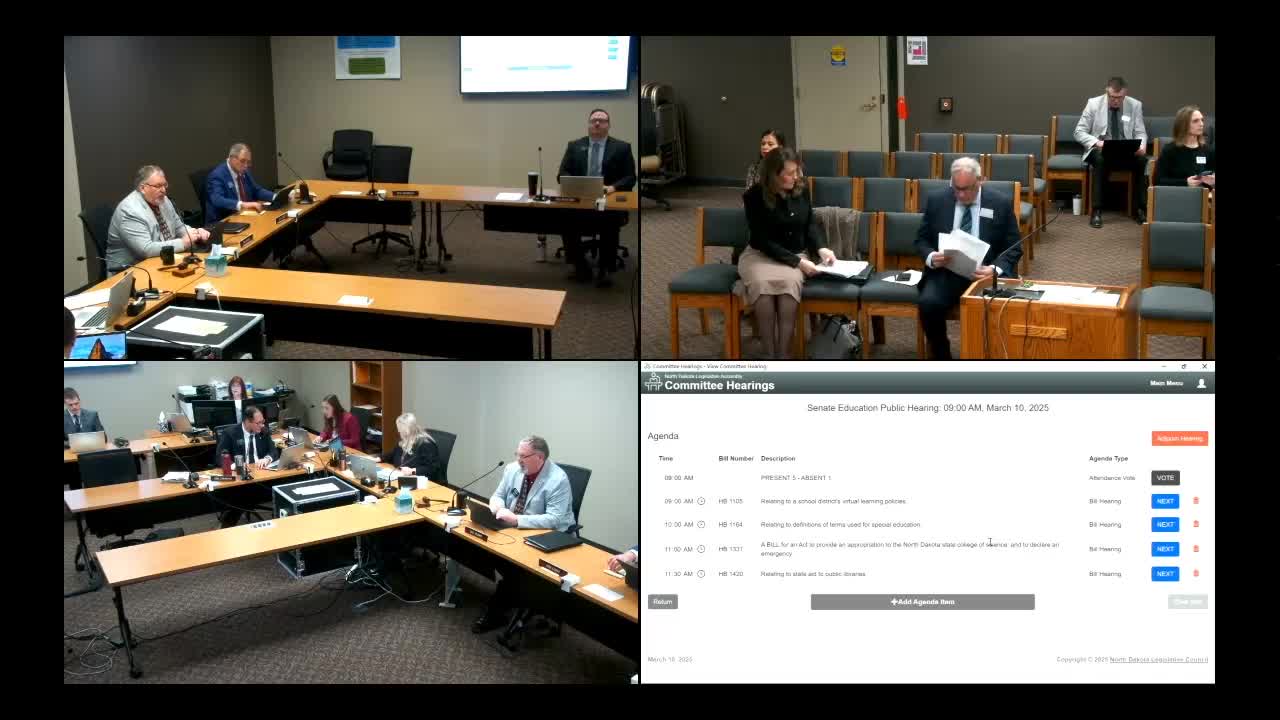
Senate Education Committee hears House Bill 1105 to set guardrails for virtual learning
Summary
Representative Mark Jonas urged the Senate Education Committee to support House Bill 1105, which would let school districts adopt policies and give state rulemaking authority for virtual instruction, after witnesses described rapid enrollment growth at the North Dakota Center for Distance Education and fiscal strain on districts.
Representative Mark Jonas, sponsor of House Bill 1105, opened the Senate Education Committee hearing describing the bill as a response to rapid growth in virtual enrollments and to what he called “unintended consequences” that strained school budgets.
"It ensures students' academic needs are met while maintaining fiscal responsibility," Representative Jonas said, describing the bill as a framework for districts to adopt virtual-instruction policies and for the state superintendent to adopt related rules.
The bill would allow a school district board or governing board of a nonpublic school to adopt a policy that permits students to engage in virtual instruction, require districts to align virtual-course registration with district registration schedules and deadlines, and direct the superintendent of public instruction to adopt implementing rules. Testimony at the hearing detailed how those provisions aim to reduce duplicate district spending when students shift from in-person to online courses mid‑term.
Alyssa Martin, state director of the North Dakota Center for Distance Education (CDE), said the center has expanded rapidly since prior legislation and now serves roughly 30,500 course enrollments representing about 9,100 students. Martin described several practical changes the guidance and bill intend to clarify: course duration and how district semester calendars interact with CDE’s 20‑week course window; who must register and pay for a course; eligibility for retakes and who bears the cost; rules for course withdrawals and transcript notations (for example, WP/WF for withdrawal passing or failing); and requirements to supply IEP and 504 documentation promptly so accommodations can be implemented.
"We are a supplementary education provider," Martin told the committee, adding that CDE students are typically district-enrolled or considered homeschooled. She described steps the center has taken to strengthen academic integrity — competency-based assessments, a dean of students who runs rapid-progression reports to flag unusual pacing, exam password rotation, and AI‑use guidelines — and to work with districts on course-load limits and use of learning coaches as on-site proctors.
School leaders and advocacy groups testified in support. Dr. Jeff Fosnott, superintendent of Bismarck Public Schools, said districts had seen short, accelerated completion times and instances of students leaving in-person classes mid‑term to take online courses — creating both instructional and budgeting challenges. He praised the collaborative process that produced the current bill and guidance documents.
Mike Eilman, executive director of North Dakota Small Organized Schools, and Leslie Bieber, superintendent of Alexander Public School, both said the CDE is an essential provider for small districts and that the bill’s flexibility for locally adopted policies would let districts address scheduling, academic progression and fiscal impacts in ways appropriate to their size.
Committee members asked about specific provisions, including how the bill treats attendance and eligibility (Martin noted that for districts with virtual academies the foundation-aid formula contains a half‑time on-site standard, while districts without virtual academies will need to set their own on-site standards), prerequisites for sequential courses, and how retakes would be funded in special-education situations versus cases where students made no effort. Representative Jonas and Dr. Martin emphasized that the bill and accompanying guidance are intended to preserve access while giving districts clearer local control and fiscal safeguards.
The committee closed the hearing on House Bill 1105 with no vote recorded. Senators asked for follow-up materials: Dr. Martin agreed to provide her slide deck and the guidance documents she referenced. Senator Lem requested additional research on reported summer-school or hour‑requirement questions from a constituent, and committee members signaled they would review the guidance further before any formal action.
The hearing record contains district cost examples given by Jonas and witnesses: West Fargo’s biennial cost for CDE enrollments was cited at about $500,000; Bismarck and Grand Forks were each cited as roughly $100,000 over the biennium. Witnesses attributed those figures to growing enrollments and some virtual‑academy arrangements that shift where foundation aid and per‑course payments are recorded.