Get Full Government Meeting Transcripts, Videos, & Alerts Forever!
Get email alerts on the Victim Services Notifications topic
No spam. Unsubscribe anytime.
Judiciary committee advances bill requiring victim notice for education releases, allows authorized representatives to give parole/pardon notices
Summary
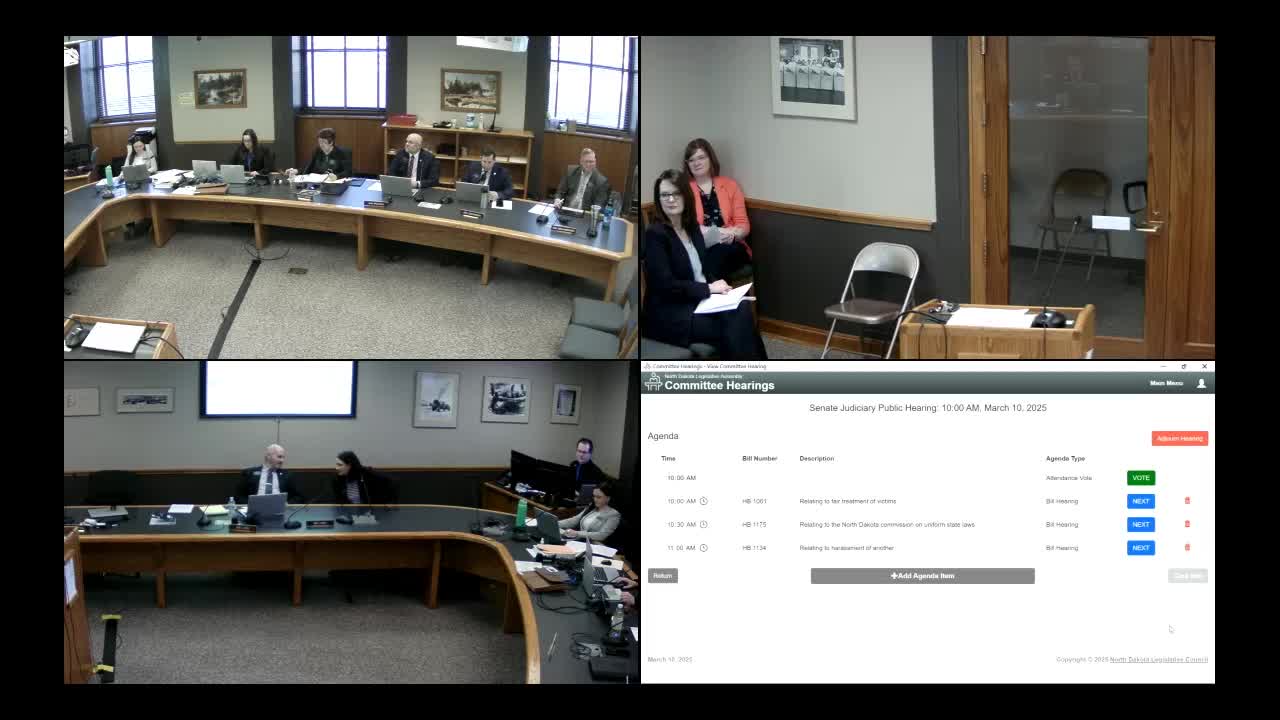
The Senate Judiciary Committee recommended a due pass for House Bill 1061, which adds education-release programs to events that must trigger victim notification through the ND7 system and permits parole or pardon notices to be delivered by an "authorized representative."
The Senate Judiciary Committee recommended a due pass on House Bill 1061 after hearing that the bill would add education-release programs to the list of offender releases that must trigger victim notifications and would allow certain parole- or pardon-related notices to be provided by an "authorized representative."
Committee members heard support testimony from Claire Ness, chief deputy attorney general, who said HB 1061 clarifies how the North Dakota Statewide Victim Information and Notification System (ND7) is used and would help custodial authorities meet their notification duties under state law and the state constitutional victims' rights provision known informally as Marcy's law.
ND7 provides automated notifications to registered victims about offender custody, probation, commitment and court events via text, email or automated phone calls, Ness told the committee. "ND7 provides crime victims with automated notifications regarding offender incarceration, probation, commitment, and criminal court case status and events," Ness said. She described ND7 as a tool to help corrections, courts and victim-service providers meet notification requirements while preserving staff time for casework and safety planning.
Heidi Smith, director of the Attorney General's ITCIS division, answered technical questions about the system and said registered victims can opt out of notifications. Smith also described internal monitoring and troubleshooting functions ND7 provides so custodial authorities can confirm whether a notice was sent and correct technical failures.
Under the engrossed bill, section 1 would add education-release programs to the releases that require prompt notification; section 2 would permit the parole board or pardon clerk to designate an "authorized representative" (for example, ND7 administrators) to provide notice to registered victims. Ness described the change as largely clarifying or housekeeping language that reflects how ND7 has been used in practice.
Senators voted to give HB 1061 a due-pass recommendation. Senator LeWitt moved the due-pass motion; Senator Lueck seconded. Roll-call responses recorded affirmative votes from Senator Luke, Senator Paulson, Senator Brownberger, Senator Castaneda, Senator Cory and Chair Larson. The chair announced, "Yes. Motion carries." The committee received a handout explaining the bill.
The measure cleared the Judiciary Committee for further consideration on the Senate floor; committee members asked staff to be available for technical follow-ups about system functioning.
Ending — The bill’s changes are limited: adding education-release programs as a trigger for victim notification and allowing parole- or pardon-related notices to be delivered by an authorized representative. The committee recorded a due-pass recommendation and sent the bill forward with a committee handout explaining technical details.