Get Full Government Meeting Transcripts, Videos, & Alerts Forever!
Get email alerts on the Pretrial Monitoring Fees topic
No spam. Unsubscribe anytime.
Judiciary Committee recommends do-not-pass on amendment banning fee waivers for 24/7 monitoring program; due process and indigency cited
Summary
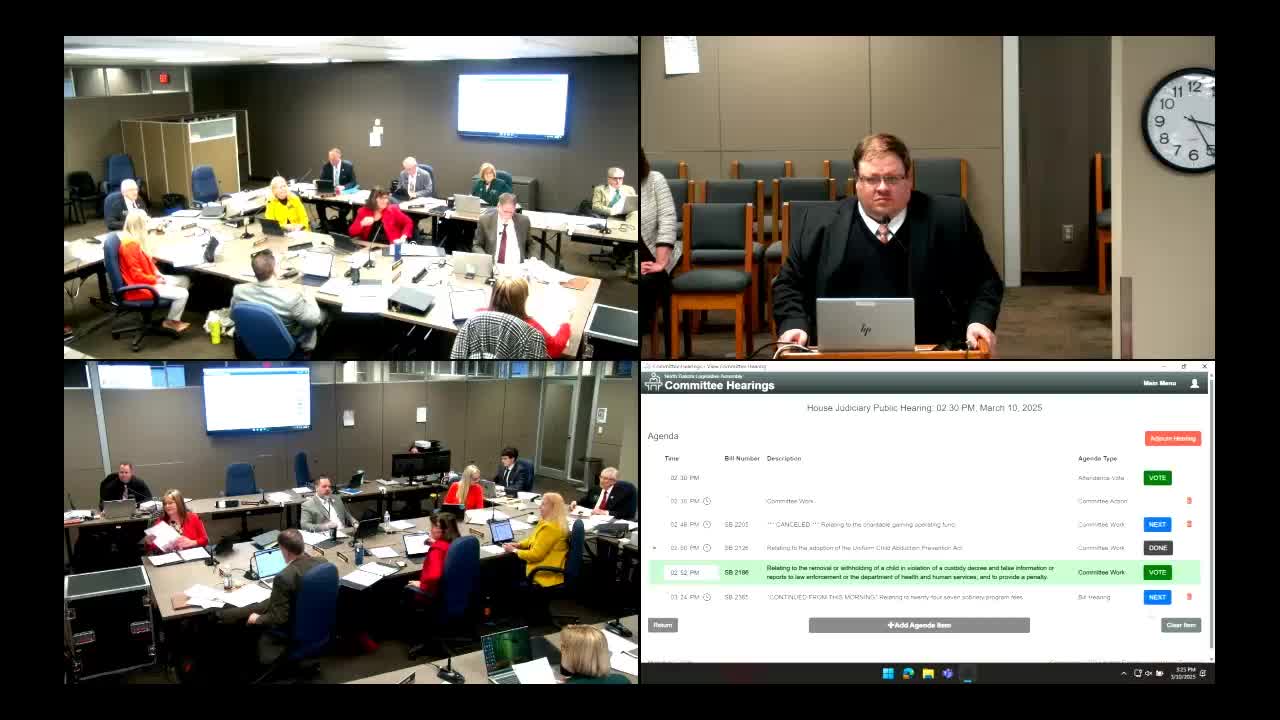
After testimony from the Commission on Legal Counsel for Indigence, the Judiciary Committee voted 7–4, with three absent, to recommend a do-not-pass on Senate Bill 2365 as amended in the Senate because removing fee waivers for the 24/7 monitoring program raised due process and equal-protection concerns.
The Judiciary Committee voted to recommend a do-not-pass on Senate Bill 2365 after hearing testimony that a Senate amendment would bar waiving fees for the statewide 24/7 monitoring program. Representative Satrim moved the do-not-pass recommendation, seconded by Representative Twite; the roll call vote was 7–4 with three members absent.
Travis Fink, executive director of the Commission on Legal Counsel for Indigence, told the committee that the amended Senate language removing the ability to waive program fees could create constitutional problems on due-process and equal-protection grounds. “If you remove that ability to pay those fees, you're moving from a valid government function that's part of the release...that shifts in my opinion and in the opinion of the commission, that shifts the balance and puts it closer to a due process problem,” Fink said. He explained that on pretrial release a defendant who cannot afford testing fees may be forced to stay in custody while wealthier defendants who can pay obtain release.
Fink described the 24/7 program as a public-safety measure whose rules, promulgated by the Attorney General, currently allow fee waivers on a pretrial basis. He said the change the Senate made—prohibiting any fee waiver—could effectively punish indigent defendants before adjudication and risk unequal treatment. He and other speakers urged the committee to preserve fee-waiver authority or provide an appropriation to reimburse sheriffs for waived fees.
Committee members raised practical details discussed in testimony: reported refunds to participants of $4,398 in one county; unit costs for monitoring such as $2 per test for courthouse testing and about $60 per drug patch every two weeks for SCRAM or patch monitoring; and county jail per‑diems (the Southwest Multicounty Correctional Center rate cited at $150 per day) used to compare the cost of keeping people in custody versus waiving fees. Witnesses and members also referenced related case law, including the U.S. Supreme Court decision Bell v. Wolfish on pretrial punishment and a Montana appellate decision, State v. Spady.
Some members proposed alternatives. Representative Culverston offered to prepare an amendment adding an appropriation; he suggested $99,000 as a placeholder figure for discussion. Others suggested removing the Senate amendment language and leaving current law in place, which committee members said already provides a process for judges to consider waivers. Committee debate also noted inconsistent practice among counties: testimony indicated Stark County uses waivers when appropriate, while Cass County practices vary by judge and case.
After discussion, the committee voted to recommend do not pass on SB2365. Representative White was named as bill carrier for the committee’s action.