Get Full Government Meeting Transcripts, Videos, & Alerts Forever!
Get email alerts on the Appropriations Human Resources Division topic
No spam. Unsubscribe anytime.
HHS officials defend FTE block grant, outline $15 million request to retire legacy IT systems
Summary
Department of Health and Human Services leaders told the Senate Appropriations — Human Resources Division that an FTE block grant gives staffing flexibility, outlined vacancy and turnover figures (snapshot Dec. 1, 2024), and detailed a $15 million request to retire unsupported legacy technology across programs.
BISMARCK — Department of Health and Human Services deputy commissioner Sarah Stoltz told the Senate Appropriations — Human Resources Division on a budget hearing that the department’s FTE block grant has given program managers “flexibility” to respond to changing staffing needs and that the department is seeking funds to retire aging IT systems.
Stoltz, who identified herself as deputy commissioner for Health and Human Services, told the committee the department used the block grant to convert temporary employees to permanent positions, repurpose long-term vacancies into higher-need roles and to adjust staffing mixes in rural areas where full‑time applicants are scarce. “We were able to fill it with 2 part-time temp positions and repurpose that FTE for an area of greater need,” Stoltz said, describing one example of how the block grant was used.
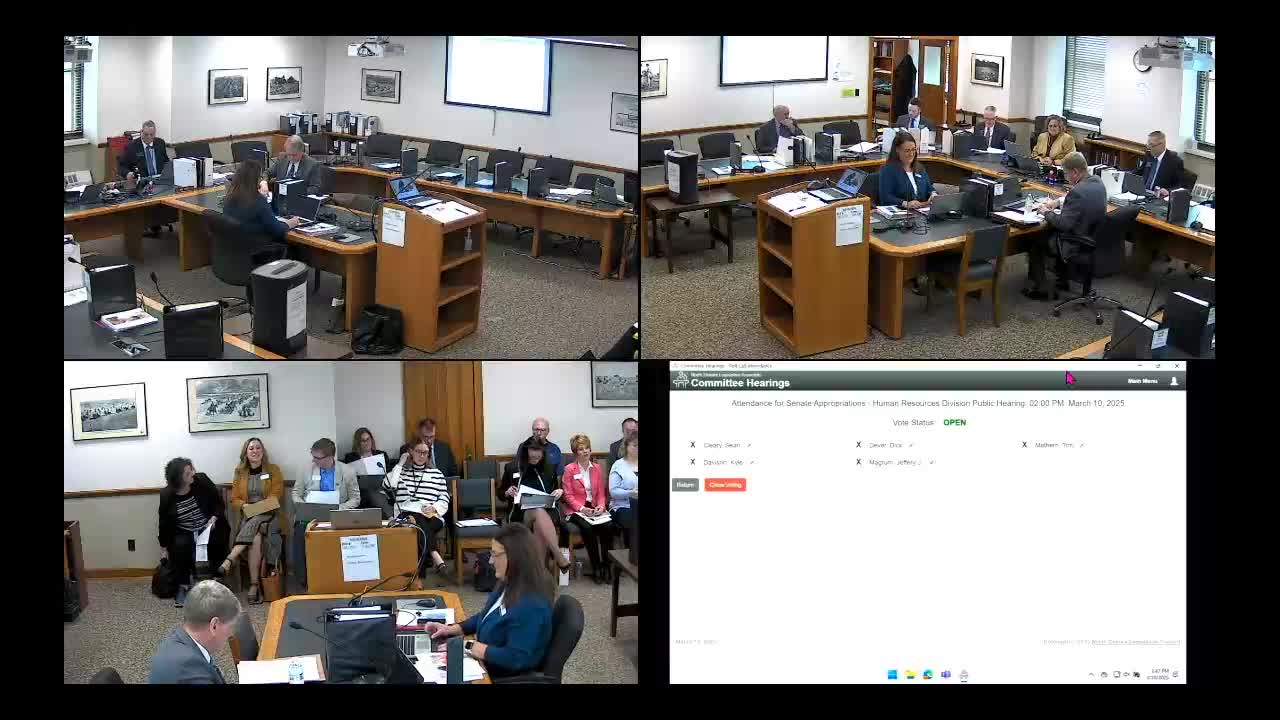
The discussion came during a hearing on House Bill 1012, the appropriations measure for the Department of Health and Human Services. Stoltz and Chief Financial Officer Donna Auckland provided program and accounting detail, and both repeatedly referenced vacancy and payroll figures taken “as of Dec. 1, 2024” as the basis for reconciliations and the department’s salary roll‑up.
Why it matters
Committee members pressed for specifics because salary and position authority affect how the department can deliver direct services across the state, and because the House reduced parts of the administration’s salary request. Committee chair Chairman Deaver said the committee must balance constituent priorities with the risk of endangering earlier House votes if large additions are made to the bill.
Key details from testimony
- FTE block grant and staffing: Stoltz said the block grant lets the department manage its salary dollars while allowing flexibility in how positions are filled. She described a four-category internal approval process for staffing changes (convert temps to FTE, backfill like‑for‑like vacancies, short‑term temps, and requests for brand‑new FTEs), and said an internal FTE committee — consisting of the commissioner or designee, the deputy commissioner, the chief HR officer and the CFO — reviews requests every other week.
- Vacancy and turnover snapshot: Stoltz said the department had 374.63 vacant position numbers as of Dec. 1, 2024, and described the multi‑phase hiring pipeline (posted, interviewing, offers pending, filled but not yet started). She reported turnover rates for 2024 by program area: public health about 6%, behavioral health about 14%, Medicaid about 6.75%, human services about 6.37% and business operations about 12.5%.
- Contracts and operations scale: Stoltz and Auckland said HHS manages a complex finance operation that includes more than 4,000 contracts and roughly 400 separate funds. The department operates a network of 43 locations beyond its central office, and its finance team manages more than 4,000 provider, vendor and grantee contracts, Stoltz said.
- Legacy IT systems and decision package: The department requested funding to “retire legacy systems.” Stoltz said there are 29 unsupported technology systems the agency continues to pay to maintain and that the governor’s budget and the House support a $15,000,000 request to retire those systems. Donna Auckland told the committee the one‑time funding is broken out in program areas on the department long sheets: $10,000,000 in business operations to retire the mainframe; $2,000,000 for economic assistance legacy systems; $2,000,000 for medical/Medicaid systems; and $1,000,000 for behavioral health legacy systems.
- Salary roll‑up and underfunding noted by the House: Stoltz said the department’s 2023‑25 biennium salary appropriation was $551,714,842 (as presented by the department) and that the House reduced parts of the administration’s compensation request. She told senators the House reduced the governor’s recommended salary package in ways the department terms an “underfund” and that Donna Auckland would explain the department’s reconciliation of those reductions on the long sheets provided to the committee. Auckland presented a spreadsheet showing an internal base, projected expenditures through December 2024, and projected salary spend for the biennium; she told the committee the department projects salary expenditures through the biennium and that projected travel and contract costs for temporary clinical staff are roughly $11.7 million.
Requests for follow up and scheduling
Committee members asked for additional detail the department said it would provide: an itemized explanation for how the retirement amounts for legacy systems were estimated by program; an updated vacancy reconciliation run as of March 5; and a county‑by‑county list of where public computers are available in human service zone offices. Donna Auckland offered to return the next morning to complete the long‑sheet walkthrough and the committee agreed to reschedule remaining witnesses (Division for Developmental Disabilities and Refugee Services) for the following week.
Quotes and attributions
- “We were able to fill it with 2 part time temp positions and repurpose that FTE for an area of greater need,” Sarah Stoltz, deputy commissioner for Health and Human Services.
- “If you go to business operations — dash 100 — you’ll see one‑time funding of $10,000,000 to retire mainframe,” Donna Auckland, chief financial officer, said when describing where the long sheet places the one‑time retirement costs.
- “Every human service zone does have a computer that’s available for someone who walks into their office and wants to use it to apply for benefits,” Stoltz said in response to a senator’s question about public access to technology in county offices.
Ending
The committee closed the hearing after committee members and department officials agreed to return for a follow‑up session to finish the long‑sheet review and to provide the requested supporting documentation. No formal votes on House Bill 1012 were taken at the hearing.