Get Full Government Meeting Transcripts, Videos, & Alerts Forever!
Get email alerts on the Correctional Industries topic
No spam. Unsubscribe anytime.
Roughrider Industries pitches workforce gains and requests equipment funds; paint line replacement singled out as urgent
Summary
Roughrider Industries presented a video and testimony describing vocational training for incarcerated residents, recidivism outcomes, high demand for production, and capital needs including a long‑delayed paint/coatings line replacement and license‑plate production upgrades.
Roughrider Industries, the correctional industries program within the Department of Corrections and Rehabilitation, presented the committee with program highlights and several capital and operating pressures that staff said will affect production and reentry outcomes.
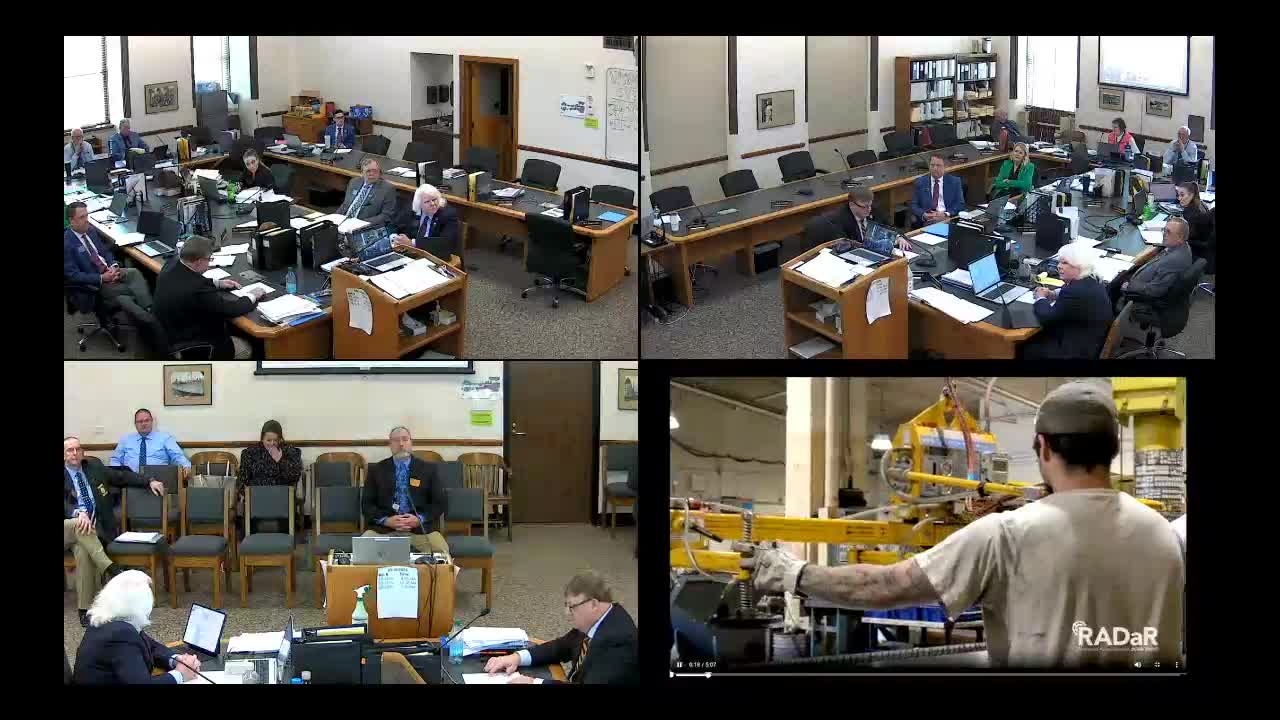
A video shown to the committee described Roughrider’s mission of preparing incarcerated residents for reentry through education, job skill training and certified work experience. The video narrator said, “92 percent of residents who have been enrolled in the Roughrider Industries program for at least 6 months during their incarceration successfully reintegrate back into our communities,” language presented to the committee as program performance.
Rick Gardner, chief administrator for correctional industries, told the committee the shops now run a broad set of businesses — furniture fabrication, metal fabrication, license plates, signs, sewing, upholstery, commissary and sandbag operations — and operate a separate weld facility at MRCC. Gardner said the program has high demand: he reported roughly $2,300,000 in open orders and said some production lines are at capacity, limiting the ability to accept new orders close to the end of the fiscal year.
Gardner identified three capital pressures: sharply rising raw‑material costs (he cited recent steel price increases), an urgent need to replace a 40‑year‑old coatings (paint/powder) line, and equipment upgrades for license‑plate production. He told the committee the coatings contract procurement has been difficult — vendors are busy and bringing contractors into a correctional setting requires extra liability and indemnification steps — and that the replacement contract negotiations have been underway for about a year.
On equipment asks, Gardner listed a TriJet license‑plate printer and laminator and a modern blanking line for license‑plate production, plus a robotic/CO2 welder to expose residents to current technology. He said license‑plate equipment and reflectivity changes drive periodic reissues and that an inkjet printer would reduce production time and cost compared with the department’s current thermal transfer process.
Committee members and Gardner discussed Roughrider’s sales and self‑funding model. Gardner said Roughrider can sell directly to government entities, nonprofits and authorized retailers, and that prior legislative language to “encourage” purchases from Roughrider had been removed after opposition from some business groups. Representative Murphy noted that raw‑materials outlays are ultimately recycled into revenue as sales are completed; Gardner agreed, describing Roughrider as self‑funded.
The committee also heard success stories: Gardner described a former resident, Mano, who served a long sentence, was paroled and subsequently hired by private industry after briefly working as a Roughrider staff member. Gardner said those hires and training opportunities reduce recidivism and provide manufacturing and equipment operation skills relevant to private‑sector employers.
Gardner and other DOCR staff asked the committee to consider funding or equipment replacement timing, but the committee did not record a formal vote on any decision packages during the session. Gardner emphasized the paint/coatings line replacement as an operational risk: if the line fails, the metal shop’s production could be halted.