Get Full Government Meeting Transcripts, Videos, & Alerts Forever!
Get email alerts on the Criminal Justice topic
No spam. Unsubscribe anytime.
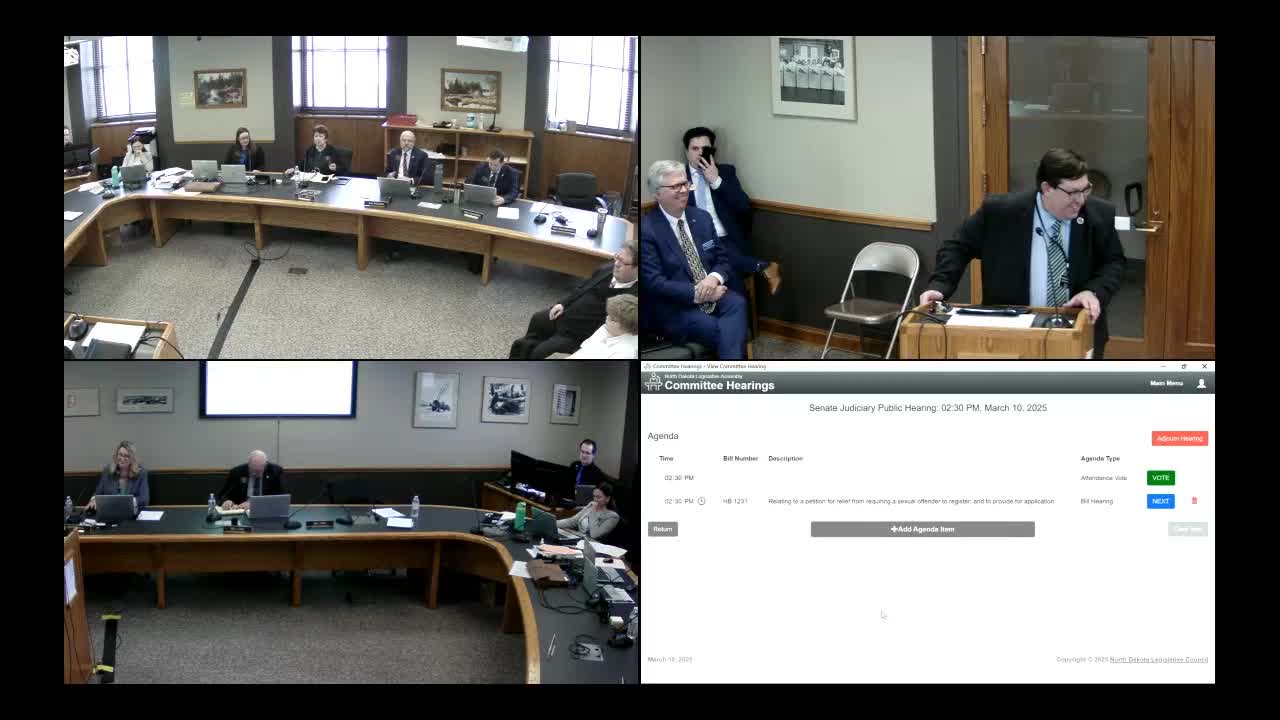
Senate Judiciary Committee delays action on bill to allow some registrants to petition for removal after seven years
Summary
Lawmakers and witnesses in Bismarck debated House Bill 1231, which would let certain low‑risk registered offenders seek court review to end public registration after seven years instead of 15; the committee did not vote and asked for more work or a study.
At a Senate Judiciary Committee hearing in Bismarck, legislators heard competing testimony on House Bill 1231, which would allow certain low-risk registered offenders to petition a court to terminate their obligation to remain on the public registry after seven years rather than the current 15-year period. The committee did not act on the measure and agreed to take more time to consider amendments or a study of the issue.
Representative Jason Doctor, District 7, Bismarck, said he introduced the bill to help people he described as "low *** offenders" who face severe collateral consequences despite long periods without new offenses. "My whole point to this bill was low *** offenders," Doctor said, citing examples such as elderly people with dementia who cannot enter assisted living and an 18-year-old whose consensual conduct with an underage partner left them registered. Under the bill as introduced, an eligible person who has completed treatment and had no new offenses for seven years could petition a court for relief.
Supporters told the committee the proposal offers a judicial avenue for relief that currently may be handled only administratively. Travis Fink, executive director of the Commission on Legal Counsel for Indigence, said, "This bill only allows for that petition to be brought. There's still a judge that reviews this and has to ultimately make the determination whether or not that individual should be relieved of their requirement to register as an offender." Brad Peterson, legal director at Protection and Advocacy, described cases in which elderly people with dementia or individuals who completed treatment were blocked from appropriate housing or care because of public registration.
Opponents and state officials urged caution and narrower language. Jonathan Byers, representing the North Dakota State's Attorneys Association, supplied draft amendments that would keep the decision for shortening registration within the existing SORAC (Sex Offender Registration and Community Notification) administrative process rather than moving it to routine court petitions. Byers warned that changing registration length could risk noncompliance with federal guidance tied to funding and said the state's existing assessment process considers treatment, prior behavior and other factors that a conviction‑only federal tiering would not.
Casey Miller, chief agent for the North Dakota Bureau of Criminal Investigation, described the range of convictions that can receive a "low risk" SORAC assessment and cautioned that the bill as drafted sweeps broadly. "As of right now we have 540 low risk *** offenders in the state," Miller said, adding that only 13 current cases meet the narrow "Romeo and Juliet" (small age-gap) scenario some supporters described. Miller and others suggested a narrower focus or a study period to let stakeholders refine eligibility criteria and procedural safeguards, including victim notice requirements and post‑decision review.
Witnesses discussed procedural details in the draft bill and proposed amendments. Supporters emphasized that the measure requires benchmarks — such as completion of ordered treatment and a seven‑year offense‑free period — before a petition could be filed. Opponents stressed that SORAC currently reassesses risk levels and that an administrative process could ensure a recent assessment and appropriate safeguards; some draft amendments proposed a required recent assessment and proof of treatment completion before any reduction. Testimony also touched on constitutional and statutory safeguards: witnesses noted the bill as drafted provides for victim notification consistent with Marcy's Law if the petition is served on a state's attorney, while an alternative that placed decisions solely with SORAC raised questions about how the state's constitutional victim‑rights provisions would be observed.
Committee members asked for data and details on several subjects, including how SORAC assigns the 15‑, 25‑ or lifetime registration periods, how time on supervision and incarceration affects the 15‑year clock, recidivism rates by SORAC risk level, and how juveniles are handled on public lists. Several senators, including Senator Castaneda and Senator Brownberger, questioned whether a new seven‑year pathway would be technically noncompliant with federal tiering (often described in testimony as the Adam Walsh Act) and whether any change would risk federal grant funding.
After more than an hour of testimony and questioning, Chair Larson closed the hearing without a committee vote. Chair Larson said the committee would "take some time and consider this" and consider the amendments presented or turning the topic into a study rather than advancing the bill immediately.
The hearing record includes submitted written testimony from the Commission on Legal Counsel for Indigence and Protection and Advocacy and amendment language circulated by the State's Attorneys Association. If the committee pursues changes, witnesses suggested the refined language should limit eligibility to a narrow class of cases, require recent assessments and treatment verification, maintain victim‑notification safeguards, and preserve an appeal route to district court if an administrative body denies relief.