Get Full Government Meeting Transcripts, Videos, & Alerts Forever!
Get email alerts on the Business Taxes topic
No spam. Unsubscribe anytime.
Business division briefing covers corporate and specialty taxes, marijuana distributions and payment safeguards
Summary
The Department of Revenue business division described administration of business taxes including the corporate activity tax and marijuana tax distributions, the agency’s payment center operations and fraud‑prevention controls for large attempted payments.
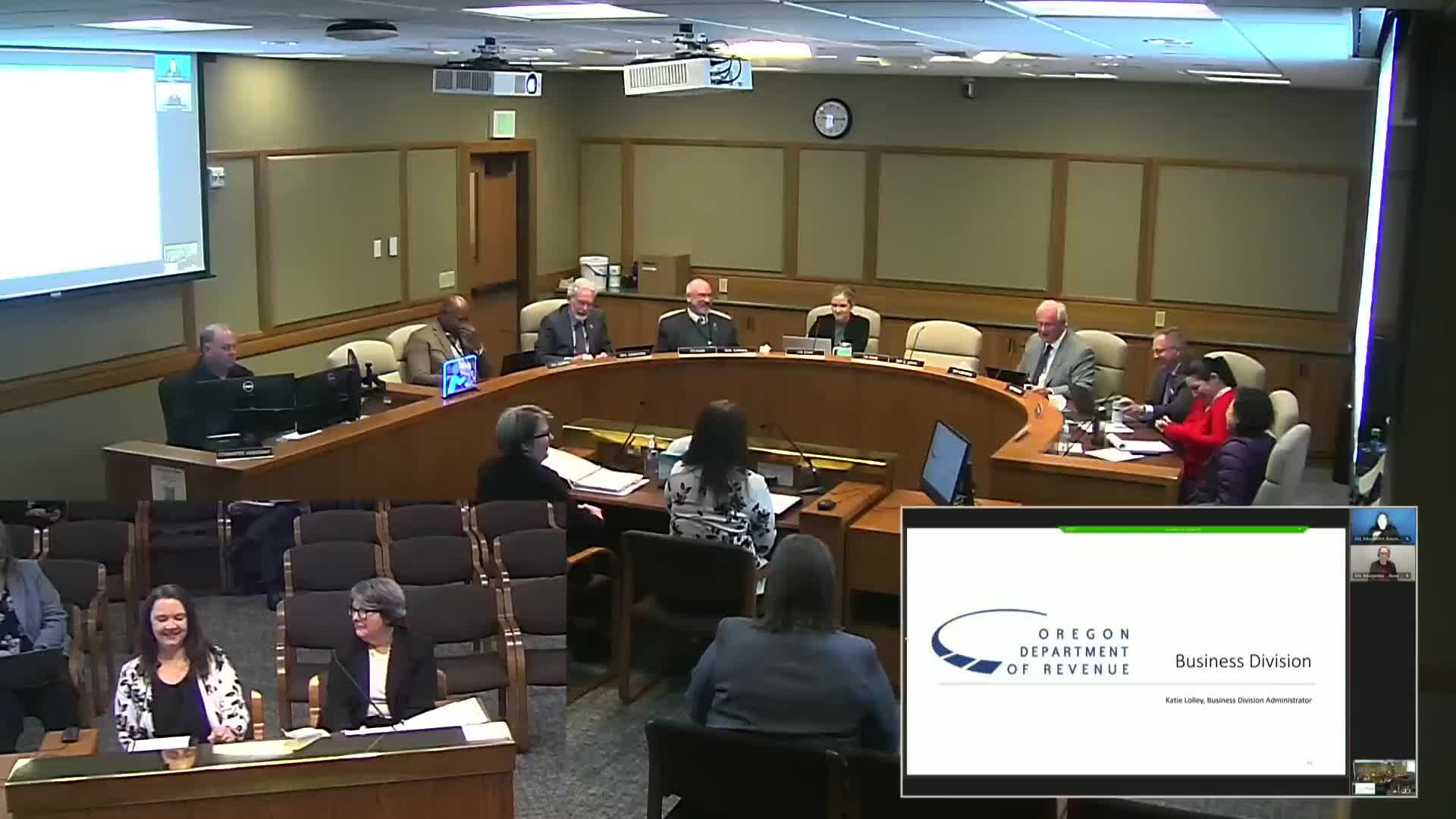
Katie Lawley, business division administrator at the Oregon Department of Revenue, briefed the Senate General Government Subcommittee on March 10 about the division’s oversight of business tax programs, marijuana tax distributions and payment‑processing protections.
Lawley said the business division administers 29 tax and fee programs that together produced about $15,800,000,000 in fiscal year 2024. She described three organizational sections within the division: corporate programs (corporate income and excise), payroll and withholding (which also handles transit withholding), and a special business programs section that includes the corporate activity tax (CAT) and 12 smaller taxes and fees.
On marijuana revenue, Lawley presented a distribution chart for calendar year 2024 showing statutorily set recipients (which are indexed for inflation) and the remaining funds that flow to the Drug Treatment and Recovery Services Fund. She reported the division collected $144,300,000 in state marijuana revenue in 2024 and about $24,000,000 in local marijuana taxes for 94 localities.
Committee members asked about cash handling at the department’s payment center for cannabis businesses and about fraud risks. Lawley said the payment center remains operational and the division has added credit‑card payment options for some customers; she also said more banking institutions now serve marijuana businesses. On fraud and large attempted payments, she described recent automated system stops where parties attempted repeatedly to post very large payments without actual funds backing them; the department’s systems blocked those attempts and did not issue improper refunds.
Lawley said many other other‑fund programs administered by the division carry a statutory administrative cap or a capped administrative percentage (for example, lodging taxes), and that the department deducts actual estimated costs for administration where allowable. She said the business division’s enforcement work includes in‑person audits, out‑of‑state site visits and inspections aimed at identifying noncompliance and levelling the playing field for compliant businesses.
Lawley also noted that marijuana revenue has trended slightly down since a peak in about 2021 and that forecasting is handled by the Office of Economic Analysis. She closed by summarizing the division’s goals: support voluntary compliance, provide service and education, and use data for targeted enforcement.