Get Full Government Meeting Transcripts, Videos, & Alerts Forever!
Get email alerts on the Healthcare Finance topic
No spam. Unsubscribe anytime.
Senate committee hears testimony on bill to extend hospital and insurer assessments, reinsurance program
Summary
The Senate Committee on Finance and Revenue held a public hearing on House Bill 2010A on March 10, 2025, to consider extending Oregon's hospital and insurer provider assessments and the Oregon Reinsurance Program through February 2032.
The Senate Committee on Finance and Revenue held a public hearing on House Bill 2010A on March 10, 2025, to consider extending Oregon's hospital and insurer provider assessments and the Oregon Reinsurance Program through February 2032. Witnesses from the Oregon Health Authority (OHA), the Department of Consumer and Business Services (DCBS) and Legislative Council described the program's funding flows and legal analysis, and hospital and insurer representatives urged support.
The bill matters because the assessments help fund the Oregon Health Plan (OHP) and the Oregon Reinsurance Program, drawing federal matching dollars that officials say stabilize the individual market and support Medicaid benefits for about 1.4 million Oregonians. Committee members did not take a vote; the measure remains under consideration with work sessions planned.
Legislative Council attorney Rachel Hungerford explained the office's legal test for whether a measure is a “bill for raising revenue” under Article IV, Section 25 of the Oregon Constitution. "The first part of the test is does this bill bring revenue into the state treasury? And yes, this bill does," Hungerford said. She said the second part asks whether the bill has the "essential features of a bill levying a tax," which the office assesses by whether payers receive a direct, identifiable benefit beyond the general benefits of government. Hungerford said in the office's view the providers who pay these assessments receive such benefits—insurers via the reinsurance program and hospitals via increased Medicaid reimbursement rates—so the package does not meet the controlling features of a constitutional tax as previously defined by Oregon courts.
OHA and DCBS staff summarized program history and fiscal mechanics. Emma Sandow, Medicaid director, said about 1,400,000 people are enrolled in OHP and noted that roughly 70% of Medicaid funding comes from federal sources in typical years. Rochelle Layton, OHA chief financial officer, said House Bill 2010A would align sunset dates for the hospital assessment (currently set to expire in 2025) and the insurer assessment (set to expire in 2026) and extend both through February 2032; the bill also seeks to extend the Oregon Reinsurance Program in a way that preserves consumer protections. "The governor's recommended budget proposes to extend OHSU's reimbursement rate under the intergovernmental transfer," Layton said, and described an OHSU IGT projected at about $1.2 billion for the 2025–27 biennium and a current reimbursement practice at roughly 87 percent that would otherwise lower to 84 percent on July 1 absent the budget action.
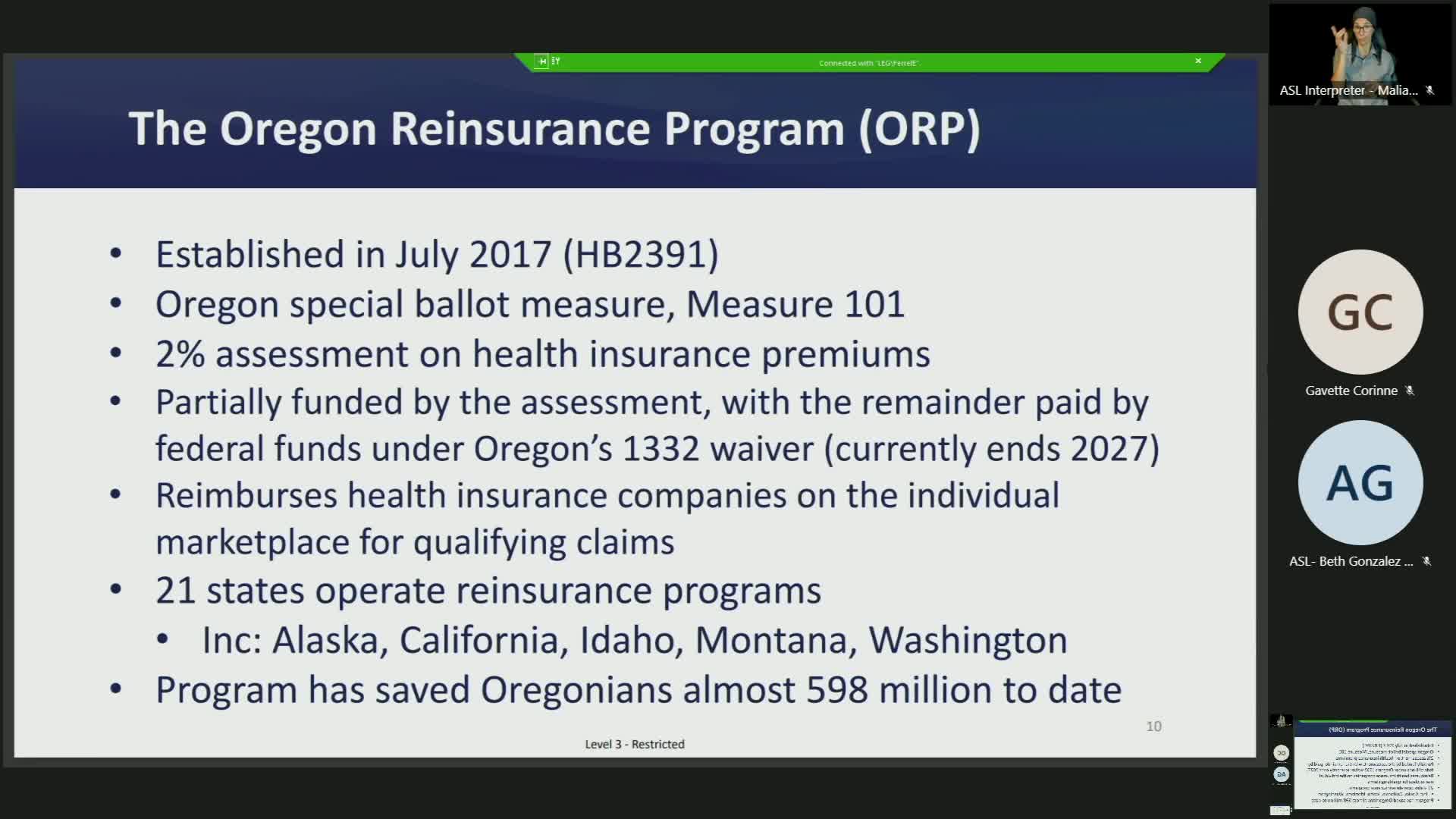
T. K. Keane of DCBS outlined the reinsurance program's history: established in 2017, the initial insurer assessment was 1.5 percent and was increased to 2 percent in 2019; the program operates under a federal 1332 waiver process and is approved in multiyear increments (the current waiver period is up for renewal in 2027). Keane and other presenters said the reinsurance program has drawn federal pass-through dollars, produced roughly $1.5 billion in assessment revenue over its life, and, with federal matching, helped reduce individual-market premiums—DCBS reported that the program has saved Oregonians nearly $600 million in premiums and that DCBS has retained about $325 million of collected assessments for program operations and reinsurance payouts.
Hospital and insurer witnesses uniformly urged the committee to support the extension. Brian Berrier of the Oregon Medical Association said fully funding OHP is “the first step in creating some stability for health care finances” and stressed the effect on recruiting and retaining clinicians in rural areas. Fawn Berry, representing Moda and Eastern Oregon CCO, said the package helped stabilize rural hospital operations during the pandemic and urged support. Elizabeth Remley of Cambia Health Solutions (the local Blue Cross plan) said renewing the assessment at current rates draws federal matching dollars that lower premiums in the individual market and helps preserve carrier participation statewide. Sean Comer of the Hospital Association of Oregon emphasized that most assessment dollars fund OHP benefits and that maintaining funding supports patient access.
Committee members asked for follow-up information on specific items, including Legislative Council's reasoning about the tax threshold and OHA's estate-recovery collections related to long-term care. OHA staff said federal law limits which members are subject to estate recovery—generally certain people age 55 and older who received specified long-term care services—and offered to provide the committee with collections figures.
The committee did not vote. Chair Meek said the committee will hold work sessions on House Bill 2010A before future action and noted the next committee meeting schedule.