Get Full Government Meeting Transcripts, Videos, & Alerts Forever!
Get email alerts on the Tax Administration Fraud topic
No spam. Unsubscribe anytime.
Department of Revenue personal-tax unit says it stopped $1.4 billion in fraudulent refund claims in 2024
Summary
The personal tax and compliance division detailed fraud prevention gains, customer‑service challenges, Direct File Oregon uptake, outreach for the Oregon kids credit, and resource needs as refunds and workloads grow.
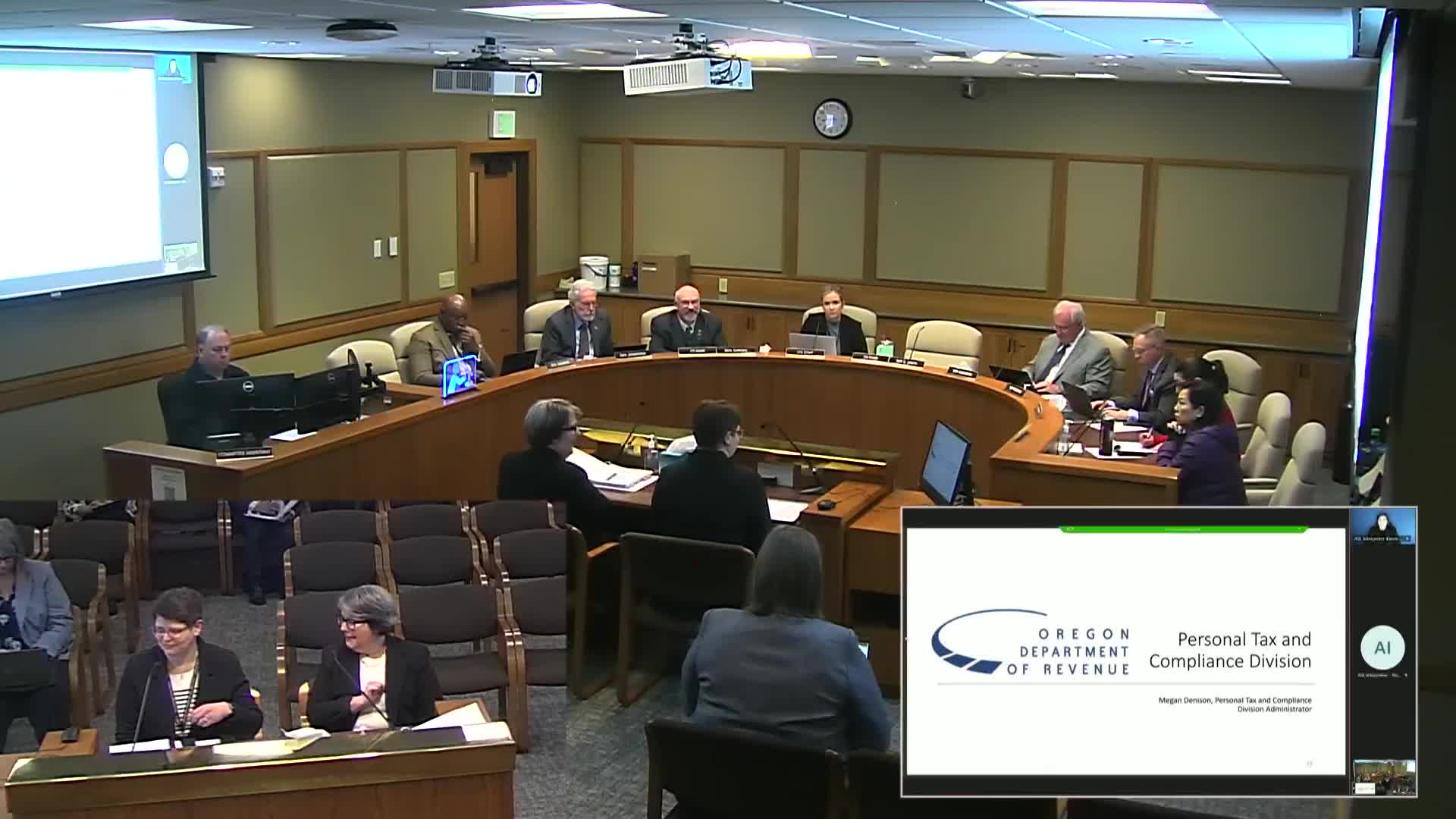
Megan Dennison, administrator of the personal tax and compliance division (PTAC) at the Oregon Department of Revenue, told the Senate General Government Subcommittee on March 10 that the division stopped over $1,400,000,000 in fraudulent refund claims during the 2024 processing year.
That figure matters for taxpayers and the state because fraud prevention preserves public funds and protects legitimate filers. Dennison said the stops affected more than 20,000 returns and that the 2024 total was driven in part by “a $1.113 billion refund request that we stopped.” She added that even excluding that single large outlier, PTAC saw about a 45% increase in dollars stopped compared with the prior year.
Dennison outlined PTAC’s approach as a three‑phase model: assistance, education and enforcement. The division answers calls, provides in‑person services across multiple offices and performs audits, filing enforcement and discovery work that uses third‑party information returns (for example, electronic payments) to identify leads for audits or filing enforcement. She told the committee PTAC processed roughly 2.2 million returns annually and that the personal income tax program produced about $25,000,000,000 in the 2021–23 biennium.
On customer service and modernization, Dennison said the agency has been improving “Where’s My Refund” functionality so taxpayers who log into Revenue Online receive more detailed status information, including the processing step, when that step began and whether a letter has been sent and received. She described the department’s letters project — a multi‑year effort to simplify and consolidate confusing notices — as underway and noted improvements in online refund visibility compared with prior years.
Dennison described Direct File Oregon, an agency-built free filing application launched last season, as having received over 7,000 returns and averaging more than four out of five stars in user feedback; the division also added the ability to file amended returns via the tool. She said outreach events, library partnerships and presentations to high‑school students are part of ongoing efforts to increase voluntary compliance and taxpayer awareness of credits such as the newly implemented Oregon kids credit.
The division reported several key performance measures: an average of 13 days to process a personal income tax refund (improved year over year), continued increases in e‑filing, and mixed results on a customer‑satisfaction composite tied to contact‑center wait times. Dennison said the kicker and growth in refund volume increased manual review work and contributed to longer wait times for callers.
Committee members asked about fraud sources and enforcement jurisdiction; Dennison said fraudsters operate both internationally and inside the state, and that enforcement is sometimes coordinated with the IRS and other states when schemes cross jurisdictions. On tax‑professional data breaches, she said 30 breaches were reported or identified over the last two years and that those breaches led to roughly $4.5 million in refunds being stopped over that period.
Dennison closed by noting PTAC’s budget request for the 2025–27 biennium: $78,900,000 total funds supporting 278 FTE and no policy option packages for PTAC specifically; she also flagged ongoing operational work needed to balance fraud prevention, speed and customer expectations.