Get Full Government Meeting Transcripts, Videos, & Alerts Forever!
Get email alerts on the Above Ground Storage Tanks topic
No spam. Unsubscribe anytime.
Committee advances bill to exempt certain small oil-and-gas storage tanks from state rules
Summary
A legislative committee approved a committee substitute for Senate Bill 592 that would expand exemptions in West Virginia’s Above Ground Storage Tank Act for small tanks associated with oil, gas and mining operations, replacing some third‑party inspections with owner self‑inspection and annual self‑certification reported to the Department of ENV.
A committee substitute for Senate Bill 592 that would expand exemptions to West Virginia’s Above Ground Storage Tank Act moved forward after testimony from Department of Environmental Protection staff and industry representatives.
The committee substitute would amend definitions and evaluation requirements in the Above Ground Storage Tank Act (Chapter 22, Article 30) so that tanks described in the bill’s new paragraph o — devices having a capacity of 210 barrels or less located within the boundaries of a permit and not located in a zone of critical concern — would be exempted from being regulated as Level 1 or Level 2 tanks for certain purposes. Counsel told the committee the substitute also changes the program’s evaluation and certification provisions so that tanks identified in paragraphs m, n and o “require only a self inspection and self certification that's reported to DEP at least a year.”
Why it matters: supporters said the change reduces costs and regulatory burdens on small producers and family‑run operations, while DEP staff and some senators warned it could reduce oversight of tanks that contain oil, condensate, brine and other chemicals that can threaten drinking water if released.
Details and testimony
Scott Mandarola, Deputy Cabinet Secretary for the West Virginia Department of Environmental Protection, told the committee that when the original Above Ground Storage Tank Act was enacted in 2014 the state initially treated all tanks as regulated — roughly 42,000 statewide — and later developed the Level 1/Level 2 categories and geographic zones intended to protect drinking‑water sources. "The main reason we're dealing with the regulating the above ground storage tanks is to protect drinking water," Mandarola said.
Mandarola told senators the committee substitute would remove roughly 1,000 tanks from regulation (he cited both about 234 oil‑and‑gas tanks and about 703 Level 1 oil‑and‑gas tanks). He said that currently approximately 11% of tanks statewide are regulated and that the change would reduce that share to roughly 8.7%.
Mandarola described the current inspection regime for regulated tanks: Level 1 sites are inspected by DEP once every three years; owners must self‑inspect two of the three years and obtain a third‑party inspection in the third year (an owner may instead have an employee take a certification course and serve as the certified inspector for five years). He also warned that secondary containment systems are required only to be capable of containing a release for 72 hours: "If you have a release into the secondary containment, and it sits for a month, which this would change those regs to once a month, you know, it obviously could exceed the 72 hours," Mandarola said, adding that contaminants that can be present in these tanks include brine, condensate, oil and constituents of petroleum such as benzene and toluene.
Industry perspective
Philip Real, an industry representative, told the committee the tanks targeted by the bill are typically small, associated with low‑producing vertical wells and "past their prime"; he said operators already conduct frequent checks and that moving tanks out of regulatory zones has in the past imposed considerable expense on owners. "These are small producers, without the kind of resource extra resources to have the manpower, the money to pay for experts that are required at certain levels intervals here," Real said, arguing the substitute would ease a burden on small producers while leaving periodic examination and DEP oversight available.
Safety history and concerns
Mandarola told the committee that over the last three years roughly 38% of reported releases were associated with the group of tanks the substitute would exempt. Senators raised the 2014 Freedom Industries / Elk River incident in West Virginia as an example of why residents and some lawmakers are concerned about chemical releases; the transcript records a brief exchange confirming MCHM was the chemical involved in the 2014 leak. Mandarola also said the bill creates a new definition for the term "leak," which he described as a definition the agency could not find a counterpart for in federal regulations; he said the bill’s handling of releases versus leaks complicates reporting obligations and oversight.
Committee action and next steps
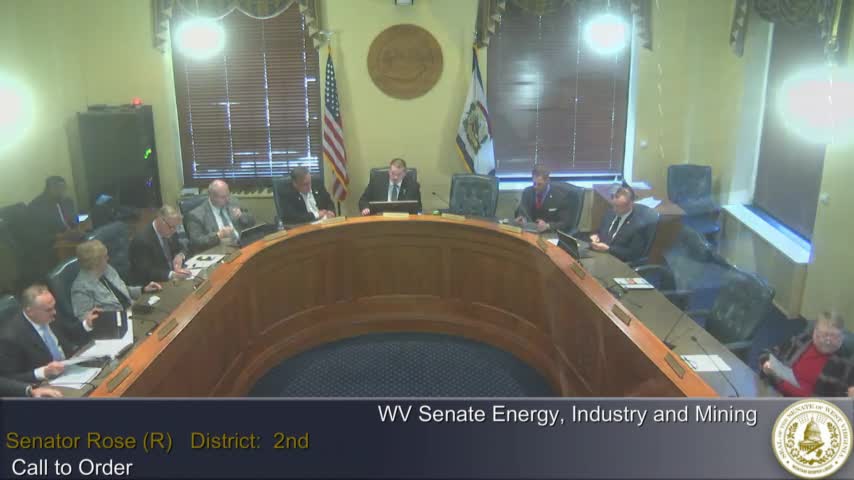
After testimony and questions, the committee agreed to the committee substitute and later voted to report the committee substitute for Senate Bill 592 to the full Senate with recommendations and the concerns raised by industry witnesses. The committee adopted the motion by voice vote; the chair declared the substitute agreed to and ordered it reported to the full Senate.