Get Full Government Meeting Transcripts, Videos, & Alerts Forever!
Get email alerts on the Pensions Bridge Benefit topic
No spam. Unsubscribe anytime.
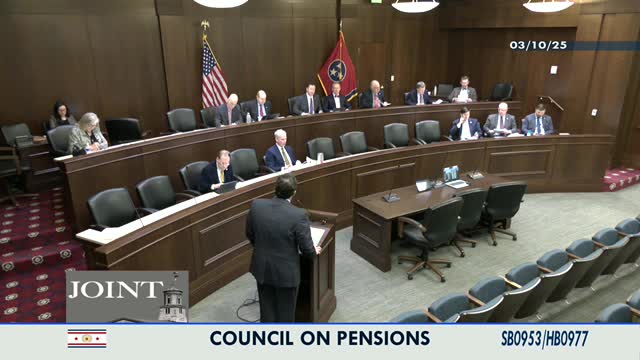
Council approves permissive change to bridge benefit that extends maximum payout regardless of retirement age
Summary
The Council on Pensions recommended passage of an amendment and House Bill 977 / Senate Bill 953 to make the public safety bridge benefit payable for a maximum of seven years regardless of the retirement age chosen by the member; the change is permissive to local governments and carries an estimated maximum cost if fully adopted.
The Council on Pensions voted to recommend passage of House Bill 977 / Senate Bill 953, with an amendment adopted during the committee, to change when the temporary bridge benefit for public safety officers (police and firefighters covered by mandatory retirement) ends.
Representative Burkhart, the sponsor, described the measure as permissive and said it would allow public safety officers who retire before the current bridge cutoff to receive the full seven‑year bridge period. Under current law the bridge runs from the later of the member’s age or age 55 until age 62; the amendment would make the bridge payable for a maximum of seven years regardless of the age at retirement, with 1967 as the latest stop date and with applicability only for retirements adopted by the political subdivision after the provision is in place.
Mister Weyman of the Department of Treasury said the amendment and bill were designed to be permissive to local governments; the department estimated that if all political subdivisions that have mandatory retirement adopt the provision, the projected cost would be $36,800,000 with a one‑year cost of about $3,240,000. Treasury staff emphasized the change applies only to members who retire on or after the date the local political subdivision adopts the provision.
Members confirmed on the record that the provision is permissive and that the fiscal numbers reflect a scenario in which all eligible political subdivisions adopt the change. The committee’s roll call recorded 11 ayes and the Council recommended the bill for passage to its standing committee.