Get Full Government Meeting Transcripts, Videos, & Alerts Forever!
Get email alerts on the Pensions Military Buyin topic
No spam. Unsubscribe anytime.
Pensions committee recommends against bill to expand military buy‑in for retirement credit
Summary
The Council on Pensions voted 10-1 to recommend against House Bill 756 / Senate Bill 966, which would remove the end date for permissive peacetime military service buy‑in to Tennessee Consolidated Retirement System (TCRS) at a 9% cost to members and increase projected pension liabilities.
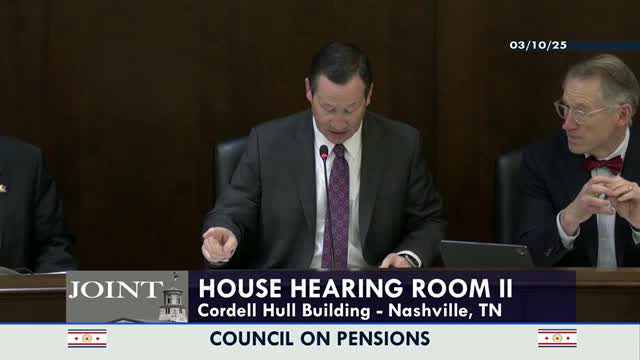
The Council on Pensions voted 10-1 on March 10 to recommend against passage of House Bill 756 / Senate Bill 966, which would remove the end date on peacetime military service that members may buy into the Tennessee Consolidated Retirement System (TCRS).
Sponsor Chairman Faison told the committee the bill is grounded in equal‑protection concerns under the Fourteenth Amendment and would allow members to “buy up to 4 years of additional retirement” for U.S. military service. Department of Treasury staff member Mister Weyman told the panel the change would permit any peacetime military service after September 1940 to be established in TCRS at a member cost of 9% of earnable compensation.
Weyman summarized existing rules and the proposed change: interrupted military service that interrupts TCRS employment is established under the Uniformed Services Employment and Reemployment Rights Act (USERRA) with required member contributions; armed‑conflict service (World War I, World War II, Korean conflict, Vietnam) is free to members; certain other active duty periods have defined crediting and cost formulas. Removing the peacetime end date would expand the pool of service eligible for buy‑in at 9% member cost.
The department provided fiscal estimates. It projected the change would raise the lump‑sum pension liability for the state plan by $9,160,000, with a first‑year cost on a 20‑year amortization of about $458,000. Estimated impacts to K–12 teachers’ plans totaled $12,760,000 with a first‑year cost of $638,000. Local governments’ permissive exposure was estimated at $11,600,000 with a first‑year cost of $580,000.
During the roll call, the committee recorded 10 ayes and 1 no; Representative Moody cast the sole recorded no vote. The committee’s action was a negative recommendation to the bill’s respective standing committee; no further committee direction or referral conditions were stated.
The measure’s proponents argued it addresses equal‑protection gaps between military members; opponents did not make extended remarks on the record during the committee vote. The bill will proceed to its next committee with the Council on Pensions’ negative recommendation noted.