Get Full Government Meeting Transcripts, Videos, & Alerts Forever!
Get email alerts on the Early Childhood Budget topic
No spam. Unsubscribe anytime.
Early Childhood officials ask Senate Finance for $5M gap funding, back $100M quality‑care pilot tied to House Bill 71
Summary
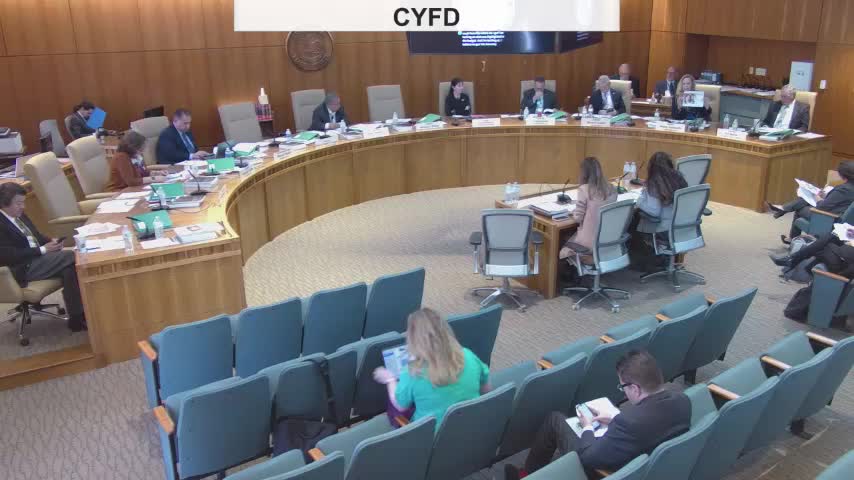
Elizabeth Graginski, secretary for the Early Childhood Education and Care Department, told the Senate Finance Committee on Tuesday that the agency is seeking a set of budget increases for fiscal 2026 to expand services, shore up the early‑childhood workforce and modernize program systems.
Elizabeth Graginski, secretary for the Early Childhood Education and Care Department, told the Senate Finance Committee on Tuesday that the agency is seeking a set of budget increases for fiscal 2026 to expand services, shore up the early‑childhood workforce and modernize program systems.
Graginski said the department has seen “an 8 percent increase in the number of children needing early intervention services” and that “71% of our children, their services are paid by Medicaid,” leaving “a $5,000,000 gap that we are truly hoping that this committee will help us address.” She asked the committee to consider the supplemental request for the Family Infant Toddler program and other items on the agency’s priorities list.
The department asked for additional recurring and nonrecurring funds that include:
- A $5 million supplemental to cover an identified gap in early intervention services for children with developmental delays or disabilities. - An increase for the Dolly Parton Imagination Library (the department currently has $660,000) to expand monthly book deliveries to build home libraries for New Mexico children. - A tribal investment request: Graginski asked the committee to support an additional $1,000,000 drawn from the governor’s $3,000,000 tribal allotment. - $2,000,000 for community‑level early childhood system‑building coalitions in every New Mexico community. - Investments in a wage scale and career lattice to raise pay for early childhood professionals as they pursue credentials ranging from a CDA to bachelor’s degrees. - Modernization of the legacy FIT Kids payment system: the department seeks $3,000,000 from the trust fund to replace an “8 legacy system” used for payments and manual monitoring. - A $100,000,000 quality‑childcare pilot (special appropriation) to better pay early‑childhood professionals; Graginski said that pilot is contingent on House Bill 71 passing.
Why this matters: Graginski and senators on the committee framed the requests as supporting parental employment, improving child outcomes and stabilizing a workforce the secretary described as essential. “The focus of this legislature over the last 2 years in improving literacy starts very early,” Graginski said when describing the Imagination Library proposal.
Committee members pressed Graginski on how higher‑quality (5‑star) programs could be financially viable. Senator Woods asked how providers could “become 5 star providers” when a modeled 5‑star center runs a loss. Graginski answered that additional legislative investment would need to close the gap so centers could pay the wages embedded in higher rates; she said a modeled 5‑star center could be losing about $111,000 a year under current assumptions. Graginski noted the department’s market assumptions are based on a 2018 survey updated for inflation and that some providers charge less because families in some communities cannot afford higher private tuition.
On private pay levels, the department reported a monthly private‑pay estimate of $1,113 for a 5‑star spot and $863 for a 2‑star spot (monthly). Graginski also summarized a cost calculator and revenue/expense scenarios the department distributed to the committee showing how group size and staff ratios drive revenues and costs for infant through school‑age programs.
Trust fund and House Bill 71: Committee discussion included the Permanent Early Childhood Trust Fund and proposed distribution changes tied to House Bill 71. A staff member explained that HB71 would change the distribution floor (the transcript discussion described replacing a $250,000,000 floor with $500,000,000 or 5% of a 3‑year market average, with House Bill 2 having about $100,000,000 of that increase appropriated). Committee members and staff described the fiscal mechanics and potential FY26 impacts: if HB71 passes, the department could draw a larger distribution in the near term; if it does not pass, the department would receive a lower amount (the staff described a $298,000,000 figure in the no‑change scenario shown in the department materials).
The department also described workforce supports, child‑care assistance coverage and quality rating impacts: Graginski said the state currently meets “less than 30% of the need” for childcare assistance and wants to increase coverage to “closer to 46%.” She said the department is requesting funds so higher credentials for staff translate into higher pay through the rate structure.
What’s next: Graginski told senators the quality pilot and some other special appropriations are contingent on House Bill 71 moving on the House floor this week. Senators and staff asked for additional private‑pay data and for the department to provide more granular scenarios and cost‑model assumptions.
Ending: The department stood for questions after the presentation; senators indicated they would review the materials and the budget volumes when the House and Senate continue negotiations on trust‑fund language and budget language this week.