Get Full Government Meeting Transcripts, Videos, & Alerts Forever!
Get email alerts on the Veterinary Loan Repayment topic
No spam. Unsubscribe anytime.
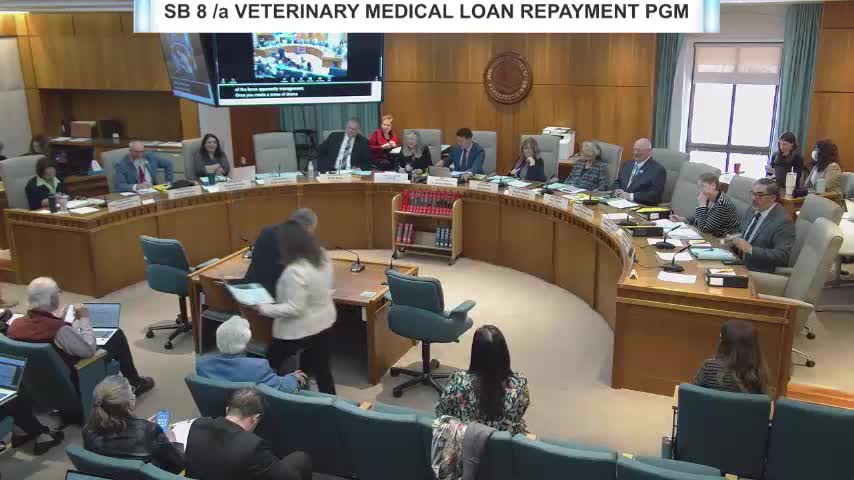
Committee advances loan‑repayment bill to recruit large‑animal veterinarians to rural New Mexico
Summary
Senate Bill 8, to create a loan‑repayment program for veterinarians who serve food‑producing animals in underserved rural areas, received a unanimous due‑pass recommendation after supporters described shortages of large‑animal vets and a $80,000 four‑year repayment structure.
The committee gave Senate Bill 8 a unanimous due‑pass recommendation after hearing testimony that the state needs more large‑animal veterinarians to support rural livestock producers, food‑safety work and disease surveillance.
Sponsor testimony described a loan‑repayment structure of $15,000 for each of the first two years, adding to $80,000 over four years as the bill is written. "We're just trying to attract vets in the underserved rural areas with, more or less, loan repayment," the sponsor said, noting the program is modeled on similar state programs.
Agricultural and livestock organizations, county officials and university representatives testified in support. Tom Patterson, a Catron County cattle rancher and president‑elect of the New Mexico Cattle Growers Association, told the committee the state has "fewer than 40 veterinarians in New Mexico who provide some material measure of large food animal services" and that an incentive program can help sustain rural practices. Rocky Mountain Farmers Union and the New Mexico Farm Bureau also urged support, citing animal welfare, disease surveillance and food safety.
Belinda Garland, executive director of the New Mexico Livestock Board, explained the regulatory role veterinarians play in interstate movement and health certification. Samantha Hollick, state veterinarian with the New Mexico Livestock Board, and the New Mexico Department of Agriculture described reliance on private veterinarians for emergency response teams and foreign animal disease diagnostic work.
During committee discussion, lawmakers asked implementation questions, including how the program would be administered and whether money for the program is in the budget. The sponsor said there is currently $2 million in the budget for the program and that she had asked for $5 million; committee members discussed the size of private loans vets carry and the program’s limits.
A due‑pass motion for Senate Bill 8 carried on a roll call with members recorded as voting yes; committee staff recorded the recommendation as a unanimous due pass. The committee did not adopt amendments in the hearing and directed staff to work on drafting implementing details with the Higher Education Department (which will administer loan repayment) and the state veterinarian's office.
Supporters said the program would help attract veterinarians who provide extensive services in rural communities, improving disease detection, food‑safety compliance and the economic viability of livestock producers. The bill now proceeds to the next legislative step with the committee's due‑pass recommendation.