Get Full Government Meeting Transcripts, Videos, & Alerts Forever!
Get email alerts on the Higher Education Homeless Liaisons topic
No spam. Unsubscribe anytime.
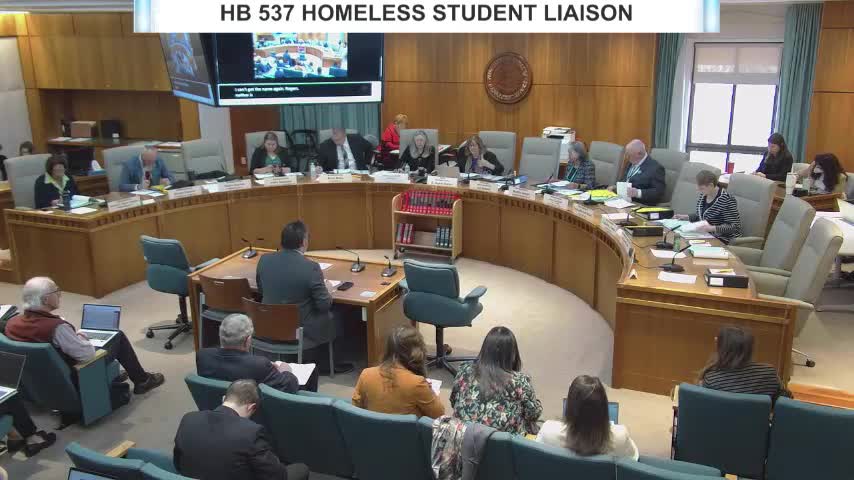
Committee hears testimony on bill to create higher-education homeless liaisons; $500,000 proposed for training
Summary
Lawmakers heard testimony supporting House Bill 537, which would designate higher-education homeless liaisons and fund training with a $500,000 appropriation; committee rolled the bill for further work and budget discussions.
A House committee heard testimony and public comment on House Bill 537 on the creation of designated homeless liaisons for higher-education institutions, and received details that the bill carries a $500,000 general-fund appropriation for training but does not fund staff salaries.
Supporters told the committee the bill aims to close a gap between K–12 homeless support under McKinney-Vento and services available to students after high school. "Students are supported in K through 12, but the support isn't the same once they go into higher education," said Rob Montz, director of state policy for SchoolHouse Connection. Montz cited the New Mexico Higher Education Student Basic Needs Report, saying surveys found high rates of housing and food insecurity among college students.
The bill would have the Higher Education Department coordinate training and an annual survey of students experiencing homelessness, according to testimony from Patricia Trujillo, deputy cabinet secretary for the higher education department, and materials in the fiscal information report (FIR). Trujillo told the committee the $500,000 in the FIR is appropriated for training and outreach only; it is not an appropriation for salaries or new full‑time positions.
University and college representatives said campuses already offer a range of student supports but that services vary by campus. "The challenge is that it doesn't happen consistently from campus to campus," Rob Montz said, arguing a dedicated liaison can improve coordination and student outcomes. Clayton Abbey of New Mexico State University, speaking in support, said existing funds and institutional staff could be braided to provide the liaison function at some campuses.
Committee members pressed for details about scale and cost. Representative Roybal Caballero referenced the FIR and asked whether the $500,000 would be sufficient; he noted one campus estimate put annual costs at about $700,000. Sponsor comments acknowledged the appropriation in the bill would fund training and survey administration but not necessarily full FTE salaries, and suggested institutions could assign duties to existing staff in some cases.
Members debated whether the program should initially cover four-year campuses only or include two-year and branch campuses; several lawmakers urged including community colleges and other institutions so the program would cover the spectrum of students who rely on two-year institutions. Committee members also discussed FAFSA and Pell Grant mechanics; witnesses said FAFSA can identify students who are homeless for federal purposes but that Pell Grant awards and other aid often do not fully meet housing and basic-needs costs.
No formal vote on the bill was taken. Committee members discussed budget options and coordination with the Senate side; the sponsor said she would work with the Higher Education Department to seek additional budget authority if needed. "If we can polish this up, make it better, and make it more inclusive, and include more of the things that have come up, I would be more than willing to do that," the sponsor said. The committee elected to roll the bill for further work rather than advance it that day.
Supporters asked the committee to consider the Basic Needs Consortium's ongoing work and to pursue braided funding from state, institutional and private sources to cover positions and wraparound services if the program is expanded beyond training. The committee did not adopt amendments during the hearing and left open the option of returning with clarified language and budget requests.